
Explore how Einstein’s relativity theory is essential for GPS precision and satellite tech, ensuring accurate navigation and timekeeping.
Understanding Relativistic Corrections in Precision GPS and Satellite Technology
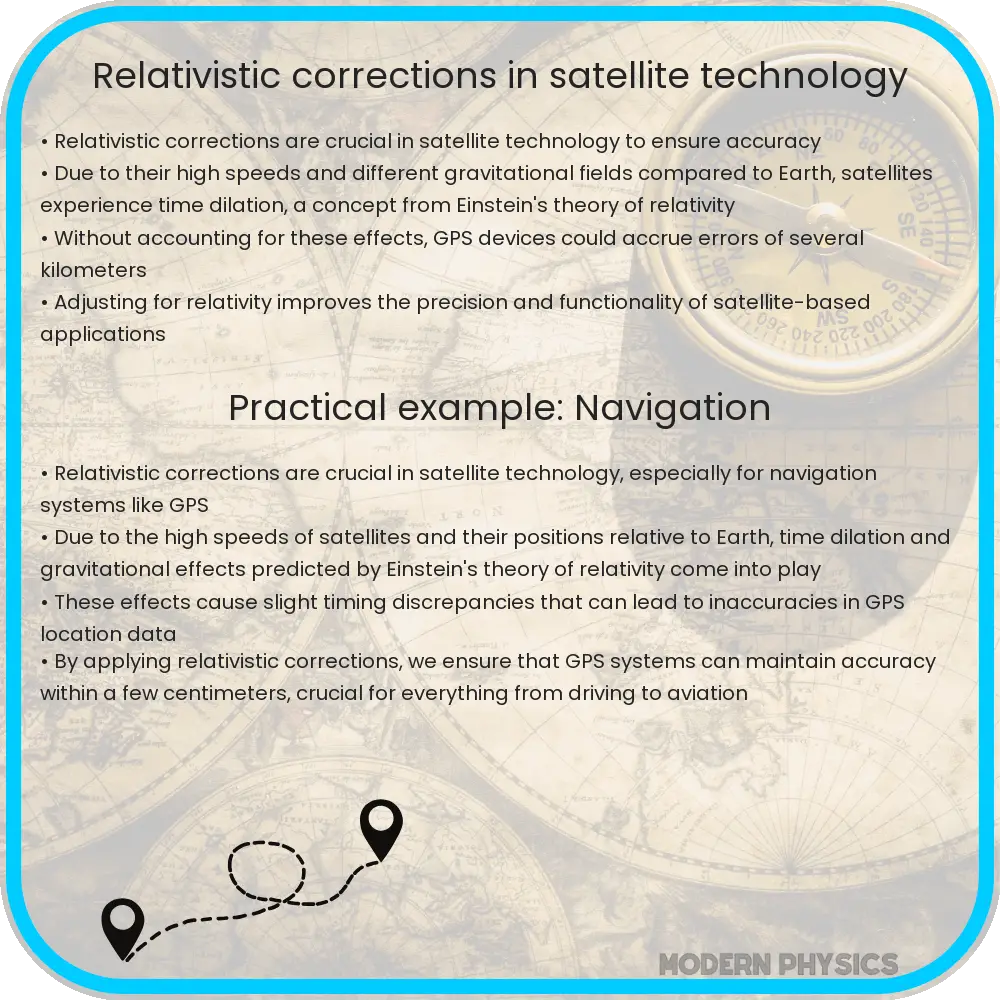
The advent of Global Positioning System (GPS) technology has revolutionized navigation and timekeeping in the modern world. However, the accuracy of GPS, which relies on a constellation of satellites orbiting the Earth, is heavily influenced by the principles of Einstein’s theory of relativity. Relativistic corrections are vital in ensuring the precision of GPS and other satellite technologies, accounting for the differences in the experience of time between satellites in orbit and observers on Earth.
Impact of General Relativity on Satellite Clocks
General relativity, a cornerstone of modern physics, predicts that time is experienced differently depending on the strength of a gravitational field. Satellites in orbit are further away from the Earth’s massive core, and thus experience weaker gravitational forces compared to objects on the Earth’s surface. This difference leads to satellite clocks running slightly faster than clocks on the Earth’s surface, a phenomenon known as gravitational time dilation. Without compensating for this effect, GPS systems could accrue errors of up to 7 microseconds per day, which translates to a navigational error of approximately 2 kilometers.
Special Relativity and Orbital Speed
Conversely, special relativity, which deals with the physics of objects in motion, introduces an opposing effect. According to this theory, as an object moves faster, time appears to slow down for it relative to a stationary observer. Satellites orbiting the Earth at high velocities experience time dilation, causing their onboard clocks to tick slower compared to stationary clocks on Earth. This effect partially counteracts the time dilation caused by general relativity, but it’s less pronounced. The net result still requires precise adjustments to maintain GPS accuracy.
Implementing Relativistic Corrections in GPS Technology
Modern GPS receivers and satellite technologies incorporate these relativistic corrections to maintain precision. The satellite’s onboard atomic clocks are pre-adjusted to tick at a slightly slower rate on the ground. Once in orbit, the combined effects of general and special relativity bring these clocks into sync with those on Earth. This intricate balancing act is a testament to the profound impact of Einstein’s theories on practical technology. Without these adjustments, GPS, which requires nanosecond precision, would fail to deliver the accuracy we rely on today.
Moreover, the application of relativistic principles extends beyond GPS to other satellite-based technologies. Communications satellites, astronomical observatories in space, and even the synchronization of financial networks globally require an understanding and application of these relativistic effects. This interplay of advanced physics and technology underscores the increasingly sophisticated nature of our global systems.
Is this conversation helpful so far?
Challenges and Future Perspectives in Satellite Technology
As satellite technology evolves, the challenges in maintaining precision in the face of relativistic effects become more complex. The introduction of more advanced, higher-orbit satellites requires even finer adjustments. Additionally, the development of new technologies such as quantum clocks, which promise even greater timekeeping precision, may further complicate relativistic corrections. These future advancements will necessitate a deeper understanding and more sophisticated application of relativistic physics.
Relativistic Corrections in Deep Space Missions
Beyond Earth orbit, relativistic corrections play a crucial role in deep space missions. Spacecraft traveling to other planets or solar system bodies must account for both special and general relativistic effects to ensure accurate navigation and data transmission. As missions venture further into space and approach higher velocities, these corrections become even more critical.
Impact on Earth-Based Technologies and Research
On Earth, the implications of relativistic corrections extend to various fields of research and technology. For instance, precise timekeeping is crucial in experiments that probe the fundamental laws of physics, such as those conducted at particle accelerators. Additionally, the synchronization of global financial markets, telecommunications networks, and power grids are subtly but critically dependent on GPS timing signals corrected for relativistic effects.
Conclusion
The integration of relativistic corrections into GPS and satellite technology is a remarkable example of how abstract scientific theories have concrete, everyday applications. The precise synchronization and navigation capabilities we enjoy today are a direct result of understanding and applying Einstein’s theories of relativity. As technology continues to advance and we push the boundaries of space exploration and communication, the role of these corrections will only grow in importance. This ongoing interplay between theoretical physics and practical engineering challenges us to continually refine our understanding of the universe, demonstrating the profound impact of scientific thought on the fabric of modern life.