
Explore the nuances of the relativistic center of mass in physics, contrasting it with classical mechanics and its significance in astrophysics.
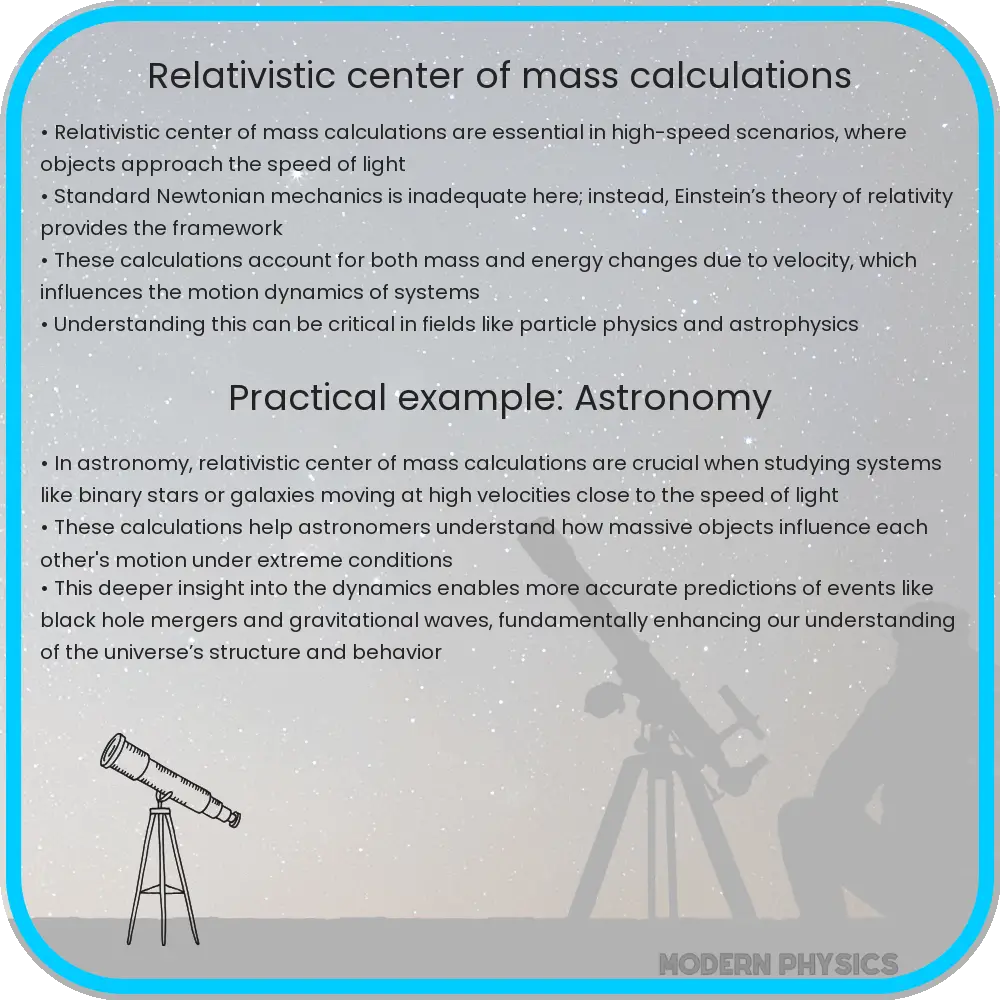
Understanding the Relativistic Center of Mass
The concept of the center of mass in classical mechanics is straightforward, denoting a point where the mass of a system is considered to be concentrated. However, in the realm of relativistic physics, where velocities approach the speed of light, this concept requires a more nuanced understanding. The relativistic center of mass is not merely a simple extension of its classical counterpart but involves a profound interplay of mass, energy, and momentum, as dictated by Einstein’s theory of relativity.
Classical vs. Relativistic Center of Mass
In classical mechanics, the center of mass of a system of particles is calculated using the weighted average of their positions, weighted by their masses. Mathematically, it is expressed as R = Σ(miri)/Σmi, where mi and ri represent the mass and position vector of the ith particle, respectively. This framework suffices for velocities much lower than the speed of light.
However, as velocities increase and approach the speed of light, relativistic effects become significant. Here, the concept of mass itself evolves. The relativistic mass depends on the velocity of the object, increasing infinitely as the velocity approaches the speed of light, as described by the equation m = m0/√(1 – v2/c2), where m0 is the rest mass, v is the velocity of the object, and c is the speed of light.
The Relativistic Center of Mass Equation
The relativistic center of mass is derived by considering both the mass and energy distribution of a system. In relativity, mass and energy are equivalent and interchangeable, as stated in Einstein’s famous equation E = mc2. This equivalence means that in calculating the center of mass, one must consider not only the mass but also the energy distribution within the system. The formula for the relativistic center of mass is more complex, integrating the contributions of both mass and energy.
One fundamental difference in the relativistic treatment is the dependency on the observer’s frame of reference. Unlike in classical mechanics, where the center of mass is an invariant point for all observers, in relativity, the center of mass can vary depending on the observer’s state of motion. This variation stems from the relativistic effects like length contraction and time dilation, which are pivotal in understanding high-speed phenomena.
In the next section, we will delve deeper into the mathematical formulation and the physical implications of the relativistic center of mass, highlighting its significance in modern physics.
Mathematical Formulation of Relativistic Center of Mass
The mathematical expression for the relativistic center of mass involves the energy-momentum tensor, a fundamental entity in the theory of relativity that describes the density and flux of energy and momentum in spacetime. The position of the relativistic center of mass R is given by R = Σ(Eiri)/ΣEi, where Ei represents the energy (including the rest mass energy) of the ith particle, and ri is its position vector. This formulation ensures that both mass and energy contribute to the determination of the system’s center of mass.
Physical Implications and Applications
The relativistic center of mass concept is crucial in various domains of physics, especially in high-energy astrophysics and particle physics. For instance, in the analysis of systems like binary neutron stars or black hole mergers, where gravitational fields are immensely strong, and velocities are a significant fraction of the speed of light, the classical concept of center of mass falls short. The relativistic version provides a more accurate and meaningful understanding of the dynamics of such systems.
In particle physics, especially in particle accelerators where particles are accelerated to near-light speeds, the relativistic center of mass becomes an essential tool. It allows scientists to predict collision outcomes and understand the behavior of fundamental particles under extreme conditions.
Conclusion
The concept of the center of mass undergoes a significant transformation when viewed through the lens of relativity. The relativistic center of mass is not a mere extension of its classical counterpart but a more comprehensive concept that incorporates the effects of high velocities and the equivalence of mass and energy. This advanced understanding is vital in the study of phenomena involving high speeds and energies, such as in astrophysics and particle physics. As we continue to explore the universe at both the vast scales of space and the minute scales of subatomic particles, the relativistic center of mass remains an indispensable tool in deciphering the underlying principles of the cosmos.