
Explore the concept of redshift, its role in understanding cosmic expansion, and how it helps astronomers study distant galaxies and the universe’s evolution.
Understanding Redshift: A Gateway to Cosmic Expansion and Distant Galaxies
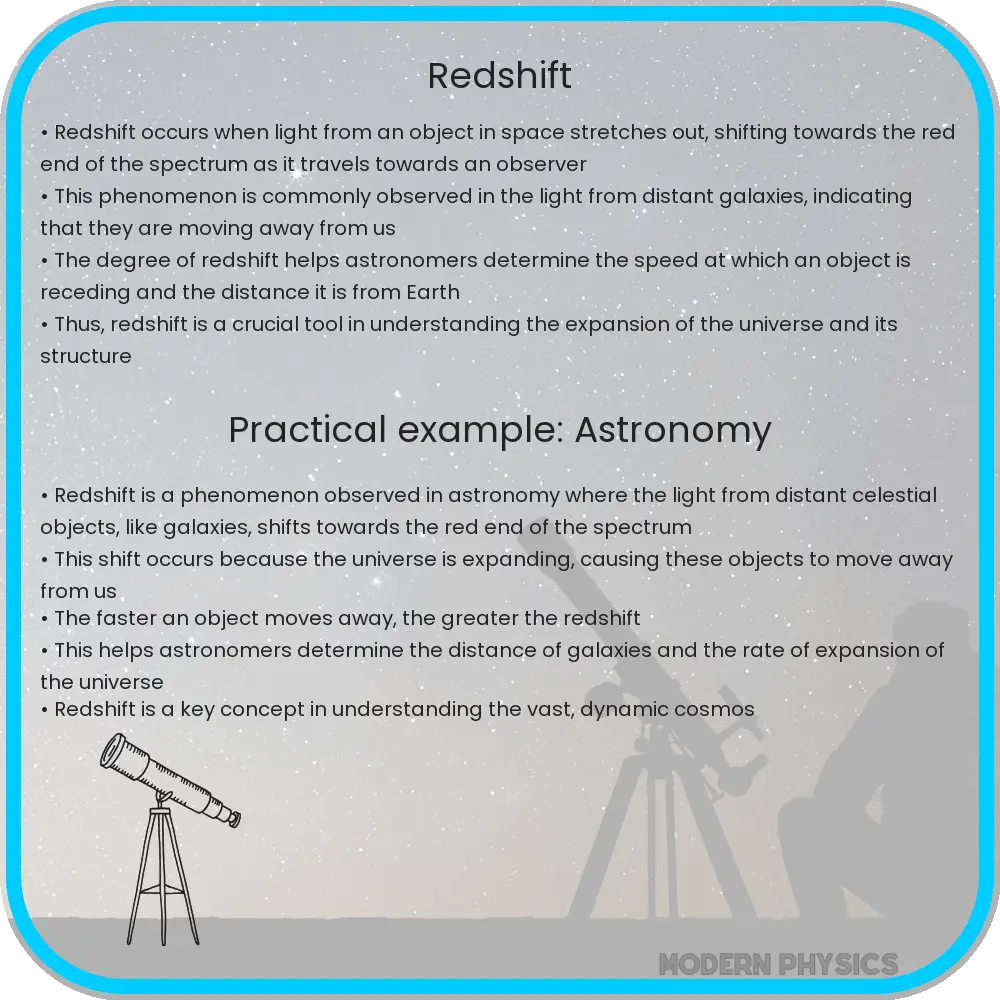
Redshift is a key concept in astrophysics that plays a crucial role in our understanding of the universe’s expansion and the properties of distant galaxies. It refers to the phenomenon where the light from an object in space (such as a star or galaxy) is shifted towards the red end of the light spectrum as it reaches an observer. This shift is not due to the actual color change of the object, but rather due to the stretching of light waves as the universe expands.
The Spectral Evidence of Redshift
The evidence of redshift is found in the spectra of celestial bodies. When astronomers analyze the light from a distant galaxy, they use spectroscopy to split it into its component colors, similar to how a prism splits sunlight into a rainbow. This spectrum reveals lines that correspond to specific chemical elements, such as hydrogen and helium. However, in the spectra of distant galaxies, these lines appear at longer (redder) wavelengths compared to where they are found in a laboratory on Earth. This shift towards the red end of the spectrum is a direct consequence of the cosmic expansion.
Measuring the Universe’s Expansion
Redshift is not only a measure of the light’s color change but also a powerful tool for measuring the universe’s expansion. By observing the degree of redshift in the light from distant galaxies, astronomers can determine how fast the universe is expanding. The greater the redshift, the faster the galaxy is moving away from us. This relationship is quantified by Hubble’s Law, which states that the velocity (v) at which a galaxy moves away from us is directly proportional to its distance (d) from us, expressed as v = H0d, where H0 is the Hubble constant.
Understanding redshift and the expansion of the universe provides invaluable insights into the nature of our cosmos. It allows us to trace back the history of the universe, understand the formation and evolution of galaxies, and explore the fundamental principles of cosmology.
The Role of Redshift in Observing Distant Galaxies
Redshift not only helps astronomers measure the rate of the universe’s expansion but also plays a pivotal role in observing distant galaxies. As light travels across the expanding universe, it stretches, causing galaxies to appear redder than they actually are. This redshift enables astronomers to estimate the distance of galaxies from Earth. By measuring the redshift, scientists can deduce how long the light has been traveling, thus determining the age of the galaxy and providing insights into the early universe’s conditions.
Challenges and Advancements in Redshift Measurement
Despite its utility, measuring redshift comes with challenges, particularly for extremely distant galaxies where the light is faint and highly redshifted. Advanced telescopes and spectroscopic techniques have been developed to address these challenges, allowing for more precise measurements and deeper understanding of the universe’s structure and evolution. The James Webb Space Telescope, for example, is designed to observe high redshift galaxies that are too faint for current telescopes, providing a glimpse into the era of the first galaxies.
Conclusion
Redshift is a cornerstone concept in astrophysics that has significantly advanced our understanding of the universe. It serves as a cosmic yardstick, enabling astronomers to measure the universe’s expansion, estimate the distances of celestial bodies, and explore the early stages of the cosmos. The study of redshift bridges the gap between theoretical physics and observational astronomy, offering insights into the fundamental properties of the universe, such as its age, size, and rate of expansion. As technology advances, our understanding of redshift and its implications will continue to deepen, unlocking new mysteries of the cosmos and contributing to the ongoing quest to understand our place in the universe.