
Explore Rayleigh Scattering in Quantum Electrodynamics (QED): Understanding light interaction, atomic structure, and its practical applications.
Understanding Rayleigh Scattering in Quantum Electrodynamics (QED)
Rayleigh Scattering, a phenomenon integral to our understanding of why the sky is blue, is deeply rooted in the principles of Quantum Electrodynamics (QED). This quantum theory, which explains how light and matter interact, offers a comprehensive view of light scattering processes at the atomic level. In this article, we delve into the intricacies of Rayleigh Scattering within the context of QED, exploring how quantum phenomena illuminate our perception of the natural world.
The Basics of Rayleigh Scattering
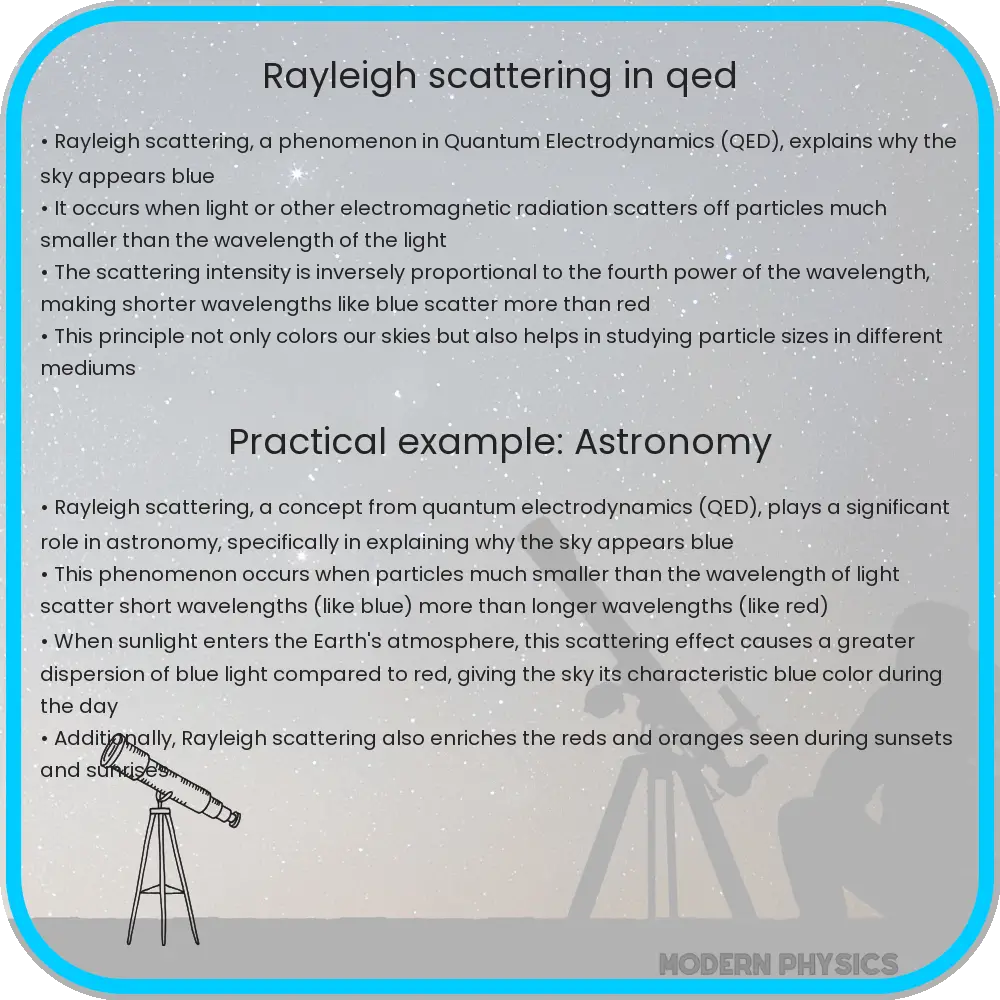
At its core, Rayleigh Scattering occurs when light, or more broadly electromagnetic radiation, interacts with particles much smaller than the wavelength of the light. This scattering is predominantly elastic, meaning the scattered photons have the same energy (and hence wavelength) as the incident photons, but their direction and phase may change. In the Earth’s atmosphere, this is most observable with shorter (blue) wavelengths of sunlight being scattered more than longer (red) wavelengths, leading to the blue appearance of the sky.
Quantum Electrodynamics (QED) Perspective
QED, a cornerstone of modern physics, combines the principles of quantum mechanics with classical electromagnetism. It provides a framework for understanding how light (photons) interacts with charged particles, such as electrons. In Rayleigh Scattering, QED describes how incident photons interact with the electric field of electrons in atmospheric molecules, leading to the scattering of light.
The QED explanation of Rayleigh Scattering involves virtual photons, a concept unique to quantum field theory. These are temporary fluctuations that exist due to the uncertainty principle and facilitate force transmission between particles. When a photon approaches an atom, it can momentarily create a virtual photon-electron pair. This interaction disturbs the atom’s electron cloud, causing the electron to oscillate and re-emit the photon in a different direction.
Furthermore, the probability of scattering, according to QED, is inversely proportional to the fourth power of the wavelength of the incident light (\( \lambda^{-4} \)). This relationship, known as the Rayleigh scattering cross-section, explains why shorter wavelengths are scattered more efficiently and are predominant in the sky’s coloration.
Role of Atomic Structure in Rayleigh Scattering
Understanding Rayleigh Scattering in QED also requires a look at atomic structure. The electrons in an atom are bound to the nucleus by electromagnetic forces, making them natural scatterers of light. When light encounters an atom, it induces a dipole moment proportional to the electric field of the light. This oscillating dipole moment then re-radiates the light in different directions. The efficiency of this process depends on the polarizability of the atom, which in turn is influenced by the electronic structure of the atom.
Experimental Verification of Rayleigh Scattering in QED
The theoretical predictions of QED regarding Rayleigh Scattering have been experimentally verified. Sophisticated experiments involving lasers and highly sensitive detectors have confirmed the \( \lambda^{-4} \) dependence of the scattering intensity. These experiments not only validate the QED model but also help in understanding atmospheric phenomena and the behavior of light in different media.
Applications and Implications
Rayleigh Scattering has significant applications in various fields. In meteorology, it explains the color of the sky and aids in weather prediction. In astronomy, it helps in the study of the atmospheric composition of planets. Furthermore, in communication technology, understanding scattering is crucial for optimizing signal transmission through the atmosphere.
Beyond its practical applications, Rayleigh Scattering in the context of QED is a beautiful example of how quantum mechanics and classical phenomena interplay. It bridges our everyday experiences, like the blue sky, with the abstract and often counterintuitive world of quantum physics.
Conclusion
In conclusion, Rayleigh Scattering, as explained by Quantum Electrodynamics, offers a profound insight into the interaction between light and matter. It not only elucidates a common natural phenomenon but also exemplifies the predictive power of quantum theory. The study of Rayleigh Scattering in QED not only enhances our understanding of the physical world but also continues to inspire technological advancements and deepen our appreciation for the intricate workings of the universe.