
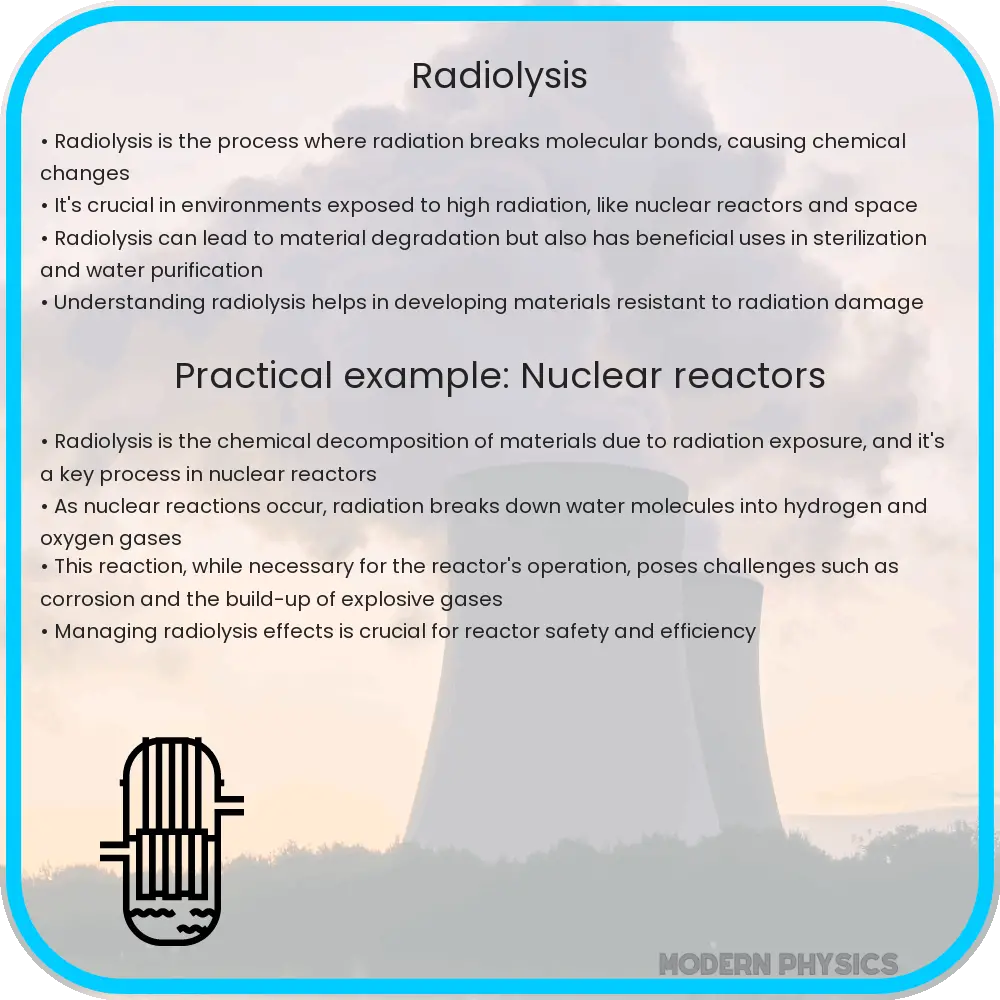
Radiolysis is the chemical decomposition of materials caused by exposure to ionizing radiation, impacting environments like nuclear reactors and medical treatments.
Overview of Radiolysis
Radiolysis is the chemical decomposition of materials caused by exposure to ionizing radiation. As a foundational phenomenon in the field of nuclear chemistry, radiolysis occurs when radiation disrupts the molecular structure of substances, often leading to the formation of new products. This process is central to understanding various applications and safety considerations in environments where radiation is prevalent, such as in space, around nuclear reactors, and in medical treatments using radiation.
Types and Mechanism of Radiolysis
Radiolysis can be induced by different types of radiation, including gamma rays, X-rays, and neutron radiation, each possessing enough energy to ionize molecules. During radiolysis, the energy absorbed from radiation breaks the chemical bonds in a molecule, leading to the formation of ions and free radicals. These ions and radicals can recombine to form a wide array of new compounds.
The general reaction for radiolysis can be represented by:
-
Primary Ionization: A molecule M absorbs energy and ejects an electron, resulting in an ionized molecule M+ and an electron e–.
-
Formation of Free Radicals: The ionized molecule M+ can then either recombine with the electron or undergo further decomposition to form radicals.
-
Secondary Reactions: These radicals can initiate chain reactions leading to more complex molecular transformations.
Effects of Radiolysis
The effects of radiolysis depend on the material involved and the radiation exposure. In biological systems, radiolysis of water, the main constituent of living cells, generates highly reactive radicals like hydroxyl and hydrogen. These radicals can damage DNA and other critical cellular components, contributing to the biological risks associated with radiation exposure.
In nuclear reactors, radiolysis of water used as a coolant can produce hydrogen gas and other corrosive substances. The accumulation of these byproducts needs to be carefully managed to prevent damage to the reactor and ensure safe operation. Reaction management includes measures such as controlled addition of chemicals to neutralize or inhibit the effects of the radicals produced.
Utilization of Radiolysis
Radiolysis finds numerous applications across various industries. In the medical field, it is utilized for sterilizing medical instruments and supplies, as well as in the development of new drugs and materials. The ability of radiation to sterilize items arises from its capacity to destroy microorganisms and their spores by breaking down their molecular structures.
In environmental engineering, radiolysis is used for the purification of water by breaking down pollutants and sterilizing the water. This process, known as radiation processing, involves exposing contaminated water to high doses of radiation to promote the formation of radicals that decompose organic contaminants.
Industrial applications of radiolysis include the modification of materials to improve their properties, such as enhancing the thermal stability of polymers and the production of nanoparticles through radiation-induced synthesis.
Challenges and Safety Measures in Radiolysis
While radiolysis offers significant benefits, it also poses unique challenges that require stringent safety measures. The primary concern in radiolysis is the control of unwanted byproducts and ensuring that the radiation levels are within safe limits to avoid the risk to human health and the environment.
-
Shielding and Containment: Proper shielding and containment prevent excessive exposure to radiation, protecting both operators and the environment.
-
Radiation Monitoring: Continuous monitoring of radiation levels ensures that they remain within the acceptable threshold, providing real-time safeguards against potential overexposure.
-
Waste Management: The byproducts of radiolysis, particularly in industrial and medical settings, must be handled and disposed of according to strict regulatory standards to prevent environmental contamination.
Future Prospects of Radiolysis
The future of radiolysis appears promising, particularly with the ongoing advancements in nuclear chemistry and radiological technologies. Researchers are exploring more efficient and safe ways to harness the power of radiolysis in fields like renewable energy, where it could potentially aid in the production of hydrogen fuel through the radiolytic splitting of water. Furthermore, the advancing granularity in control over radiation effects at molecular levels promises to open up new applications in materials science and biotechnology.
As concerns around clean energy and environmental preservation become more pressing, the role of radiolysis in addressing these issues will likely expand, highlighting the importance of continued research and development in this area.
Conclusion
Radiolysis, characterized by the chemical decomposition of materials due to ionizing radiation, plays a crucial role across various sectors, from healthcare and environmental management to industrial material processing. Understanding its mechanisms, effects, and applications allows for better exploitation of its benefits while managing its risks effectively. The challenges presented by radiolysis, especially in terms of safety and environmental impact, necessitate rigorous control measures and ongoing research to optimize and broaden its utilization. With its potential contributions to critical areas like renewable energy and pollution control, radiolysis remains a significant focus in scientific research and industrial innovation, poised to contribute solutions to some of the most pressing global challenges.