
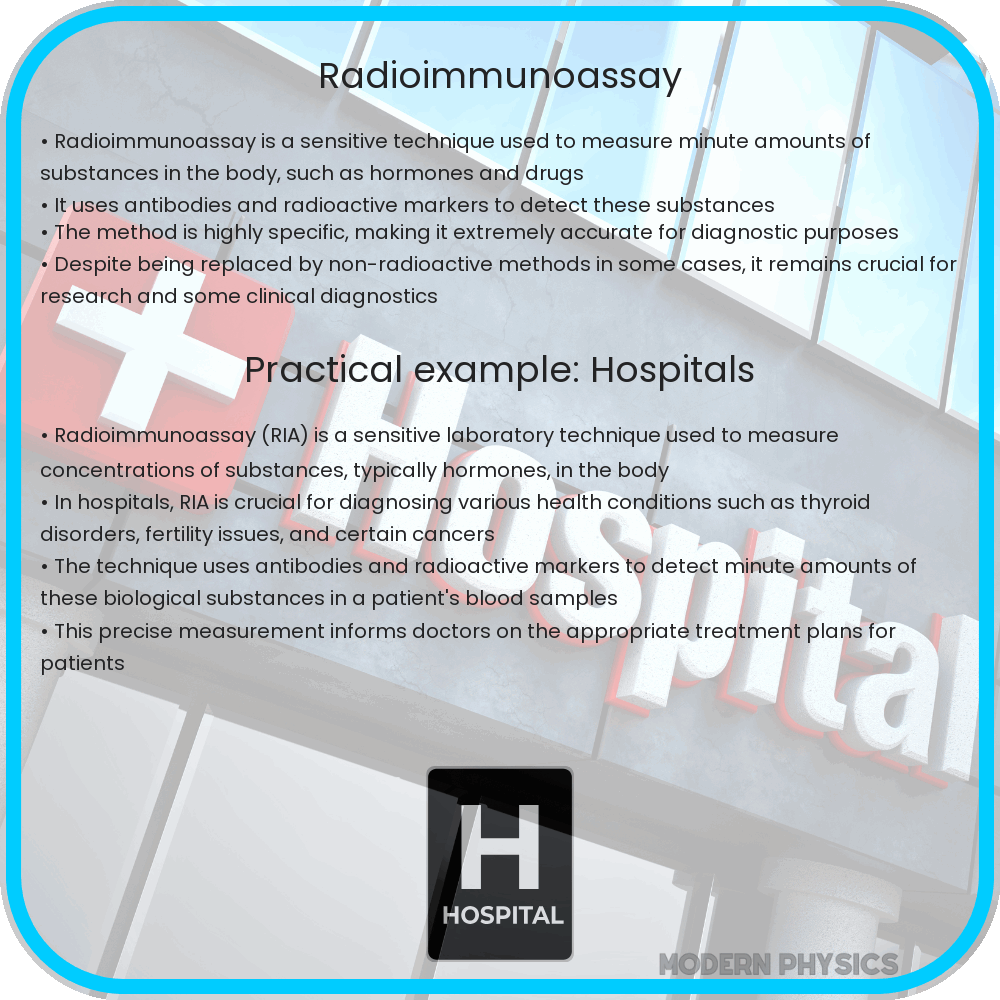
Radioimmunoassay (RIA) is a scientific technique for measuring minute amounts of antigens like hormones and drugs in samples using specific antibodies and radioactive labels.
Introduction to Radioimmunoassay
Radioimmunoassay (RIA) is a sensitive and precise scientific technique used to measure minute amounts of antigens (typically hormones, drugs, or other biological molecules) in a sample. First developed in 1960 by Rosalyn Yalow and Solomon Berson, this technique revolutionized medical diagnostics by allowing for the detection of low concentrations of substances in the blood and other fluids, which was previously not possible with older methods.
Principle of Radioimmunoassay
The fundamental principle of RIA involves the use of antibodies to specifically bind the antigen of interest and a radioactively labeled form of that antigen. The procedure quantifies the binding of the unlabeled antigen (present in the sample) and the labeled antigen to specific antibodies. As both the labeled and unlabeled antigens compete for the limited binding sites on the antibody, the amount of radioactive antigen bound will be inversely proportional to the concentration of antigen in the sample.
Steps in Radioimmunoassay
- Preparation of the Reagents: The targeted antigen is labeled with a radioactive isotope, often iodine-125 (^125I). Specific antibodies against this antigen are also prepared, which can bind both the labeled and unlabeled antigen.
- Sample and Standards Preparation: Known amounts of the antigen (standards) and unknown samples are prepared. These standards help in creating a calibration curve to interpret the sample results.
- Incubation: The sample, radioactive antigen, and antibody are incubated together. During this time, the labeled and unlabeled antigens compete to bind with the antibody.
- Separation: After incubation, the bound (antibody-linked) and free (unlinked) antigens are separated using various methods like precipitation with a second antibody or using a solid-phase separation technique.
- Detection: The radioactivity of the bound complex is measured using a gamma counter. The amount of radioactivity provides a measure of the concentration of the unlabeled antigen in the sample.
Applications of Radioimmunoassay
- Clinical Diagnostics: RIA is widely used to measure hormone levels in blood, crucial for diagnosing endocrine disorders such as diabetes, thyroid disorders, and growth hormone deficiencies.
- Research: It serves as a powerful tool in research for quantifying biological substances and studying receptor binding and enzyme activities.
- Pharmaceutical Applications: This technique supports pharmacokinetics by measuring drug levels in the blood, aiding in the development of new drugs and the formulation of dosing regimens.
Despite its numerous applications, the use of radioactivity in RIA raises safety and environmental concerns. Over the years, alternative methods such as enzyme-linked immunosorbent assays (ELISAs) have been developed to overcome these issues. Nonetheless, the precision and sensitivity of RIA keep it relevant in scenarios where other methods might not provide sufficient sensitivity or quantitative accuracy.
Challenges and Considerations in Radioimmunoassay
While RIA is a powerful tool for detection and quantification, it comes with its own set of challenges. One primary concern is the handling and disposal of radioactive materials, which must be done carefully to avoid environmental contamination and exposure to hazardous radiation. Additionally, the precision of RIA can be affected by various factors such as antibody quality, the specificity of antigen-antibody reactions, and the stability of the radioactive isotope used.
Another significant consideration is the potential for cross-reactivity, where antibodies may bind to similar, non-target antigens, potentially leading to inaccuracies. Calibration and meticulous quality control are essential to mitigate these issues and ensure reliable results.
Future Prospects
Despite the challenges and the emergence of non-radioactive techniques, RIA remains integral in fields requiring high sensitivity and specificity. Ongoing research aims to improve RIA’s safety by exploring alternative labeling substances that pose less risk than traditional isotopes. Furthermore, advancements in automation and data analysis are set to enhance the accuracy and efficiency of these assays, making them faster and more user-friendly.
Conclusion
Radioimmunoassay has been a cornerstone in diagnostic and research laboratories since its development in the 1960s. Its ability to detect tiny amounts of biological substances has made significant contributions to medicine, particularly in the diagnosis and management of hormonal disorders. Despite the potential risks associated with radioactivity, the precision and sensitivity of RIA make it irreplaceable in certain scientific and medical scenarios. With advancements in science and technology, we can anticipate improvements that will address current limitations and broaden the scope of RIA’s applicability, ensuring its relevance in modern science for years to come.
Understanding and respecting both its capabilities and limitations allows scientists and medical professionals to effectively harness the power of radioimmunoassay, contributing to ongoing improvements in health care and scientific research.