
Explore the impact of quasiparticle poisoning on superconductivity, its prevention methods, and innovative solutions to enhance device performance and stability.
Understanding Quasiparticle Poisoning in Superconductivity
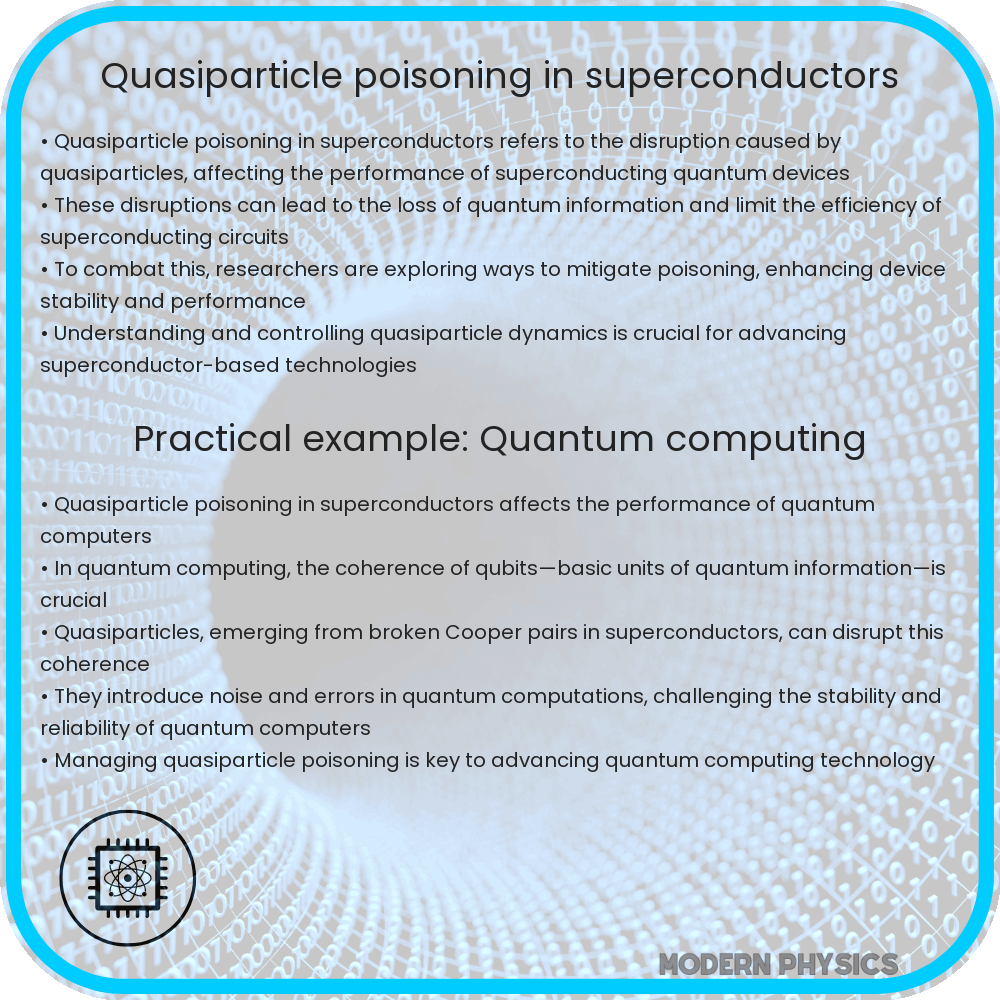
Quasiparticle poisoning is a significant challenge in the field of superconductivity, particularly affecting devices based on Josephson junctions, such as quantum computers and superconducting quantum interference devices (SQUIDs). This phenomenon arises when excess quasiparticles—combinations of electrons and holes—disrupt the superconducting state, leading to a reduction in device performance and stability.
Impact of Quasiparticle Poisoning
The presence of quasiparticles in superconducting systems can lead to a variety of detrimental effects. Primarily, they can break Cooper pairs, the electron pairs responsible for superconductivity, thus weakening the superconducting state. This degradation manifests as increased noise, reduced coherence times in quantum systems, and diminished efficiency in superconducting circuits. For high-precision applications, such as in quantum computing, these effects can significantly impede the system’s overall performance and reliability.
Prevention Strategies
- Cooling Techniques: Lowering the temperature of superconducting devices helps reduce thermal excitations, thereby minimizing the formation of quasiparticles.
- Material Engineering: Using materials with higher superconducting gap energies can reduce the likelihood of quasiparticle generation, as it requires more energy to break Cooper pairs.
- Shielding: Implementing electromagnetic shielding minimizes the impact of external radiation, which can induce quasiparticle formation.
Solutions to Mitigate Quasiparticle Poisoning
Addressing quasiparticle poisoning involves both innovative engineering solutions and advanced material science. One approach is the development of quasiparticle traps—regions within the superconducting device designed to attract and capture quasiparticles, thereby preventing them from interfering with the superconducting state. Additionally, enhancing the quality of the superconducting materials and junction interfaces can lead to a reduction in quasiparticle generation and improved device resilience.
Another strategy is the application of non-equilibrium techniques, such as applying bias currents or magnetic fields, to shift the energy levels within the superconductor and expel quasiparticles from the active regions of the device. These approaches, while complex, show promise in enhancing the performance and stability of superconducting systems in the face of quasiparticle challenges.
Advanced Research and Future Directions
Continued research into quasiparticle dynamics and superconductivity is crucial for developing more effective strategies to combat quasiparticle poisoning. Innovations in materials science, such as the discovery of new superconducting compounds or the refinement of existing materials, could provide breakthroughs in reducing quasiparticle generation. Furthermore, advances in nanotechnology and fabrication techniques may enable the creation of more precise and effective quasiparticle traps and filters.
On the theoretical front, deeper understanding of quasiparticle behavior in various superconducting phases is essential. This knowledge could lead to the development of novel superconducting devices that are inherently resistant to quasiparticle poisoning. Additionally, the integration of quantum computing algorithms that can tolerate or correct for the effects of quasiparticles may also play a significant role in mitigating their impact.
Practical Applications and Industry Impact
The practical implications of overcoming quasiparticle poisoning extend beyond the realm of quantum computing. Improved superconductivity can enhance the performance and efficiency of a wide range of applications, including medical imaging devices, digital circuits, and magnetic levitation transport systems. In the energy sector, advancements in superconducting materials and technologies could lead to more efficient power transmission and revolutionary changes in the generation and storage of electricity.
As the industry moves forward, collaboration between researchers, engineers, and technologists across disciplines will be vital in addressing the challenges posed by quasiparticle poisoning. By combining theoretical insights with practical engineering solutions, the field can advance towards more robust and reliable superconducting systems.
Conclusion
Quasiparticle poisoning remains a significant challenge in the field of superconductivity, impacting the efficiency and performance of superconducting devices. However, through a combination of innovative cooling techniques, material engineering, and advanced device design, significant strides have been made in mitigating its effects. Ongoing research and collaboration across disciplines are essential to develop more effective strategies and technologies to overcome this obstacle. The future of superconductivity, bolstered by these advancements, holds promising potential for a wide range of applications, from quantum computing to energy transmission. By addressing the challenges posed by quasiparticle poisoning, the scientific community moves closer to unlocking the full potential of superconducting technologies.