
Learn about quasicrystal alloys, non-repeating atomic structures offering unique symmetry and remarkable durability in material science.
Understanding Quasicrystal Alloys
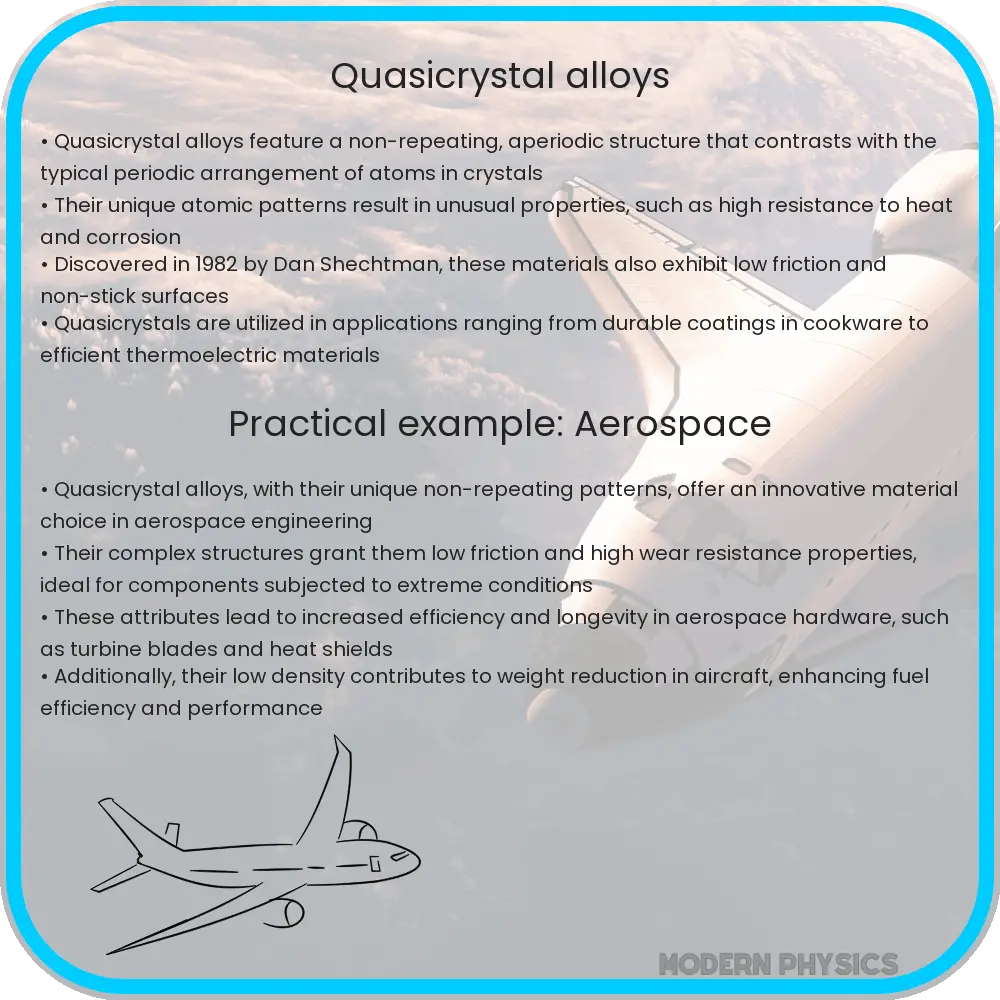
Quasicrystal alloys are a fascinating and relatively recent discovery in the field of materials science. Unlike traditional crystals, quasicrystals feature a non-repeating pattern that displays a unique form of symmetry. This intriguing structure not only challenges our understanding of crystallography but also offers a range of practical applications due to their unique properties.
The Unique Structure of Quasicrystals
Typical crystals, such as salt or diamonds, have an atomic arrangement that repeats periodically across three dimensions. This repetitive pattern fits neatly within the mathematical frameworks of traditional crystallography. Quasicrystals, on the other hand, exhibit what is known as ‘aperiodic’ order. This means that their atomic arrangement is ordered but lacks periodicity. They display symmetrical patterns that cannot be translated along regular spatial intervals.
One of the most striking features of quasicrystals is their ability to exhibit five-fold rotational symmetry, something that is forbidden in conventional crystals. This kind of symmetry involves rotating an object by one-fifth of a full turn (or 72 degrees) and having the object look the same at each stage of rotation.
Durability of Quasicrystal Alloys
The atomic structure of quasicrystals contributes to their impressive mechanical properties, including high hardness and good resistance to wear and corrosion. These characteristics stem from the complex aperiodic arrangement of atoms, which can restrict dislocation movement within the material. Dislocations are defects in the crystal structure that can propagate under stress, leading to deformation and fracture. The unique structure of quasicrystals effectively traps these dislocations, making them particularly durable under mechanical stress.
Applications of Quasicrystal Alloys
Quasicrystal alloys find utility in a variety of fields due to their distinct properties. Some common applications include:
- Coatings: Their resistance to wear and ability to reduce friction makes quasicrystals ideal for surface coatings in tools and machine parts.
- Catalysts: Quasicrystals have been used as catalysts in certain chemical reactions due to their large surface area and stability.
- Thermal Barriers: The poor thermal conductivity of certain quasicrystalline phases is beneficial in applications requiring thermal barrier materials, such as in aerospace components.
Despite their benefits, the complexity and cost of producing quasicrystal alloys have been barriers to their widespread usage. However, ongoing research is focused on developing more efficient manufacturing processes and expanding the applications of these fascinating materials.
Concluding Remarks
Quasicrystals represent a unique and remarkable advancement in materials science, merging an intricate structure with a set of properties that can significantly enhance product performance across various industries. Their discovery not only posed a challenge to established scientific doctrines but also opened new pathways for innovations, particularly in materials engineering.
The study of quasicrystals is still evolving, with researchers and scientists unraveling more about their properties and potential uses. As technology progresses, the efficiency of manufacturing quasicrystal alloys is expected to improve, reducing costs and allowing these materials to become more mainstream. This could lead to wider applications in electronics, aerospace, and other fields requiring materials with specific mechanical and thermal properties.
The curiosity and continuing investigation into quasicrystals are a testament to the endless possibilities that materials science offers to technological advancement. The journey from a perplexing discovery to a material with practical applications underscores the importance of research and innovation in driving progress.
In conclusion, the field of quasicrystal alloys is just beginning to be explored, and its full potential is yet to be realized. These materials not only challenge our understanding of solid matter but also hold the promise of revolutionizing industries through applications that take advantage of their unique properties. For students, researchers, and professionals in the field of materials science, quasicrystals offer a fertile ground for exploration and could lead to groundbreaking developments in the years to come.