
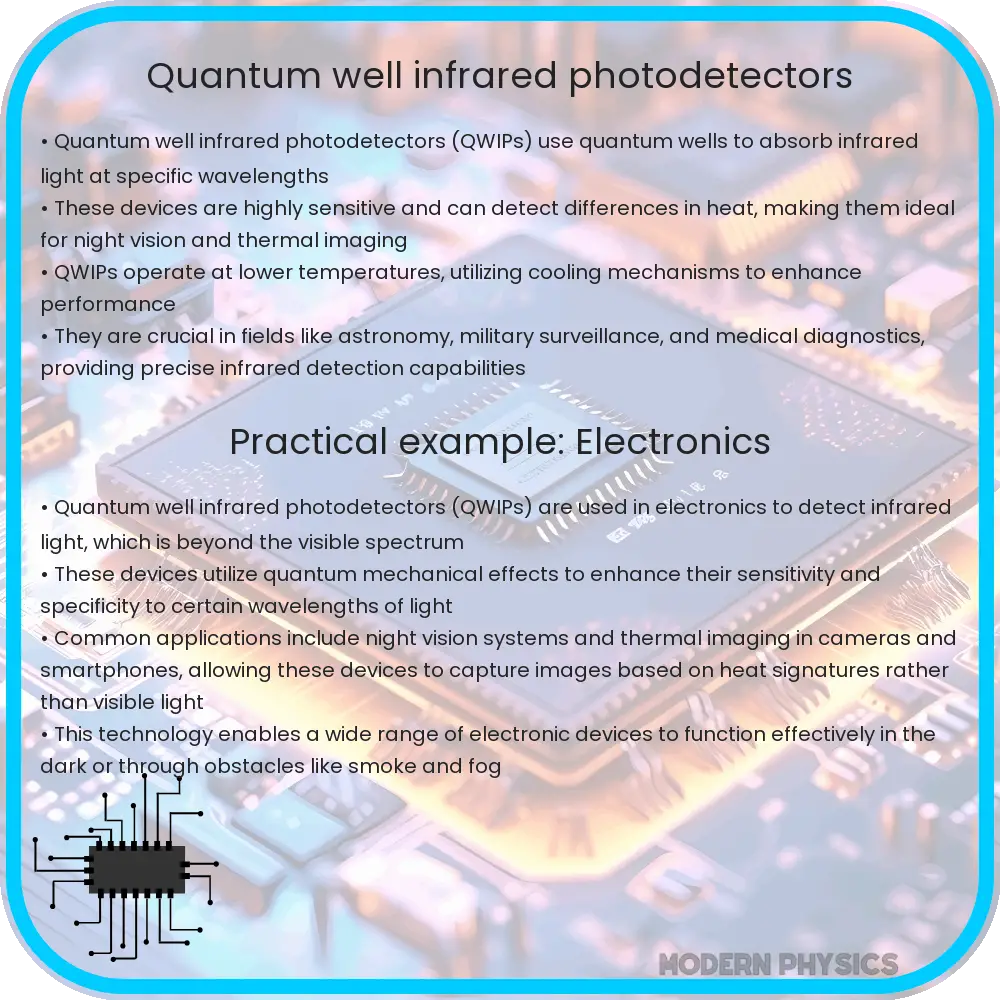
Quantum Well Infrared Photodetectors (QWIPs) are devices that use quantum mechanical effects to detect infrared light, essential for thermal imaging and environmental monitoring.
Quantum Well Infrared Photodetectors: Efficiency & Design
Quantum Well Infrared Photodetectors (QWIPs) are devices that exploit quantum mechanical effects to detect infrared (IR) light. These photodetectors have become crucial in various applications such as thermal imaging, environmental monitoring, and spectroscopy due to their high sensitivity and specific detection capabilities.
Basic Concept of QWIPs
QWIPs are based on the concept of quantum wells, which are potential wells that confine particles such as electrons in the quantum scale. These wells are typically formed using semiconductor materials like GaAs (Gallium Arsenide) and AlGaAs (Aluminum Gallium Arsenide).
- Quantum Wells: In a quantum well, the motion of electrons is restricted to two dimensions, significantly affecting their energy levels.
- Photodetection Mechanism: When IR photons hit the detector, they excite electrons from the ground state confined in the quantum well to higher energy states. This excitation results in a change in conductivity, enabling the detection of the IR light.
Design of QWIPs
The design of QWIPs is a critical factor that influences their performance and efficiency. Key design elements include the choice of materials, the structure of the quantum wells, and the configuration of the photodetector.
- Material Selection: Choosing the right semiconductor materials is crucial for fabricating effective quantum wells. Common materials include combinations of GaAs and AlGaAs due to their favorable electronic properties.
- Layer Structure: QWIPs typically consist of multiple quantum wells separated by barriers. The thickness of these wells and barriers can be engineered to control the energy levels of electrons. A typical structure might include layers of GaAs for the wells and AlGaAs for the barriers.
- Number of Quantum Wells: Increasing the number of quantum wells can enhance the device’s sensitivity by providing more sites for electron excitation. However, this must be balanced against the complexity and cost of fabrication.
Efficiency of QWIPs
The efficiency of a QWIP is determined by several factors:
- Absorption Efficiency: The ability of the photodetector to absorb IR photons effectively. This depends on the material properties and the design of the quantum wells.
- Quantum Efficiency: Defined as the ratio of the number of charge carriers generated to the number of photons absorbed. It is influenced by the quality of the quantum well structures and the alignment of energy levels.
- Noise Performance: Noise can significantly impact the performance of QWIPs. Lowering the noise and increasing the signal-to-noise ratio are essential for improving detection efficiency.
Optimizing these parameters involves precise engineering at the atomic scale and careful consideration of the material properties and structural design.
Applications of QWIPs
Quantum Well Infrared Photodetectors (QWIPs) play a pivotal role in various real-world applications, thanks to their high sensitivity and ability to detect specific infrared wavelengths.
- Thermal Imaging: QWIPs are extensively used in thermal imagers, which are essential for night vision technology, surveillance, and security systems. They can create precise thermal images in low light conditions.
- Environmental Monitoring: QWIPs are used to detect gases and pollutants by analyzing the IR light that different substances emit or absorb. This capability is useful in monitoring air quality and detecting hazardous substances.
- Spectroscopy: In scientific research, QWIPs help in studying molecular compositions. By detecting specific IR wavelengths, they can identify different materials and compounds in a sample.
- Astronomy: In space telescopes, QWIPs help in observing celestial objects across infrared wavelengths, revealing features that are invisible in the visible spectrum.
Challenges and Future Directions
Despite their excellent capabilities, QWIPs face some challenges that need addressing to further enhance their efficiency and applicability:
- Cooling Requirements: QWIPs often require cooling to cryogenic temperatures to reduce thermal noise and maintain high performance. Developing materials and designs that can operate efficiently at higher temperatures is an ongoing area of research.
- Integration with Other Technologies: Integrating QWIPs with other sensor technologies and ensuring compatibility with modern electronic systems can broaden their application scope.
- Cost Reduction: The fabrication process of QWIPs can be expensive. Research into cost-effective materials and manufacturing techniques is necessary to make these devices more accessible for commercial use.
Future advancements in material science and nanoscale engineering hold the potential to overcome these challenges, leading to more robust, efficient, and versatile QWIPs.
Conclusion
Quantum Well Infrared Photodetectors (QWIPs) are at the forefront of infrared detection technology, leveraging quantum mechanics to offer highly sensitive and specific IR light detection. These devices have a range of applications from thermal imaging to environmental monitoring, and they continue to evolve with advancements in material science and engineering. By addressing current challenges and exploring new materials and designs, the future of QWIPs looks promising, potentially revolutionizing how we use infrared detection in various fields.