
Explore the intriguing world of quantum vortex states in superconductors, their applications in technology, and their impact on quantum computing.
Understanding Quantum Vortex States in Superconductors
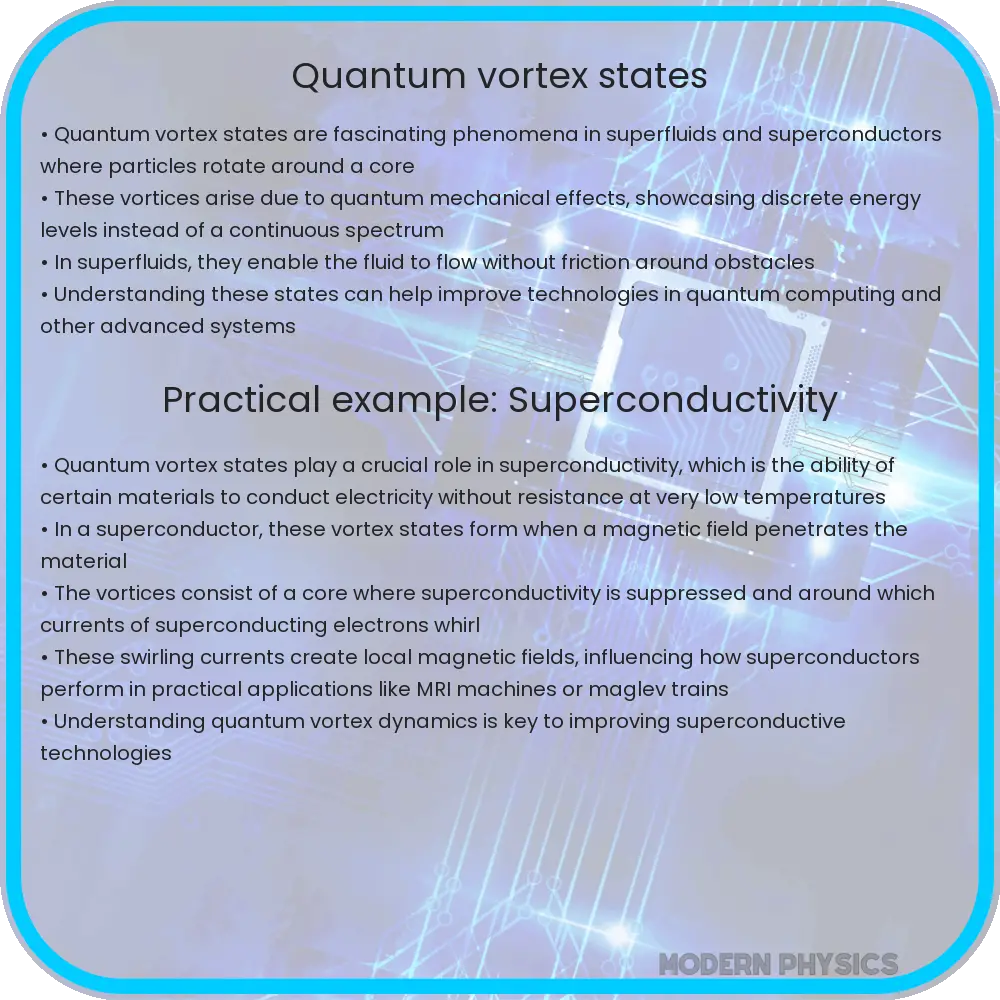
Quantum Vortex States are pivotal in the realm of superconductivity, a quantum mechanical phenomenon where materials exhibit zero electrical resistance. These vortices form when a type-II superconductor is placed in a magnetic field that exceeds a certain threshold, known as the lower critical field (Hc1). As the field increases, magnetic flux begins to penetrate the superconductor, creating quantized vortex lines where superconductivity is suppressed, surrounded by circulating supercurrents.
The core concept behind these quantum vortex states is the quantization of magnetic flux in superconductors. According to quantum theory, the magnetic flux through a superconducting loop is quantized, meaning it can only take on values that are multiples of the magnetic flux quantum, Φ0 = h/2e, where ‘h’ is Planck’s constant and ‘e’ is the electron charge. In quantum vortex states, each vortex carries exactly one quantum of magnetic flux.
Applications in Modern Technology
The study and manipulation of quantum vortex states have vast applications in modern technology. One prominent application is in the field of magnetic resonance imaging (MRI), where superconducting magnets are used to generate high magnetic fields. Understanding vortex dynamics can improve the stability and efficiency of these magnets. Additionally, quantum vortices play a crucial role in the development of quantum computers. The ability to control and manipulate these vortices leads to advancements in qubit design, crucial for quantum computation.
Theoretical Background and Phenomena
The theoretical understanding of quantum vortex states is rooted in the Ginzburg-Landau theory and the BCS (Bardeen-Cooper-Schrieffer) theory. These theories describe how superconductivity arises and how quantum vortices form and behave within superconductors. Another significant phenomenon associated with quantum vortex states is the Abrikosov lattice, a highly ordered structure formed by vortices in type-II superconductors under high magnetic fields.
Understanding Quantum Vortex States
Quantum vortex states are fascinating phenomena observed in the realm of superconductivity, particularly within type-II superconductors. These states occur when an external magnetic field penetrates a superconductor, leading to the formation of discrete, quantized vortex lines. Each vortex carries a quantum of magnetic flux, denoted as Φ0, equivalent to approximately 2.07 x 10⁻¹⁵ weber.
At the core of each quantum vortex, superconductivity is locally suppressed, allowing the magnetic field to penetrate. This core is surrounded by a circulating current that creates the magnetic field necessary to sustain the vortex. The arrangement of these vortices within the superconducting material forms a lattice-like structure, typically hexagonal, known as the Abrikosov lattice, after the Soviet physicist Alexei Abrikosov who predicted their existence.
Applications and Implications
The study and manipulation of quantum vortex states have significant applications in various technological fields. For example, they play a crucial role in the functioning of superconducting magnets, which are essential components of magnetic resonance imaging (MRI) machines and particle accelerators. Additionally, understanding vortex dynamics is key to improving the performance of superconducting wires and tapes, which are used in power cables and magnetic levitation (maglev) trains.
Moreover, quantum vortices are instrumental in the field of quantum computing. The ability to control and manipulate these vortices can lead to advancements in qubit design, enhancing the stability and performance of quantum computers.
Conclusion
The exploration of quantum vortex states opens a window into the complex interplay between magnetic fields and superconductivity. It not only deepens our understanding of quantum mechanics and superconducting materials but also drives innovation in medical, scientific, and transportation technologies. As research progresses, the potential applications of these quantum phenomena continue to expand, promising exciting developments in the future.