
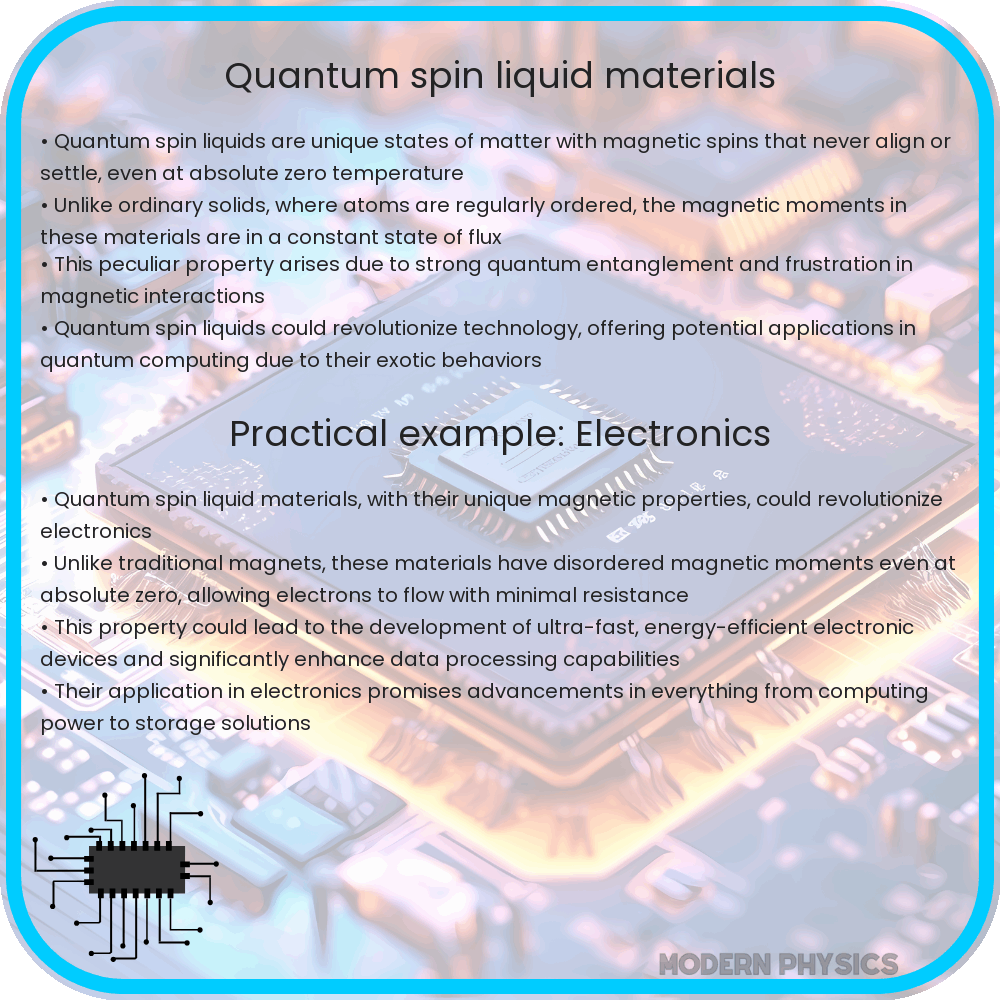
Quantum spin liquid materials are states of matter with liquid-like magnetic properties, resisting ordered states even at absolute zero.
Quantum Spin Liquid Materials
Quantum spin liquid materials represent one of the most intriguing and complex phenomena in the world of condensed matter physics. Such materials showcase the mysterious and exotic phases of matter, quite distinct from traditional solids, liquids, or gases. Let’s delve into what makes quantum spin liquids so fascinating, particularly in relation to their magnetic properties and the theoretical frameworks that describe them.
Understanding Spin in Quantum Mechanics
In quantum mechanics, “spin” refers to an intrinsic form of angular momentum carried by elementary particles, composite particles (like protons and neutrons), and atomic nuclei. Unlike everyday spinning objects, quantum spin does not correspond to actual physical motion; instead, it is an abstract property that is a key aspect of the quantum world. Every particle has a specific spin, which can adopt a series of discrete values typically measured in units of Planck’s constant (ℏ).
The Basics of Quantum Spin Liquid (QSL)
Quantum Spin Liquids (QSLs) are a state of matter displaying liquid-like magnetic properties down to very low temperatures, despite the expectation for magnetic order in typical materials. What makes QSLs extraordinary is their resistance to magnetically ordered states, even at absolute zero, which defies the norms seen in conventional ferromagnets or antiferromagnets where spins align or counter-align in a regular pattern.
The peculiarity of QSLs lies in the perpetual fluctuation of the direction of quantum spins. These fluctuations prevent the spins from freezing even in conditions where classical physics would predict them to do so, leading to a “liquid” state of constant change. This phenomenon primarily arises from strong quantum entanglement and the highly frustrated arrangement of spins – that is, an arrangement where spins cannot stabilize into a simple pattern due to geometric or interactional complexities.
Magnetic Properties of QSLs
Unlike conventional magnetic materials, QSLs do not exhibit straightforward magnetism. Instead, their magnetic effect is subtle and primarily observable in their responses to external magnetic fields. Studies using techniques such as neutron scattering have shown that these materials can exhibit fractionalized magnetic excitations – a scenario where collective excitations lead to quasiparticle phenomena that do not bear the same characteristics as the basic particles themselves.
One of the fascinating aspects of QSL is the presence of “spinons” – emergent excitations that carry spin but no charge. In most magnetic materials, elementary excitations involve spin waves or magnons, which involve collective oscillations of spins in an ordered magnetic moment. In QSLs, spinons can propagate freely through the material, resembling the behavior of electrons in a conductor, but confined strictly to spin-related phenomena.
Theoretical Approaches to QSL
The theoretical exploration of QSLs is deeply rooted in quantum field theory and many-body physics. The complexity of these systems often requires sophisticated models and computational techniques. One of the cornerstone theoretical models used to describe QSLs is the Kitaev model, which employs a hexagonal lattice structure to accurately depict the interactions that lead to spin liquid behavior. This model helps in understanding how topological phases, which are robust against local perturbations, can emerge from quantum entanglement and geometrical frustration.
Other significant theoretical methods include the use of variational Monte Carlo simulations, which provide ways to visualize the highly entangled ground states of QSLs, and perturbation theory, which helps to appreciate the impact of slight changes in system parameters on the state of the material.
Applications and Future Prospects of QSLs
Quantum Spin Liquid materials are not just theoretical curiosities; they hold practical potential for the development of future technologies, especially in the field of quantum computing. The robust and error-resistant properties of quantum spin liquids could lead to significant advancements in creating stable qubits for quantum computers. Furthermore, the unique magnetic properties of QSLs can pave the way for novel approaches to data storage and magnetic sensors.
Researchers are also exploring the possibility of utilizing spinons in QSLs for energy transport applications. Since spinons behave somewhat like electrons but are not charged, they could potentially contribute to energy transfer methods that reduce heat loss, making systems more efficient. However, practical applications are still in their infancy, and much more research is needed to fully harness the capabilities of these materials.
Challenges in QSL Research
Despite their promising applications, studying and developing technologies based on Quantum Spin Liquids presents significant challenges. The synthesis of QSL materials can be highly complex and requires precise conditions. Moreover, detecting and measuring the subtle magnetic properties and excitations in these materials demand advanced instrumentation and techniques that are not widely available.
The complexity of theoretical models also presents a hurdle. The mathematical descriptions and computational simulations necessary to grasp the behaviors of QSLs demand extensive expertise in quantum mechanics and materials science. As such, advancing our understanding and practical applications of QSLs depends heavily on interdisciplinary collaboration and technological advancement in experimental tools.
Conclusion
Quantum Spin Liquid materials are a fascinating frontier in condensed matter physics, offering a window into the enigmatic behaviors of quantum mechanics manifested in solid state materials. Their peculiar properties challenge traditional notions of magnetic order and open up potential avenues for technological innovation, particularly in quantum computing and magnetic applications. Despite the formidable challenges they present in terms of theoretical understanding, material synthesis, and experimentation, the ongoing research into QSLs demonstrates a promising path forward. As interdisciplinary efforts continue to grow and technological capabilities advance, the mysteries and potentials of Quantum Spin Liquids are expected to become increasingly accessible, heralding a new era of materials science driven by quantum phenomena.