
Explore Quantum Shielding: the future of protective technology using quantum mechanics and advanced materials for diverse applications.
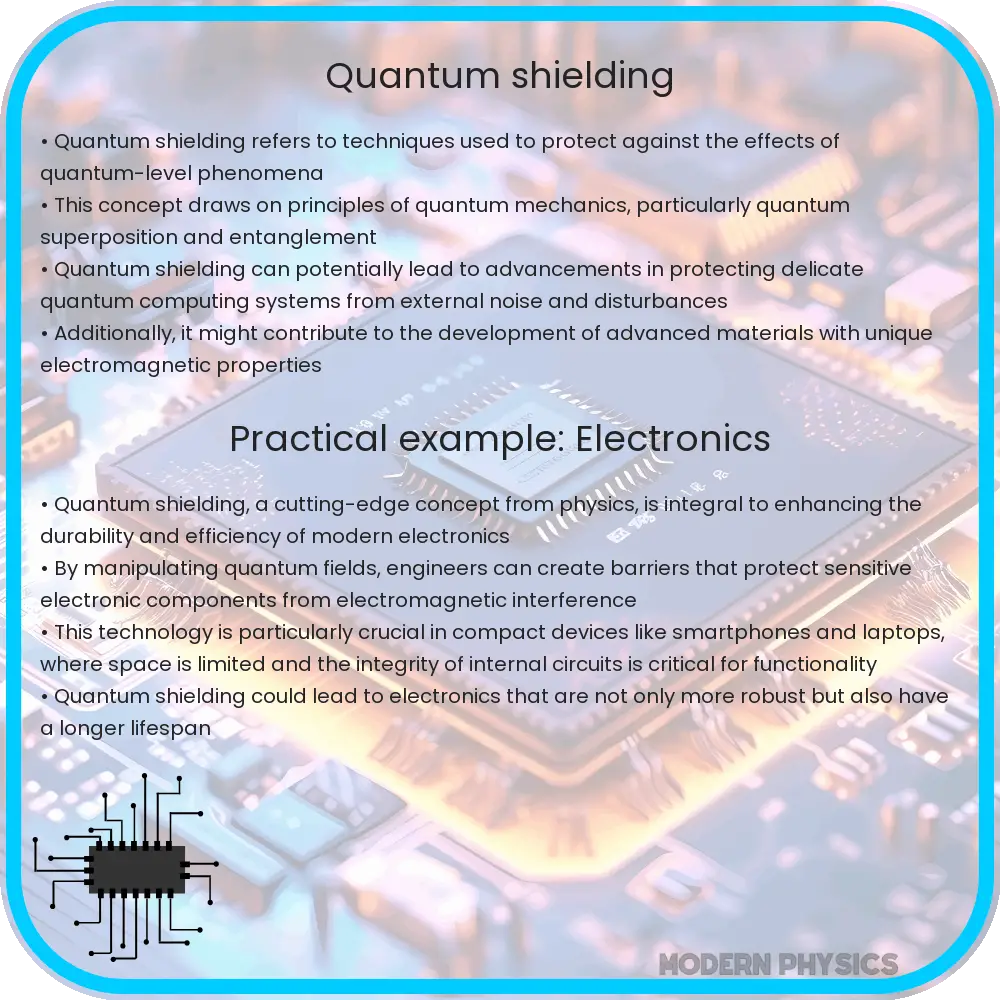
Understanding Quantum Shielding: A New Frontier in Protection Technology
In an era where technological advancements shape our daily lives, Quantum Shielding emerges as a groundbreaking concept. This innovative approach to protection combines the intricacies of quantum mechanics with advanced material science, promising unparalleled safety and durability in various applications. But what exactly is Quantum Shielding, and how does it redefine our understanding of protective technologies?
The Science Behind Quantum Shielding
Quantum Shielding revolves around the principles of quantum mechanics, a branch of physics that deals with the behavior of matter and energy at the atomic and subatomic levels. At this scale, particles exhibit properties that can be harnessed for superior protective capabilities. The core idea of Quantum Shielding lies in exploiting these quantum properties to create barriers that are exceptionally resilient to physical, chemical, or electromagnetic disturbances.
Materials and Mechanisms
The materials used in Quantum Shielding are not your typical metals or polymers. They are often complex compounds or nano-engineered structures designed to leverage quantum effects. These materials might include graphene, carbon nanotubes, or other advanced nanomaterials, characterized by their exceptional strength, conductivity, and thermal properties. For instance, graphene, with its honeycomb lattice, exhibits remarkable strength and flexibility, making it an ideal candidate for Quantum Shielding applications.
One significant aspect of Quantum Shielding is its ability to manipulate electromagnetic fields. By using materials with unique electromagnetic properties, Quantum Shields can effectively deflect or absorb harmful radiation, making them a potent solution for electromagnetic interference (EMI) protection. This is particularly vital in sensitive electronic equipment, where EMI can disrupt functionality or cause long-term damage.
Applications and Potential
The potential applications of Quantum Shielding are vast and varied. In the field of electronics, it can provide superior protection for delicate circuits and components, significantly enhancing the durability and performance of devices. In aerospace, Quantum Shielding could lead to lighter, stronger materials for aircraft and spacecraft, improving efficiency and safety. Additionally, in everyday consumer products, from smartphones to vehicles, Quantum Shielding offers an extra layer of durability and protection against wear and tear, impacts, and environmental factors.
Moreover, Quantum Shielding holds promise in the realm of personal protective equipment (PPE). Imagine helmets, vests, or even entire suits made with materials that are not only incredibly tough but also capable of shielding the wearer from various forms of radiation or extreme temperatures.
In conclusion, Quantum Shielding is not just a futuristic concept; it’s a tangible innovation that’s set to revolutionize the way we think about protection and durability in a multitude of fields. As research and development in this area continue to advance, we can expect to see Quantum Shielding technologies becoming more prevalent and integral to various industries and everyday applications.
Challenges and Future Directions in Quantum Shielding
While Quantum Shielding offers immense potential, it is not without its challenges. The primary obstacle lies in the complexity and cost of producing quantum materials on a large scale. Advanced materials like graphene are notoriously difficult and expensive to produce in large quantities, limiting their widespread application. Additionally, integrating these materials into existing manufacturing processes poses significant technical challenges.
Another consideration is the environmental impact of these advanced materials. As with any new technology, it is crucial to assess the lifecycle and sustainability of Quantum Shielding materials. Researchers and manufacturers must ensure that these materials can be produced, used, and disposed of or recycled in an environmentally responsible manner.
Regulatory and Safety Considerations
The unique properties of Quantum Shielding materials also bring regulatory and safety considerations. Given their novel nature, there is a need for comprehensive testing and standardization to ensure that these materials are safe for use in various applications. Regulatory bodies will play a crucial role in establishing guidelines and standards for the use of Quantum Shielding materials, particularly in sensitive areas such as medical devices or aerospace.
Moreover, as Quantum Shielding finds its way into consumer products, educating the public about its benefits and limitations will be essential. Clear communication about the capabilities and safety of these materials will be crucial in gaining public trust and acceptance.
Conclusion: The Quantum Leap in Protection Technology
In conclusion, Quantum Shielding represents a significant leap forward in the field of protective technology. Its potential to provide unparalleled resilience against physical, chemical, and electromagnetic threats opens new horizons in various industries, from electronics and aerospace to personal protective equipment. However, realizing the full potential of Quantum Shielding requires overcoming significant challenges in material production, integration, environmental sustainability, and regulatory compliance.
As we move forward, the continuous research and development in this field will undoubtedly lead to more practical and cost-effective solutions, making Quantum Shielding a more accessible and commonplace technology. The ongoing collaboration between scientists, engineers, industry leaders, and regulatory bodies will be key to harnessing the true power of Quantum Shielding, paving the way for a safer and more advanced future.
Quantum Shielding is not just a scientific marvel; it’s a testament to human ingenuity and the relentless pursuit of innovation. As this technology matures, we can look forward to a world where the quantum realm not only fascinates us but also provides tangible, everyday benefits, enhancing the safety and durability of the products and systems we rely on.