
Explore the precision and innovation of quantum sensors, their applications in medical imaging, navigation, and environmental monitoring.
Quantum Sensors: Revolutionizing Precision and Applications
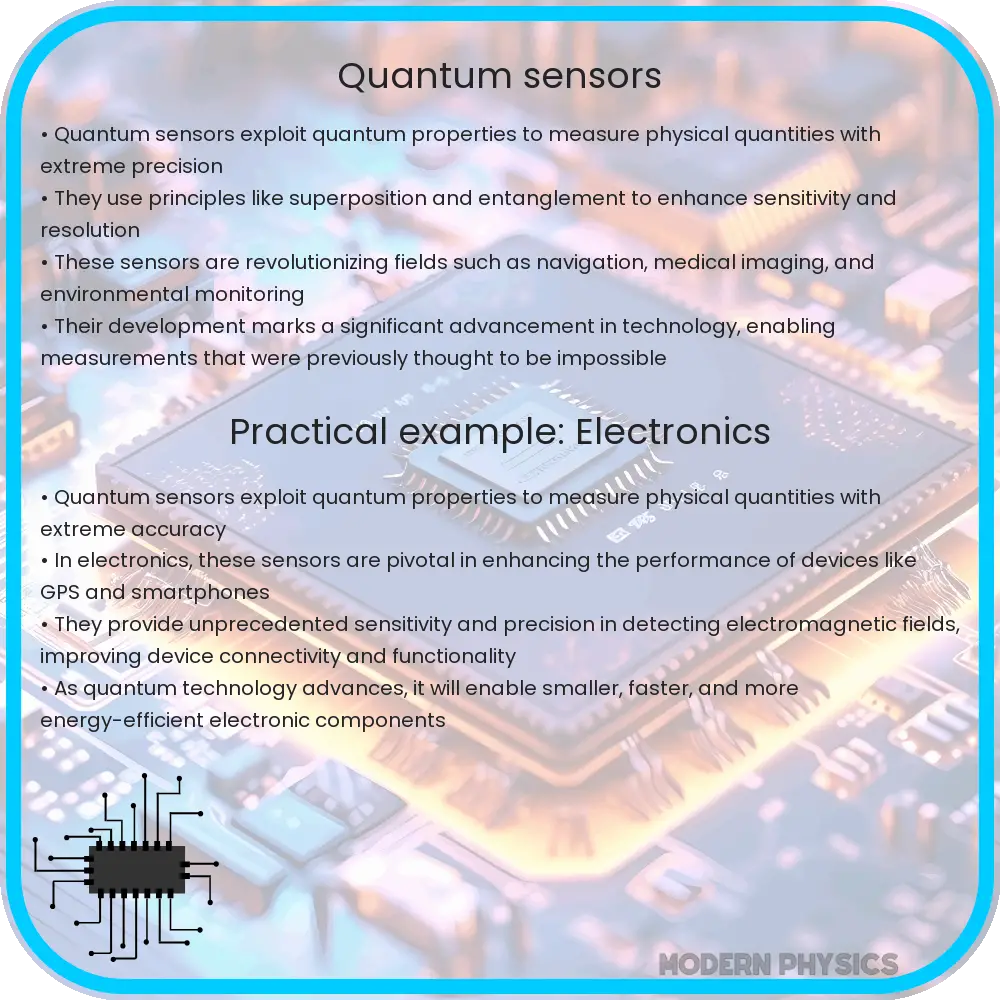
Quantum sensors represent a significant leap forward in measurement technology, offering unparalleled precision and sensitivity. These devices harness quantum properties, such as superposition and entanglement, to measure physical quantities with extraordinary accuracy. This technology has vast potential applications, from medical diagnostics to navigation systems, making it a cornerstone of innovation in various fields.
Understanding Quantum Sensors
At their core, quantum sensors operate by exploiting the quantum states of particles like photons or electrons. Unlike classical sensors, which measure physical quantities based on macroscopic properties, quantum sensors rely on the fundamental principles of quantum mechanics. This allows for measurements at the atomic or subatomic level, offering a degree of precision that was previously unattainable.
Applications of Quantum Sensors
- Medical Imaging and Diagnostics: Quantum sensors can dramatically improve the resolution and sensitivity of medical imaging techniques. For example, in magnetic resonance imaging (MRI), sensors based on nitrogen-vacancy centers in diamonds can detect changes at the cellular level, potentially enabling early detection of diseases like cancer.
- Environmental Monitoring: These sensors can detect minute environmental changes, such as subtle shifts in magnetic fields or gravitational anomalies. This makes them invaluable for monitoring volcanic activity, earthquake prediction, and even tracking climate change.
- Navigation Systems: Quantum sensors offer a significant upgrade over traditional gyroscopes in navigation systems. They can provide extremely accurate measurements of orientation and position, crucial for aerospace and submarine navigation, where GPS signals are unavailable.
Innovations in Quantum Sensor Technology
Recent advancements in quantum sensor technology have led to the development of more compact, durable, and efficient sensors. For instance, the integration of quantum dots and photonic circuits has paved the way for miniaturized sensors that can be used in a variety of portable devices. Moreover, researchers are exploring new quantum phenomena and materials, like topological insulators and two-dimensional materials, to further enhance the capabilities of these sensors.
One notable innovation is the use of cold atoms. By cooling atoms to near absolute zero, scientists can minimize external noise and achieve incredibly precise measurements. This approach has been employed in developing highly sensitive gravitational wave detectors, which could open new frontiers in astrophysics.
The potential of quantum sensors extends beyond current applications, with ongoing research exploring their use in quantum computing and secure communications. As this field continues to grow, the implications for technology and society are profound, promising a future where quantum sensors play a pivotal role in advancing human knowledge and capability.
Challenges and Future Directions in Quantum Sensor Technology
Despite their impressive capabilities, quantum sensors face several challenges. One of the primary issues is their sensitivity to environmental interference, which can disrupt the quantum states essential for their operation. Researchers are actively working on developing isolation techniques and error-correction algorithms to mitigate these effects. Another challenge is the scalability and integration of quantum sensors into existing technology. Making these devices smaller, more energy-efficient, and compatible with current electronics is crucial for their widespread adoption.
Another exciting development is the potential integration of quantum sensors with artificial intelligence (AI). AI algorithms can analyze the vast amounts of data produced by these sensors, leading to more accurate predictions and efficient data processing. This synergy could revolutionize fields like autonomous vehicles, where real-time data analysis and decision-making are crucial.
Economic and Societal Impact
The economic impact of quantum sensors is expected to be significant. As they become more integrated into various industries, they will likely drive innovation, create new markets, and enhance productivity. Sectors like healthcare, environmental monitoring, and defense will particularly benefit from these advancements. Additionally, the societal impact, particularly in terms of improved healthcare outcomes and environmental conservation, is immense.
Quantum sensors also raise important ethical and privacy considerations. Their ability to detect and measure at such fine scales could lead to concerns about surveillance and data security. It’s essential for policymakers and technologists to address these issues as the technology develops.
Conclusion
Quantum sensors are at the forefront of a measurement revolution. By leveraging the peculiarities of quantum mechanics, they offer unprecedented precision and sensitivity. Their applications range from medical diagnostics to environmental monitoring and beyond, representing a significant leap in our ability to understand and interact with the world around us.
While challenges remain in terms of environmental sensitivity, scalability, and ethical considerations, the future of quantum sensors is incredibly promising. The ongoing integration of these sensors with other cutting-edge technologies like AI, along with continued research and development, will undoubtedly unlock new possibilities and transform various sectors of society. As we continue to harness the power of quantum mechanics, the potential of quantum sensors to contribute to scientific discovery and technological advancement is limitless, paving the way for a more informed, efficient, and interconnected world.