
Explore the quantum properties of light, including wave-particle duality and entanglement, and their impact on technology and our universe.
Exploring the Quantum Properties of Light: Wave-Particle Duality and Entanglement
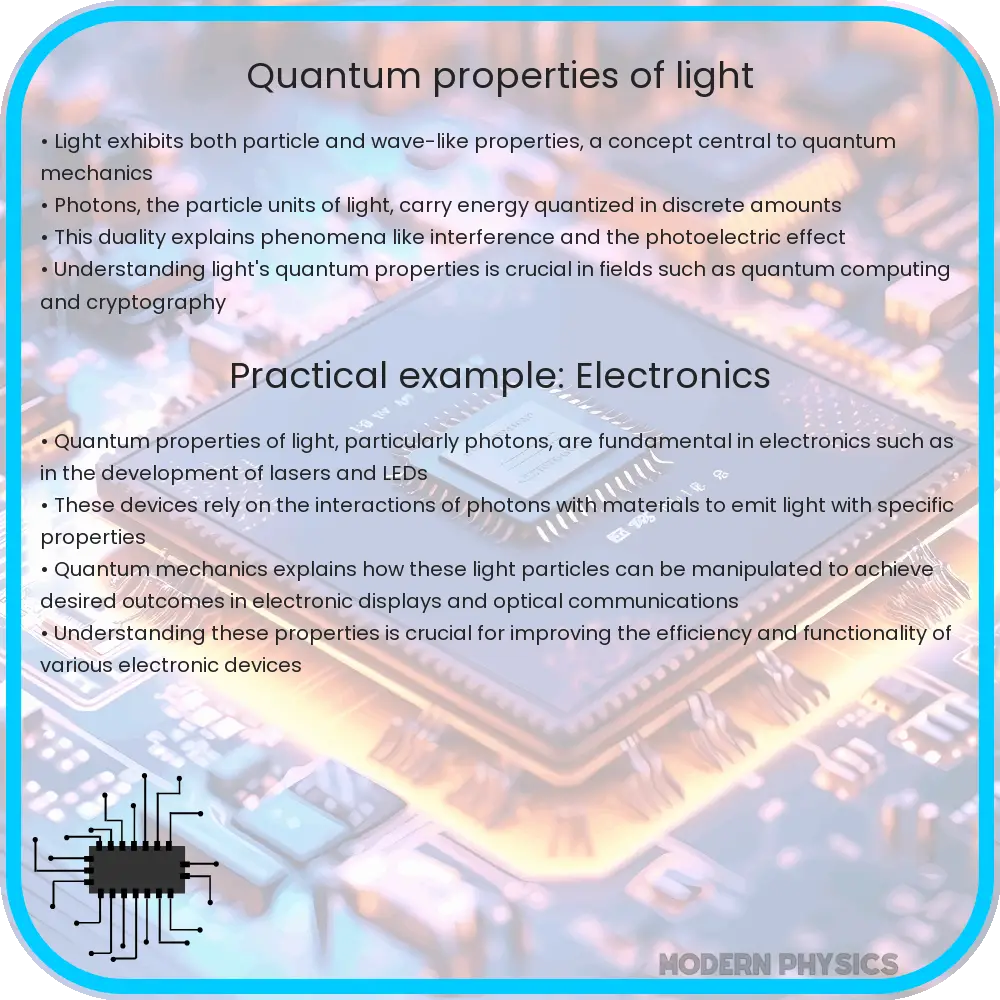
Light, one of the most familiar and fundamental aspects of our universe, exhibits behavior that challenges our classical understanding of physics. At the heart of this challenge are the quantum properties of light, specifically wave-particle duality and entanglement. These phenomena highlight the dual nature of light and its ability to exhibit characteristics of both waves and particles, as well as the interconnectedness of light particles across distances.
Wave-Particle Duality
The concept of wave-particle duality emerged from the work of early 20th-century physicists, who discovered that light can exhibit both wave-like and particle-like properties, depending on the experimental setup. This duality is best illustrated by the double-slit experiment, which shows that light can produce interference patterns (a wave property) when not observed, but acts as individual particles (photons) when measured.
This peculiar behavior led to the development of quantum mechanics, a branch of physics that describes the behavior of energy and matter at the smallest scales. In quantum mechanics, the exact state of a particle, including its position and momentum, is not determined until it is observed. This principle, known as the Heisenberg Uncertainty Principle, underscores the probabilistic nature of quantum phenomena and the fundamental limits of precision in measurements.
Quantum Entanglement
Another astonishing aspect of light’s quantum properties is entanglement, a phenomenon where pairs or groups of particles become interconnected in such a way that the state of one particle cannot be described independently of the state of the others, even when the particles are separated by large distances. This was famously referred to by Einstein as “spooky action at a distance,” challenging the notion of local realism in classical physics.
Quantum entanglement has profound implications for the development of quantum computing and quantum communication technologies, including the potential for unbreakable encryption through quantum cryptography. Entangled photons can be used to transmit information in a way that is fundamentally secure from eavesdropping, as any attempt to intercept the communication would irreversibly alter the state of the entangled particles, alerting the communicating parties to the presence of an interloper.
Applications and Implications of Light’s Quantum Properties
The quantum properties of light, particularly wave-particle duality and entanglement, are not just theoretical curiosities; they have practical applications that are shaping the future of technology and our understanding of the universe. Quantum computing, for instance, leverages the principles of superposition (related to wave-particle duality) and entanglement to perform calculations at speeds unattainable by classical computers. By exploiting these quantum properties, quantum computers can solve complex problems in cryptography, material science, and drug discovery more efficiently than their classical counterparts.
Quantum communication, another frontier technology, uses entangled photons to achieve secure communication channels. This method, known as quantum key distribution (QKD), ensures that any attempt at eavesdropping can be detected, as it would disrupt the quantum state of the entangled particles, making the theft of information fundamentally detectable.
Furthermore, the study of light’s quantum properties is also enhancing our understanding of the universe. Quantum entanglement challenges the classical notions of space and time, suggesting that our universe may be fundamentally interconnected in ways that classical physics cannot explain. This has led to new theories in quantum gravity and the ongoing quest to unify quantum mechanics with general relativity.
Conclusion
The exploration of light’s quantum properties—wave-particle duality and entanglement—opens a window into the fundamental nature of reality. These phenomena challenge our classical intuitions about the universe, revealing a world that operates according to the probabilistic rules of quantum mechanics. The implications of these discoveries extend far beyond theoretical physics, driving advancements in technology and offering new perspectives on the interconnectedness of the universe. As research in quantum physics continues to evolve, we can expect further revolutionary developments in computing, communication, and our understanding of the cosmos. The journey into the quantum realm is only just beginning, promising to unveil deeper mysteries about the fabric of reality.