
Quantum processors enhance computing with their high speed, robust security, and innovative applications across various fields.
Quantum Processors: Revolutionizing Computing through Speed, Security, and Innovation
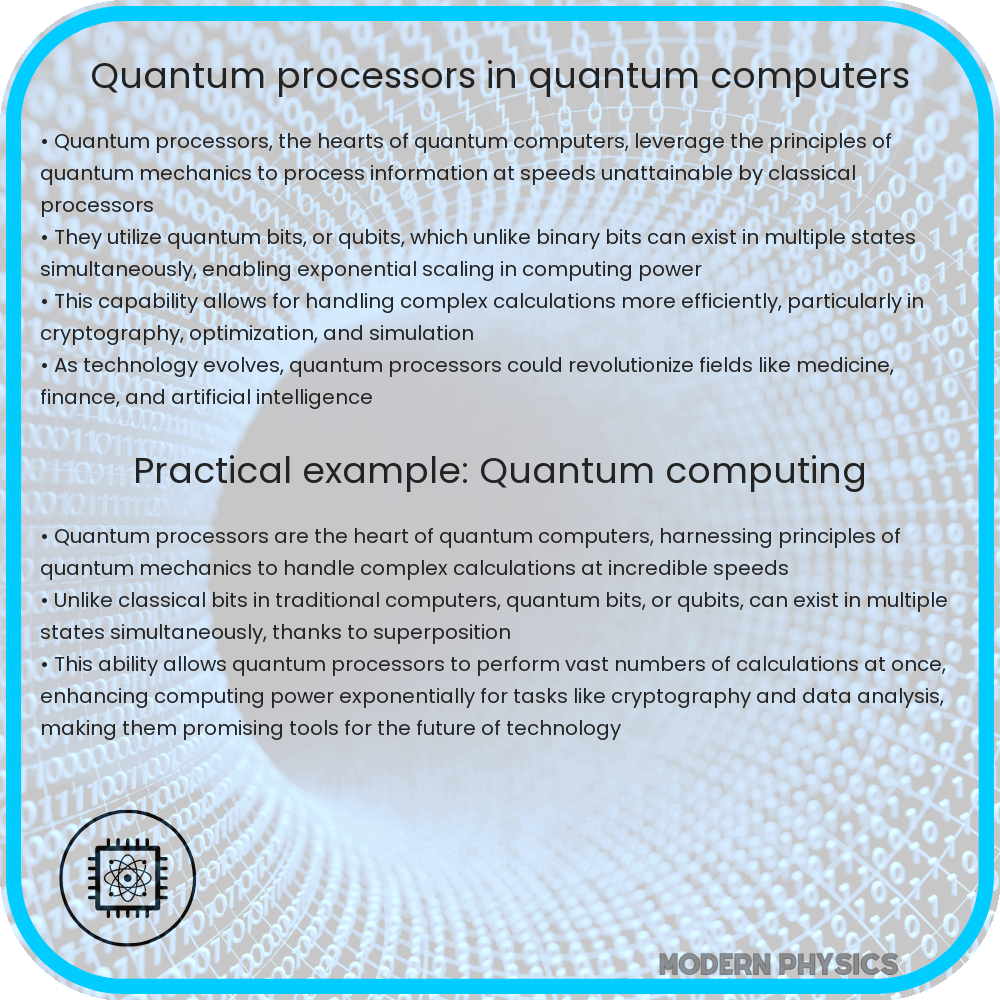
In the rapidly evolving world of computing, quantum processors stand out as a beacon of revolutionary change, offering unprecedented capabilities in processing speed, enhanced security measures, and fostering innovation across numerous fields. Aimed at transcending the limitations of classical computers, these processors capitalize on principles of quantum mechanics to handle complex problems that are currently unmanageable.
Understanding Quantum Processors
At its core, quantum computing departs radically from traditional computing. While classical computers use bits as the basic unit of data, represented either as a 0 or a 1, quantum processors use quantum bits, or qubits. Qubits are extraordinary in that they can represent a 0, a 1, or any quantum superposition of these values. This ability allows quantum computers to process a massive amount of data and solve complex calculations much more efficiently than classical computers.
Speed: Breaking the Barriers of Classical Computing
One of the most praised attributes of quantum processors is their speed. Quantum speed-up is primarily attributed to their ability to be in multiple states concurrently, thanks to a phenomenon known as superposition, combined with entanglement, where the state of one qubit will instantaneously affect the state of another, no matter the distance separating them. This principle enables quantum computers to perform many calculations at once, drastically reducing the time needed for data processing and profoundly impacting tasks such as optimization, modeling, and large-scale computations.
- Optimization Problems: Quantum processors can quickly explore a vast range of possible solutions to find the most efficient one, useful in areas like logistics and machine learning.
- Molecular Modeling: Their capability to simulate large, complex molecules could potentially accelerate new drug discoveries and improve materials science.
Security: Enhancing Data Safety with Quantum Cryptography
Security is another critical advantage of quantum computing. The principles of quantum mechanics can be used to develop quantum cryptography methods, such as quantum key distribution (QKD), which offers theoretically unbreakable encryption. This is because any attempt to intercept the quantum data causes it to be altered, revealing the presence of an eavesdropper. It’s anticipated that quantum cryptography will reshape the landscape of data security, particularly in fields requiring high-level security measures like governmental data handling or financial transactions.
Driving Innovation in Various Fields
The implications of quantum processors extend far beyond mere computational speed and security. They are poised to drive significant advancements in various sectors, including artificial intelligence, financial modeling, climate research, and more. Each of these applications could benefit dramatically from the quantum processor’s ability to quickly sort through and analyze vast amounts of data or simulate complex scenarios that classical computers find too challenging.
- Artificial Intelligence: Quantum computing could significantly speed up AI’s learning and decision-making processes, enabling more complex and intuitive models.
- Climate Research: By accurately simulating complex climate systems, quantum processors could provide more precise predictions about global warming and its impacts.
The convergence of increased processing power, enhanced security protocols, and the potential for groundbreaking applications across diverse fields posits quantum processors as a critical component of future technological advances. As this technology continues to develop, its integration into commercial and research arenas promises to unlock new levels of efficiency, security, and capability.
Challenges and Future Prospects
Despite their significant potential, quantum processors also face numerous challenges. One of the main issues is quantum decoherence, which occurs when qubits lose their quantum state due to environmental interference. Maintaining the stability of qubits requires extremely low temperatures and sophisticated error correction methods, making the technology expensive and complex to operate. Additionally, quantum algorithms are still in their infancy, requiring further research and development to fully leverage quantum computing capabilities.
Moreover, the roadmap to integrating quantum computing into everyday technology isn’t straightforward. Compatibility with existing technologies, scalability, and the creation of a skilled workforce are all hurdles that must be overcome. However, continual advances in quantum technology and increasing investment from both public and private sectors suggest that these challenges are being addressed, promising a more quantum-centric future.
Conclusion
Quantum processors represent a paradigm shift in computing technology, marked by their potential to solve problems beyond the reach of classical computers. With abilities rooted in the principles of quantum mechanics, such as superposition and entanglement, these processors offer immense speed, unparallelled security through quantum cryptography, and the promise to revolutionize industries like healthcare, finance, and environmental science.
While there are significant hurdles to overcome, the ongoing research, development, and investment in quantum computing indicate a clear vision for the future. As this exciting field continues to evolve, we can expect quantum processors to increasingly become a fundamental part of our technological landscape, pushing the boundaries of what is computationally possible and opening new avenues for innovation.
In summary, the journey of quantum computing is just beginning. As we continue to unlock the mysteries of quantum mechanics and refine the technology, the potential of quantum processors to reshape our digital world remains vast and inspiring. The fusion of theoretical physics and practical engineering in quantum computing not only challenges our understanding of the universe but also promises to enhance virtually every aspect of modern life.