
Explore the intriguing world of quantum phase, its impact on science and technology, and its potential applications in quantum computing and cryptography.
Quantum Phase: A New Frontier in Scientific Exploration
The concept of quantum phase stands at the forefront of modern physics, offering a fascinating and complex perspective on the fundamental workings of the universe. As a pivotal element in quantum mechanics, quantum phase plays a crucial role in understanding phenomena at the subatomic level. This article delves into the exploration, impact, and potential applications of quantum phase, shedding light on its significance in both theoretical and practical realms.
Exploring the Quantum Phase
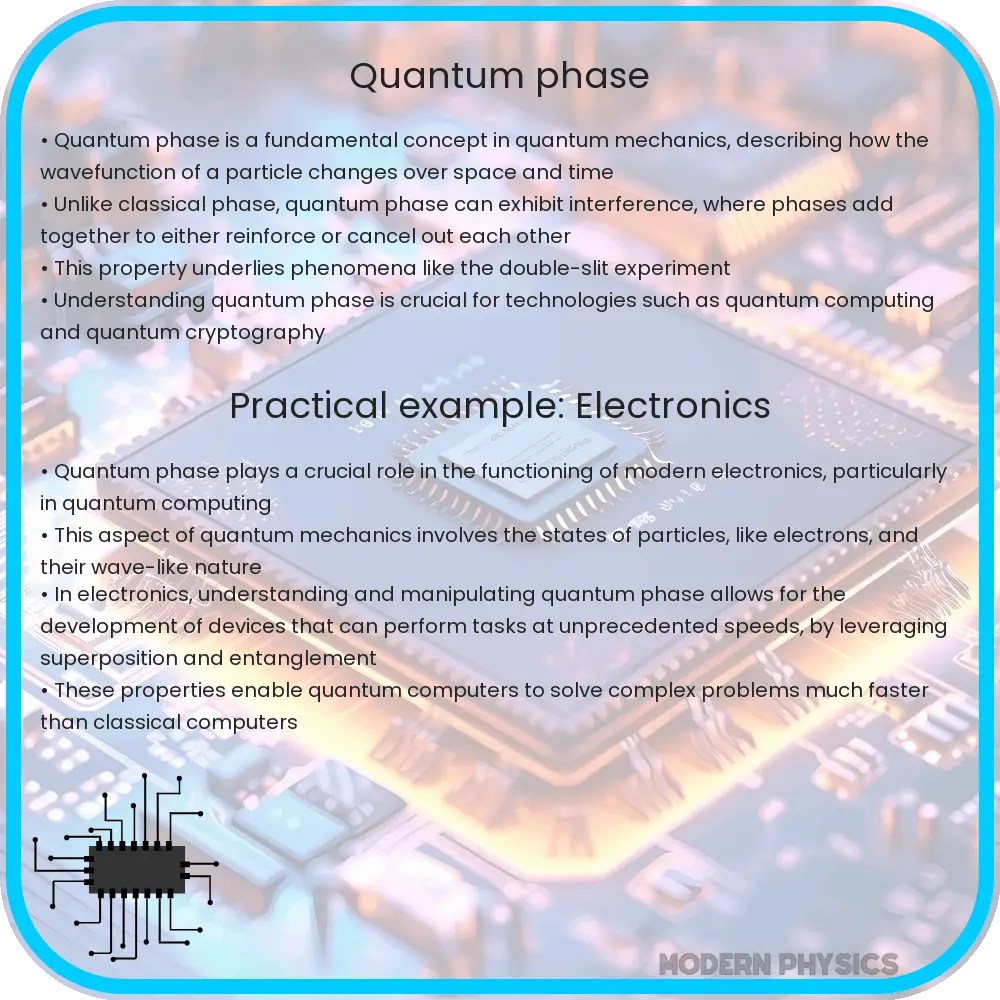
Quantum phase refers to the unique state of a quantum system characterized by its wave function. Unlike classical phases such as solid, liquid, or gas, the quantum phase is not observable in the macroscopic world. It’s a fundamental aspect of quantum mechanics, underpinning the behavior of particles like electrons, photons, and atoms. One of the most significant features of quantum phase is its role in the phenomenon of superposition, where particles exist in multiple states simultaneously until measured.
The exploration of quantum phase has led to groundbreaking discoveries, including the concept of phase transition at the quantum level. This refers to a change in the state of a matter, like the transition from a superconducting to a normal conducting state, governed by quantum mechanical principles. Understanding these transitions is key to unlocking new technologies and materials.
Impact on Scientific Understanding
The study of quantum phase has dramatically altered our comprehension of the universe. It challenges traditional notions of reality, offering a probabilistic view of nature where certainty is replaced by likelihoods. This paradigm shift has profound implications for our understanding of fundamental processes, from the behavior of elementary particles to the vast complexities of the cosmos.
One of the pivotal applications of quantum phase is in quantum computing. Here, the principles of superposition and entanglement – phenomena closely related to quantum phase – are harnessed to perform complex computations far more efficiently than classical computers. Quantum computing promises to revolutionize fields such as cryptography, drug discovery, and complex system modeling.
Another area where quantum phase finds application is in the field of materials science. Researchers are exploring quantum phase transitions to develop new materials with unique properties, such as high-temperature superconductors. These materials have the potential to transform industries by making electrical transmission more efficient and enabling new technologies.
Applications in Emerging Technologies
The implications of quantum phase extend far beyond the theoretical. In the realm of technology, it paves the way for advancements in various sectors. One such area is quantum cryptography, which utilizes the principles of quantum mechanics to secure information. Quantum cryptography is believed to be unbreakable by conventional means, offering a new level of security in data transmission.
Additionally, quantum phase is instrumental in the development of quantum sensors. These sensors exploit quantum properties to measure physical quantities, such as magnetic fields, with unprecedented precision. This has significant applications in fields ranging from navigation to medical imaging, where enhanced sensitivity can lead to more accurate and early detection of diseases.
Challenges and Future Prospects
Despite its potential, the exploration and application of quantum phase face several challenges. The delicate nature of quantum states makes them susceptible to decoherence, where interaction with the environment causes the loss of quantum properties. This poses a significant hurdle in the practical implementation of quantum technologies. Moreover, the complexity of quantum mechanics itself remains a barrier to a broader understanding and acceptance of these concepts.
Looking to the future, the continued study and experimentation with quantum phase are expected to yield further breakthroughs. As our ability to manipulate and control quantum systems improves, we can anticipate new applications in computing, communications, and beyond. The fusion of quantum phase research with other scientific disciplines could potentially lead to unforeseen discoveries and innovations.
Conclusion
The exploration of quantum phase marks a pivotal chapter in our quest to understand the universe. Its profound impact on scientific thought and potential in revolutionizing technology cannot be overstated. While challenges remain, the relentless pursuit of knowledge in this field promises to unlock new frontiers in science and technology. As we stand on the cusp of these exciting developments, the study of quantum phase continues to be a beacon of possibility, guiding us toward a future replete with untapped potential and transformative discoveries.