
Explore Quantum Path Integrals: Discover the core concepts, applications, and insights into quantum mechanics and its impact across sciences.
Quantum Path Integral: Unraveling the Mysteries of Quantum Mechanics
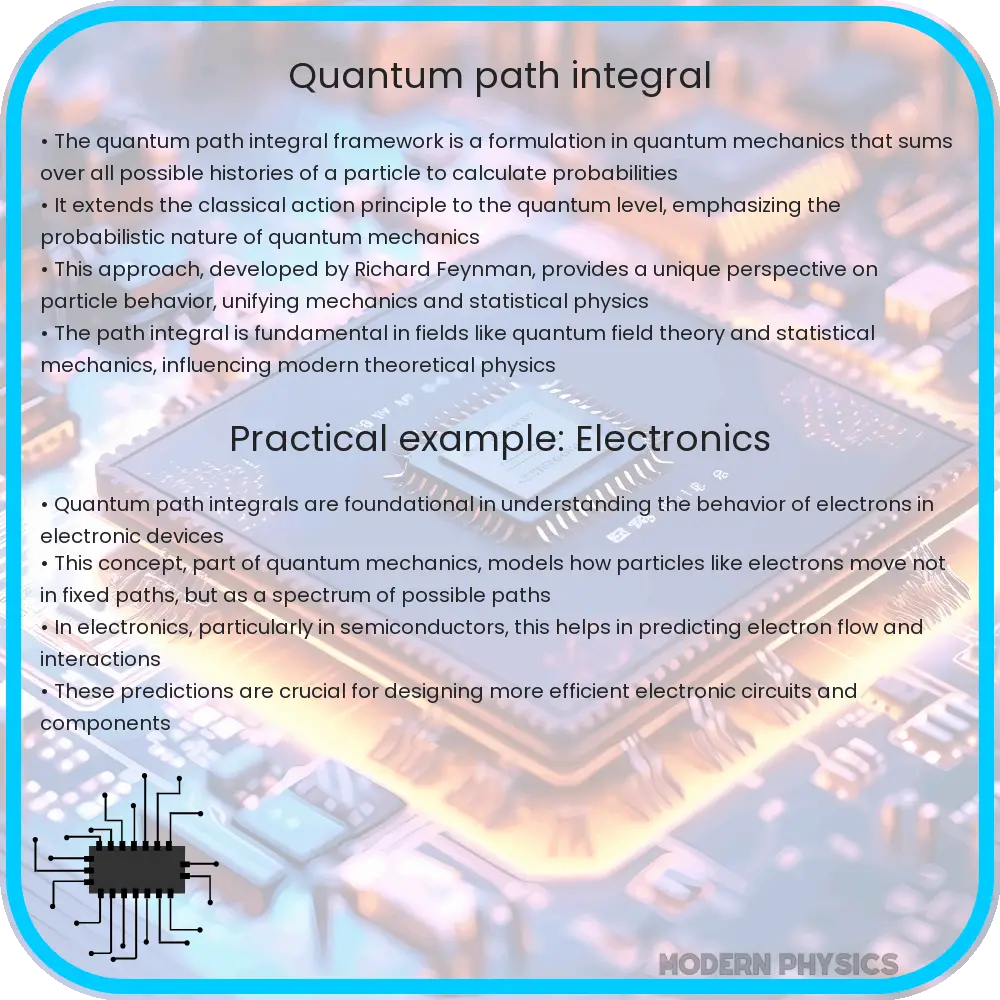
The concept of Quantum Path Integral, formulated by Richard Feynman, revolutionized the understanding of quantum mechanics. This approach provides a comprehensive framework for examining the probabilistic nature of particles at the quantum level. It diverges from the classical Newtonian mechanics, where a single, definite path is determined for a particle. In quantum mechanics, however, particles do not have a single trajectory; instead, they follow all possible paths simultaneously.
Core Concept
At its core, the Quantum Path Integral approach posits that the probability amplitude of a particle’s state is the sum of contributions from all possible paths the particle can take between two points. This is mathematically represented as an integral over all conceivable trajectories. Each path is associated with a phase factor, given by the classical action \( S \) in units of Planck’s constant \( \hbar \), expressed as \( e^{iS/\hbar} \). The constructive and destructive interference of these phase factors leads to the observable behavior of quantum particles.
Applications
- Quantum Field Theory: This integral is pivotal in quantum field theory, where it’s used to calculate the probabilities of various particle interactions.
- Condensed Matter Physics: It’s instrumental in understanding phenomena like superconductivity and quantum phase transitions.
- Quantum Computing: The principles of path integrals aid in designing algorithms for quantum computers.
Insights into Quantum Behavior
The Quantum Path Integral method offers profound insights into the behavior of particles at a subatomic level. It helps in visualizing quantum phenomena like tunneling, where particles traverse barriers that would be insurmountable according to classical physics. This approach also provides a more intuitive understanding of quantum mechanics compared to the abstract mathematical formulations of the Schrödinger equation.
In summary, the Quantum Path Integral framework is a cornerstone in the study of quantum mechanics, offering a unique perspective on how particles behave in the quantum realm. It lays the groundwork for numerous applications across various fields of physics and continues to be a subject of extensive research and exploration.
Deepening Understanding of Quantum Mechanics
The Quantum Path Integral approach not only simplifies computations in complex quantum systems but also deepens our conceptual understanding. For instance, in quantum cosmology, it provides a framework to study the entire universe as a quantum system, offering insights into the early stages of the universe’s formation and the nature of spacetime itself.
Challenges and Future Perspectives
Despite its vast applications, the Quantum Path Integral method is not without challenges. One significant issue is the mathematical complexity involved in dealing with infinite-dimensional path integrals. This has led to the development of various approximation methods and numerical techniques to make practical computations feasible.
Furthermore, extending this method to non-Abelian gauge theories, which are fundamental in understanding strong nuclear forces, remains a complex area of study. Researchers continue to explore innovative ways to apply path integrals in these contexts, pushing the boundaries of quantum physics.
Impact on Other Fields
The influence of Quantum Path Integrals extends beyond physics, impacting areas like chemistry and biology. In computational chemistry, it aids in the simulation of quantum effects in molecular systems. In biology, understanding quantum effects in photosynthesis and enzyme action is an emerging area of research, potentially leading to groundbreaking discoveries.
Conclusion
In conclusion, the Quantum Path Integral method is a fundamental tool in the arsenal of modern physics. It provides an elegant and versatile framework for understanding and predicting the behavior of quantum systems. While it challenges our classical intuitions, it opens up a world of possibilities for exploration and discovery across various scientific domains. As we continue to unravel the mysteries of the quantum world, the Path Integral approach will undoubtedly play a pivotal role in shaping our understanding of the universe and its underlying principles.