
Explore quantum optomechanics: the revolutionary field merging quantum mechanics and optics for advanced sensing, control, and groundbreaking research.
Exploring the Frontiers of Quantum Optomechanics
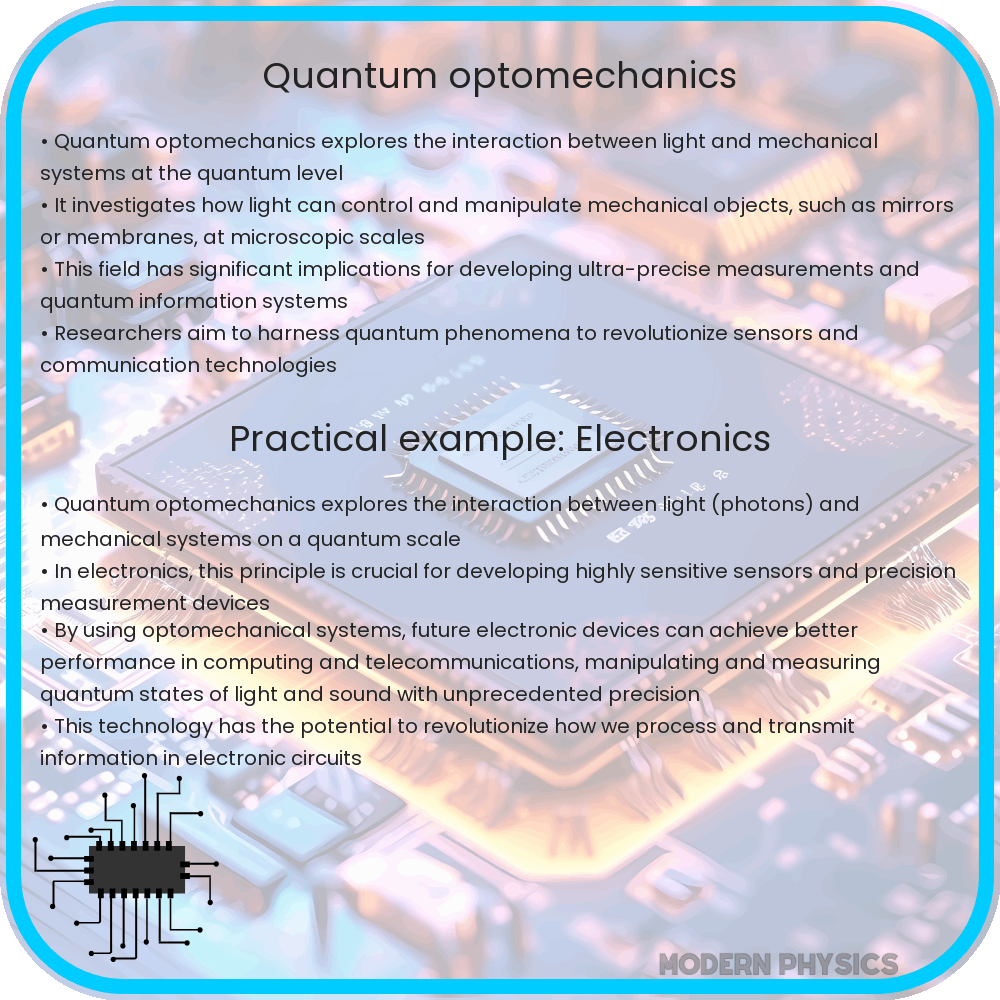
Quantum optomechanics is a fascinating field at the intersection of quantum mechanics and optics, offering groundbreaking approaches to understanding and manipulating light and mechanical systems on the quantum level. This emerging discipline leverages the principles of quantum mechanics to explore and exploit the interaction between light (photons) and mechanical vibrations (phonons), promising revolutionary advancements in sensing, information processing, and fundamental physics research.
Advanced Control in Quantum Optomechanics
One of the core achievements in quantum optomechanics is the development of sophisticated control mechanisms over quantum states. By intricately controlling the interaction between light and matter, researchers can cool mechanical oscillators to near their ground state, achieving a level of precision and stability previously unimaginable. This advanced control opens the door to ultra-precise measurements, quantum computing components, and the study of quantum phenomena on macroscopic scales.
Sensing Applications
Quantum optomechanical systems have also paved the way for revolutionary sensing technologies. These systems can detect displacements with unprecedented sensitivity, making them ideal for applications such as gravitational wave detection, where the accurate measurement of incredibly small distances is crucial. Moreover, the ability to operate at the quantum limit allows for the probing of physical phenomena with minimal disturbance, a critical aspect for experiments in fundamental physics.
Research and Future Directions
Research in quantum optomechanics is vigorously advancing, with scientists exploring various aspects of light-matter interaction at the quantum level. Key areas of interest include the entanglement of mechanical oscillators over large distances, the development of quantum networks using optomechanical systems, and the exploration of quantum effects in biological systems. As this field evolves, it promises to not only deepen our understanding of the quantum world but also lead to technologies that could transform information processing, communication, and sensing.
The exploration of quantum optomechanics represents a thrilling frontier in physics, where the quantum and macroscopic realms meet. As researchers continue to unravel the complexities of this field, the potential for innovation and discovery seems boundless, heralding a new era of technological advancement and fundamental understanding.
Challenges and Innovations in Quantum Optomechanics
Despite its significant potential, quantum optomechanics faces several challenges that researchers are actively addressing. One of the main hurdles is the decoherence of quantum states, where interaction with the environment causes a system to lose its quantum properties. Innovations in isolation techniques and materials science are helping to mitigate these effects, allowing for longer coherence times and more stable quantum states. Additionally, scaling up quantum optomechanical systems for practical applications while maintaining quantum coherence is an ongoing area of research, with promising approaches in integrated photonics and nanofabrication.
Implications for Technology and Fundamental Science
The implications of quantum optomechanics extend far beyond the laboratory. In technology, the principles of quantum optomechanics could lead to the development of highly sensitive sensors for environmental monitoring, novel methods for secure communication through quantum cryptography, and components for quantum computers that leverage the unique properties of light and mechanics. In fundamental science, quantum optomechanics offers a powerful tool for testing the limits of quantum theory, potentially leading to new insights into the nature of reality itself.
Conclusion
Quantum optomechanics stands at the cutting edge of physics, embodying the convergence of quantum mechanics and optics to explore the quantum-mechanical behavior of light and matter. Through advanced control, groundbreaking sensing applications, and continuous research, this field is not only unraveling the mysteries of the quantum world but also laying the groundwork for future technologies. The challenges that remain are substantial, yet they inspire innovative solutions that push the boundaries of what is scientifically and technologically possible. As we delve deeper into the quantum realm, the discoveries and technologies emerging from quantum optomechanics promise to redefine our understanding of the universe and our capability to interact with it on the most fundamental levels.