
Explore the transformative potential of Quantum Optical Coherence in computing, secure communications, and sensing, and the challenges and trends shaping its future.
Exploring Quantum Optical Coherence: Applications and Challenges
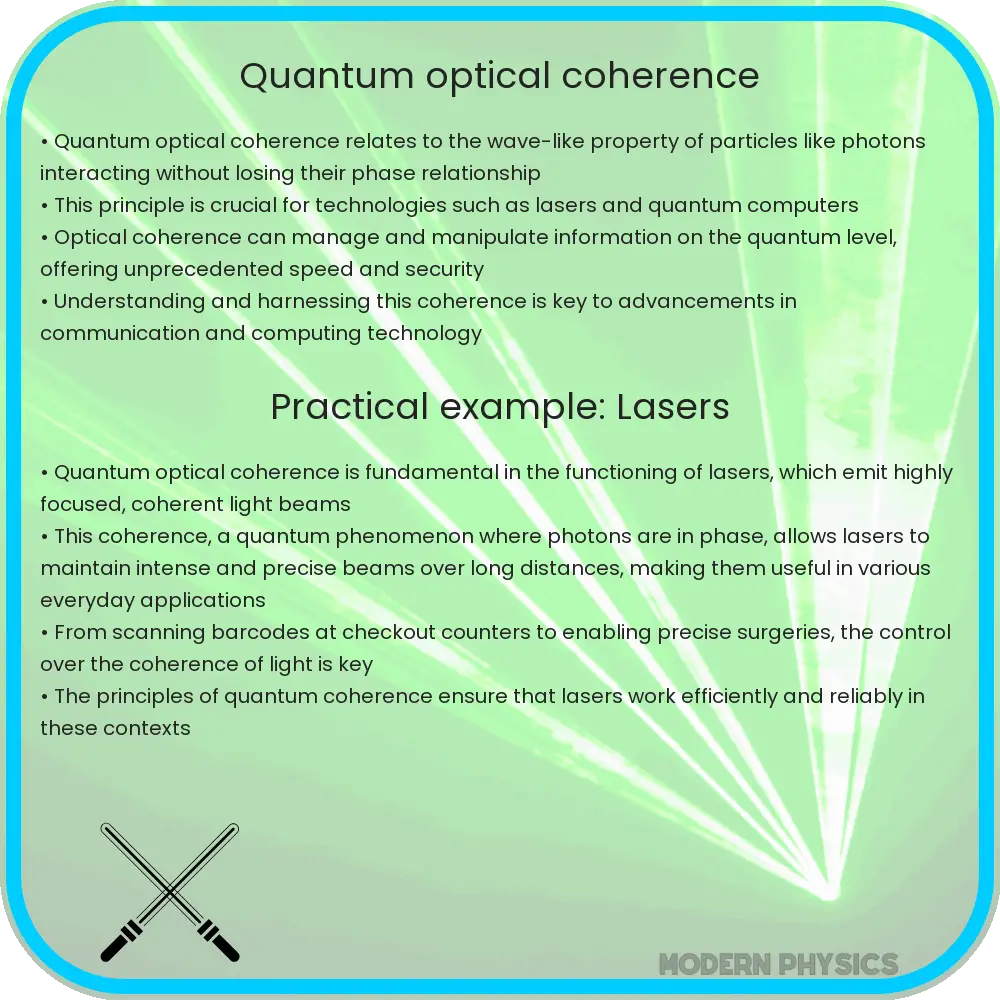
Quantum Optical Coherence represents a groundbreaking frontier in modern physics, offering profound implications for communication technologies, computing, and beyond. This phenomenon, rooted in the principles of quantum mechanics, pertains to the phase relationships between electromagnetic waves at the quantum level. It enables unprecedented control and manipulation of light, paving the way for advancements in various fields.
Applications of Quantum Optical Coherence
The applications of Quantum Optical Coherence are vast and transformative. One of the most prominent areas is in the realm of quantum computing. Quantum optical coherence allows for the development of quantum bits, or qubits, which can exist in multiple states simultaneously, thanks to superposition. This capability promises to exponentially increase computing power, making tasks that are currently infeasible for classical computers manageable within seconds.
- Secure Communications: Quantum cryptography utilizes the principles of quantum optical coherence to create secure communication channels. By employing quantum keys for encryption, it guarantees security through the laws of physics, making any attempt at eavesdropping detectable.
- High-Resolution Imaging: Techniques like quantum microscopy and telescopic imaging benefit from quantum coherence by surpassing classical diffraction limits, enabling the observation of phenomena at unprecedented scales.
- Quantum Sensing and Metrology: Enhanced sensitivity in measuring physical quantities, such as time, temperature, and magnetic fields, is another application. Quantum coherence improves precision beyond classical constraints, vital for navigation, geological exploration, and fundamental physics research.
Challenges in Harnessing Quantum Optical Coherence
Despite its potential, the path to fully harnessing quantum optical coherence is fraught with challenges. Maintaining coherence over time and distance is particularly daunting due to decoherence. Environmental interactions, such as thermal fluctuations, cause quantum systems to lose their coherent properties, a significant hurdle for practical applications like quantum computing and secure communication networks.
Moreover, the technological sophistication required to manipulate quantum states poses a barrier. The development and miniaturization of devices capable of controlling and measuring quantum phenomena demand advancements in materials science, nanotechnology, and engineering.
Trends Shaping the Future of Quantum Optical Coherence
The landscape of quantum optical coherence is rapidly evolving, driven by both scientific breakthroughs and technological innovations. Research in quantum materials, such as topological insulators and graphene, is opening new avenues for creating more stable and efficient quantum systems. Additionally, advancements in laser technology and photonics are enhancing the ability to generate and manipulate coherent quantum states with greater precision.
Another significant trend is the integration of quantum optical systems with classical networks, paving the way for quantum internet. This development promises to revolutionize data transmission, offering ultra-secure communication channels and distributed quantum computing capabilities. Furthermore, the global push towards quantum technologies has led to increased investments in research and development, fostering collaboration across academia, industry, and government sectors.
Conclusion
Quantum optical coherence stands at the cusp of revolutionizing numerous fields, from computing and communication to imaging and sensing. Its applications promise to unlock new capabilities, from ultra-secure quantum cryptography to supercharged quantum computing, while challenging our traditional understanding of physics and information. However, the path forward is not without obstacles. The technical and scientific challenges of maintaining coherence, along with the need for sophisticated technologies for manipulation and measurement, require concerted efforts in research and development.
Despite these hurdles, the trends in quantum optical coherence indicate a bright and dynamic future. With ongoing advancements in materials science, photonics, and quantum technologies, coupled with growing global investment, the potential of quantum optical coherence is increasingly within our grasp. As we continue to unlock the secrets of quantum mechanics, the horizon of what’s possible expands, promising a future where the quantum and classical worlds seamlessly intertwine for the betterment of humanity.