
Explore the revolutionary potential of Quantum Networks, offering unmatched data security and high-speed communication in various sectors.
Understanding Quantum Networks: The Next Evolution in Data Communication
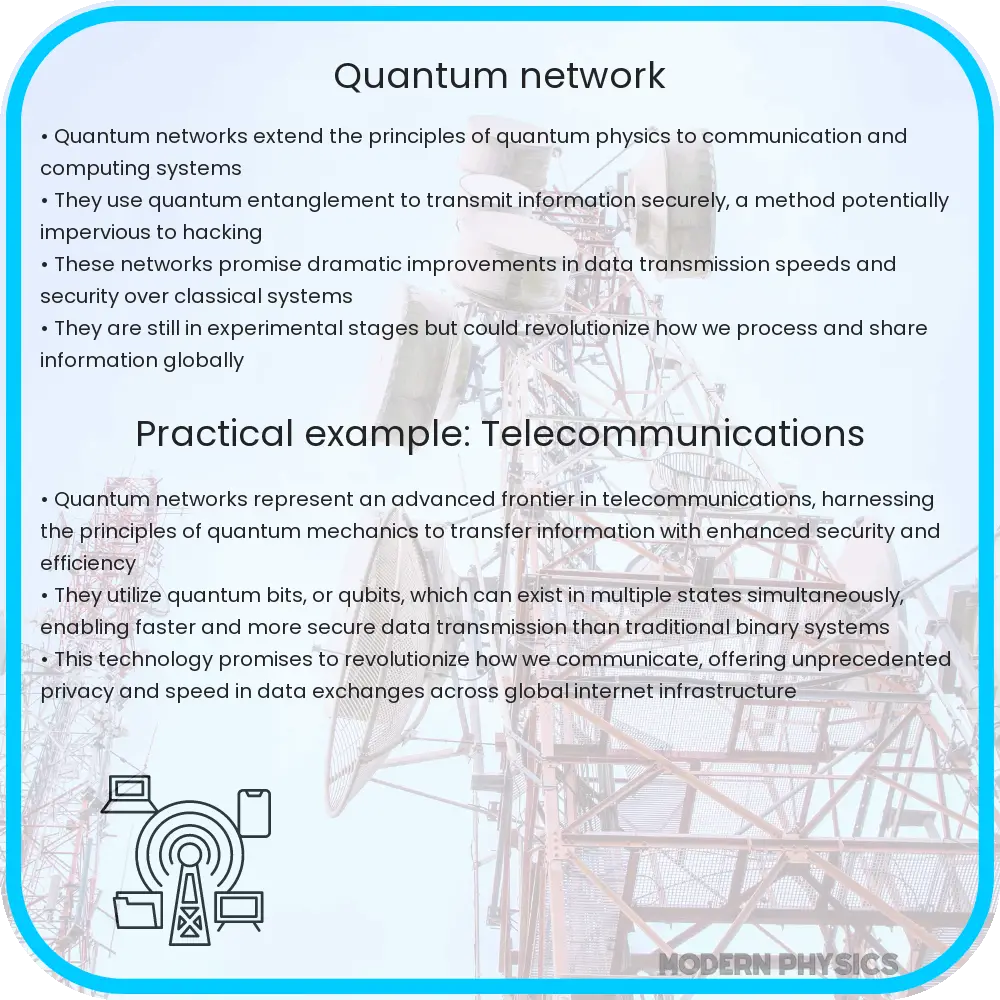
The realm of data communication and network security is on the brink of a revolutionary transformation with the advent of Quantum Networks. Quantum networking, integrating principles of quantum mechanics, promises an unprecedented level of security coupled with high-speed data transmission. This leap in technology could redefine how we approach data exchange, cybersecurity, and network architecture.
Key Features of Quantum Networks
- Enhanced Security: Quantum networks utilize the principle of quantum entanglement. This phenomenon ensures that any attempt to eavesdrop on a quantum communication channel instantly alters the state of the data, making unauthorized interception easily detectable.
- High-Speed Data Transfer: Leveraging quantum superposition allows for the transmission of more data simultaneously compared to classical networks. This feature significantly boosts the speed and efficiency of data transfer across the network.
- Revolutionary Technology Integration: Quantum networks are poised to integrate seamlessly with existing technologies, offering improvements in various sectors like healthcare, finance, and national security.
Quantum Entanglement and Data Security
At the heart of quantum networks lies quantum entanglement, a property where pairs or groups of particles are generated or interact in ways such that the quantum state of each particle cannot be described independently of the others. In practical terms, when applied to data transmission, this means that any change in the state of the data at one end of the communication channel is instantaneously reflected at the other, enabling unparalleled security.
Breaking Down the Quantum Network Architecture
The architecture of quantum networks is fundamentally different from traditional networks. It involves quantum bits, or qubits, which can exist in multiple states simultaneously, unlike classical bits. This property allows quantum networks to encode and process a vast amount of information with fewer resources. Quantum repeaters and quantum routers form the backbone of these networks, facilitating long-distance and high-speed data transmission.
Moreover, quantum networks employ advanced cryptographic protocols like Quantum Key Distribution (QKD). QKD uses quantum mechanics to securely distribute encryption keys, rendering intercepted data meaningless without the corresponding key.
Quantum networks are not just theoretical constructs; significant progress has been made in their development. Leading research institutions and tech companies are actively exploring quantum networking technologies, paving the way for a new era in secure and efficient data communication.
The Practical Applications of Quantum Networks
Quantum networks hold immense potential across various sectors. In healthcare, they can facilitate secure transmission of sensitive patient data, enhancing privacy and enabling remote diagnostics. Financial institutions could leverage quantum networks for secure transactions and fraud prevention. Additionally, these networks are crucial for national security, offering a secure communication channel immune to conventional hacking methods.
Challenges in Implementing Quantum Networks
Despite their promise, quantum networks face several implementation challenges. The technology requires highly sophisticated and sensitive equipment, which is currently expensive and complex to maintain. Furthermore, quantum states are notoriously delicate, easily disturbed by environmental factors, making stable long-distance quantum communication a significant hurdle. Addressing these challenges is crucial for the widespread adoption of quantum networks.
The Future of Quantum Networks
The future of quantum networks is bright but requires continued research and development. Efforts are focused on making quantum networking equipment more robust and affordable. As the technology matures, we can anticipate a gradual integration of quantum networks into existing infrastructures, revolutionizing the way we handle data and security.
Conclusion
Quantum networks represent a groundbreaking advancement in the field of data communication and security. With their unparalleled security features, high-speed data transmission capabilities, and potential for wide-ranging applications, they mark a significant step forward in our technological capabilities. However, the path to their widespread implementation is paved with challenges that need to be overcome. As research and development in this area continue to progress, we are poised on the cusp of a new era in secure and efficient communication, powered by the principles of quantum mechanics. The successful deployment of quantum networks will not only revolutionize data security but will also unlock new potentials in various sectors, fostering innovation and growth in the digital age.