
Explore the advancements and challenges in quantum memory, including its speed, stability, and integration, paving the way for future computing technologies.
Quantum Memory: Pioneering Speed, Stability, and Integration
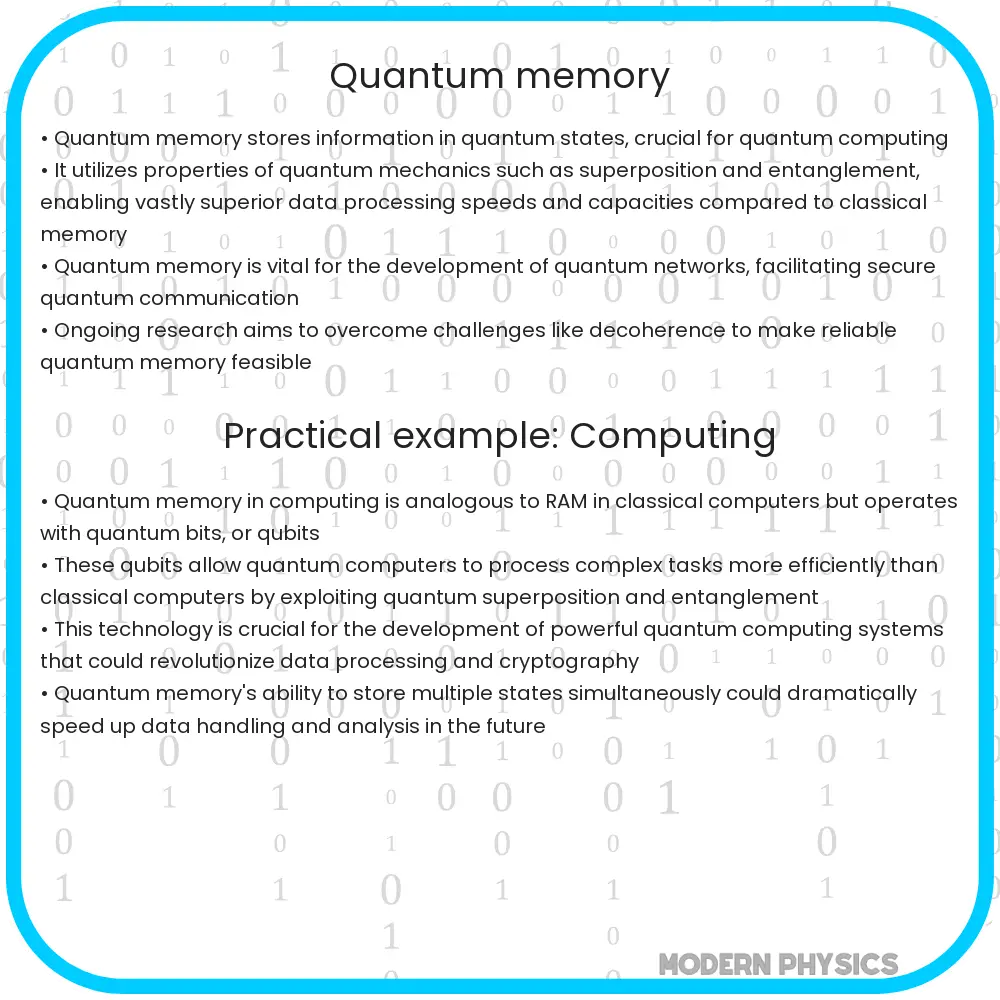
Quantum memory stands at the forefront of quantum computing, a technology promising to revolutionize computing speed, data storage, and security. By leveraging the principles of quantum mechanics, quantum memory offers unprecedented advantages over classical memory systems. This article explores the critical aspects of quantum memory, including its speed, stability, and integration into existing technologies.
Speed: Quantum Leap in Data Processing
Quantum memory’s speed advantage stems from its use of quantum bits, or qubits. Unlike classical bits, which store information as either 0 or 1, qubits can exist in multiple states simultaneously due to superposition. This ability allows quantum systems to process vast amounts of data at speeds unattainable by classical computers. Entanglement, another quantum phenomenon, enables qubits that are spatially separated to be interconnected, further enhancing processing speeds and efficiency in quantum networks.
Stability: Overcoming Quantum Fragility
The stability of quantum memory is paramount for practical applications. Quantum information is notoriously fragile, easily disturbed by environmental factors such as temperature, electromagnetic fields, and even observation, leading to decoherence. Researchers are developing innovative techniques to increase the coherence time of quantum memory, such as using error correction codes and designing systems that operate at cryogenic temperatures or employ topological qubits, which are more resilient to environmental disturbances.
Integration: Bridging Quantum and Classical Systems
Integrating quantum memory with classical computing infrastructure is essential for the widespread adoption of quantum technologies. This integration faces significant challenges, including the need for quantum-classical interfaces that can convert quantum information into a form that classical systems can process and vice versa. Recent advancements include the development of hybrid systems that combine quantum and classical elements, enabling the gradual incorporation of quantum memory into existing technology landscapes.
As we delve deeper into the capabilities and potential applications of quantum memory, it’s clear that addressing these key aspects – speed, stability, and integration – is crucial for unlocking the full potential of quantum computing. The ongoing research and development efforts in these areas are paving the way for a future where quantum and classical computing coexist, offering unprecedented computational power and capabilities.
Challenges and Future Directions
The journey towards fully operational quantum memory is fraught with challenges. One of the most significant hurdles is the physical size and complexity of quantum memory devices. Current quantum systems require extensive infrastructure, such as cryogenic cooling, to maintain operational conditions, which limits their practicality for everyday use. Moreover, the quantum state’s inherent sensitivity necessitates advanced error correction methods to ensure reliable information storage and retrieval, adding layers of complexity to quantum memory systems.
Another critical area is the scalability of quantum memory. For quantum computing to reach its full potential, quantum memory must be able to store large amounts of information efficiently. This scalability is essential not only for complex computations but also for the long-term viability of quantum networks that could span the globe, enabling secure quantum communication protocols like quantum key distribution (QKD).
Despite these challenges, the progress in quantum memory technology is relentless. Innovations in materials science, such as the use of diamond defects or exotic states of matter like Bose-Einstein condensates, offer new pathways to create more stable and scalable quantum memory systems. Furthermore, quantum repeaters, which extend the range of quantum communication by storing and re-transmitting quantum information, are under development, promising to overcome current distance limitations in quantum networks.
Conclusion
The evolution of quantum memory is a cornerstone in the advancement of quantum computing and quantum communication technologies. Its ability to process and store information at unprecedented speeds, with a level of security unattainable by classical systems, positions quantum memory as a critical component of the future computational landscape. The challenges of stability, integration, and scalability, while significant, are not insurmountable. Ongoing research and development are gradually overcoming these obstacles, paving the way for a new era of computing. As we continue to unlock the mysteries of quantum mechanics and apply these principles to data storage and processing, the potential for transformative changes in computing, communication, and beyond is within our reach. Quantum memory, with its unique properties and capabilities, is set to play a pivotal role in this technological revolution, heralding a future where the quantum and classical worlds merge to unlock unimaginable possibilities.