
Explore how quantum mechanics simulations use advanced algorithms and quantum computers to model complex quantum systems.
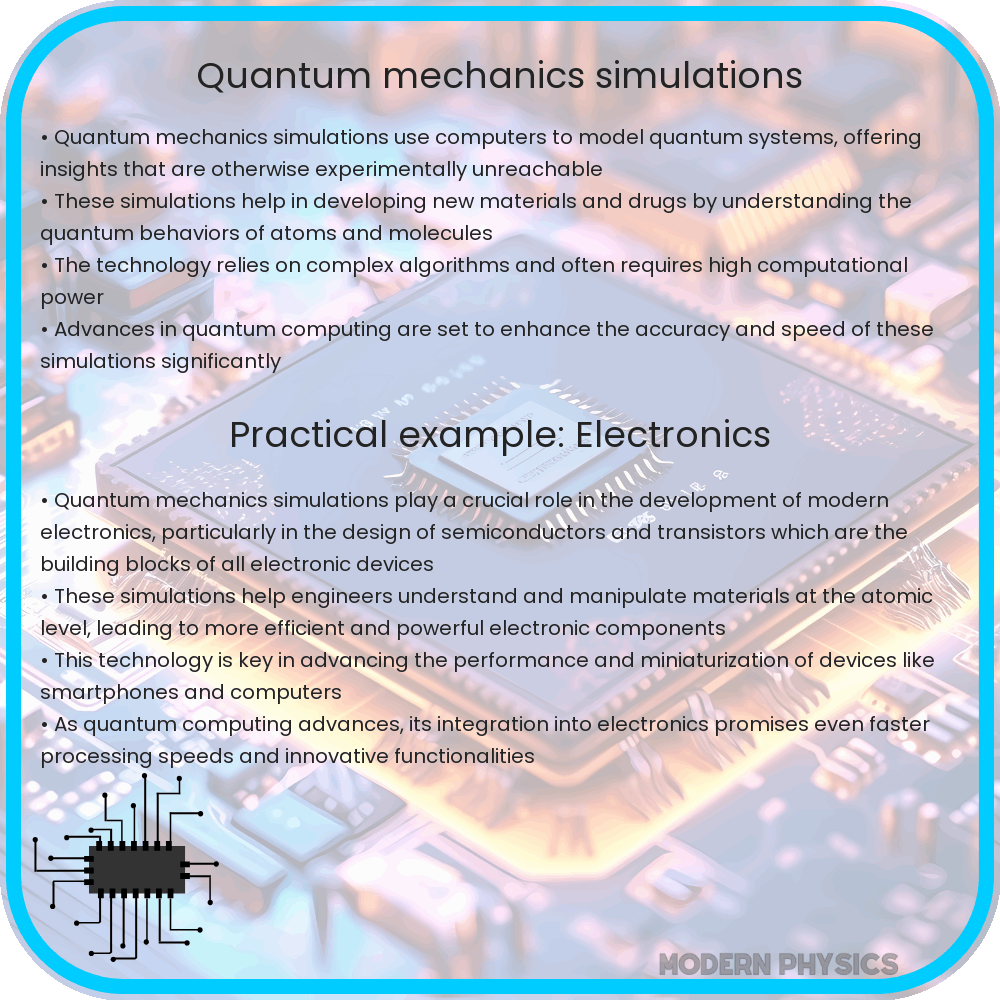
Understanding Quantum Mechanics Simulations
Quantum mechanics, a fundamental theory in physics, describes the physical properties at the smallest scales of energy levels of atoms and subatomic particles. Traditional computers can simulate classical physics equations but struggle with quantum mechanics. This challenge arises from the complex, probabilistic nature of quantum particles, which often exist in many states simultaneously (superposition) and can be entangled with each other across distances.
To address these complexities, scientists use quantum mechanics simulations, which employ advanced algorithms and, increasingly, quantum computers to model quantum systems. These simulations help in understanding more about material properties, chemical reactions, and particle interactions at a quantum level, which are essential for developing new technologies and materials.
Accuracy in Quantum Mechanics Simulations
The accuracy of quantum mechanics simulations is crucial for scientists and engineers to predict and verify the physical properties of materials and particles accurately. Quantum simulations leverage the principles of superposition and entanglement to replicate the behavior of quantum systems highly accurately. This enables researchers to explore potential outcomes and scenarios in a controlled and precise manner.
However, achieving high accuracy in simulations depends significantly on the available computational resources and the specific algorithms used. For example, the variational quantum eigensolver (VQE) is a popular algorithm in quantum computing that uses a hybrid approach of classical and quantum computing resources to find the minimum energy state of a molecule, which is vital for understanding its properties and behavior.
Speed of Quantum Mechanics Simulations
The speed of quantum mechanics simulations is another critical factor, especially given the complex nature of the calculations involved. Quantum computers offer the potential to perform these simulations much faster than classical computers by executing multiple calculations simultaneously.
For instance, the simulation of chemical dynamics within molecules, which involves time-dependent Schrödinger equations, requires massive computational efforts on a classical computer. Quantum computers, on the other hand, can potentially reduce the computation time exponentially thanks to their ability to manipulate multiple quantum states at once.
Modeling Challenges
Despite the advancements, modeling in quantum mechanics simulations faces several challenges. The foremost is the issue of ‘quantum noise’ and error rates in quantum computers, which can lead to inaccuracies in simulations. Engineers and scientists are continually working on error correction techniques and more robust quantum algorithms to mitigate these issues.
Another significant challenge is the scalability of quantum systems. As the size of the quantum system increases, the required resources and complexity of maintaining coherent quantum states increase exponentially. This scalability issue limits the current practical applications of quantum simulations but also drives innovation in quantum technology.
In conclusion, quantum mechanics simulations represent a monumental advancement in science’s capability to understand and manipulate the fundamental aspects of nature. While there are inherent challenges, the ongoing developments in quantum computing promise to expand the boundaries of what is achievable in scientific simulations.
Future Prospects and Applications
The future of quantum mechanics simulations holds promising prospects, particularly in fields like drug discovery, material science, and energy optimization. As quantum technology evolves, the ability to simulate complex quantum interactions accurately and quickly can revolutionize how we design medications, develop new materials, or even tackle climate change by finding more efficient energy sources.
Additionally, quantum simulations are poised to enhance our understanding of fundamental physics, potentially leading to the discovery of new particles or the validation of theoretical models that have eluded confirmation through traditional experimental methods. These simulations could act as a bridge between theoretical physics and practical, observable experiments.
Educational and Collaborative Impact
Quantum mechanics simulations also play a crucial role in education and collaborative research. They provide a practical approach to visualize and understand complex quantum phenomena, which can be instrumental in training the next generation of physicists and engineers. Furthermore, by sharing quantum simulation tools and resources, institutions can foster a collaborative environment that speeds up research and innovation.
Advances in Internet-based technologies and cloud computing are already making quantum simulators more accessible to researchers and students all over the world, democratizing access to these advanced tools and allowing a more widespread exploration of quantum mechanics.
Conclusion
In summary, quantum mechanics simulations are transforming our approach to science and technology. By replicating the behavior of the smallest elements of the universe, these tools open new avenues for advancement across multiple disciplines. Although challenges such as quantum noise, error rates, and scalability need to be addressed, the potential benefits of these simulations make them an essential field of study. Future developments in quantum computing and algorithm design are expected to progressively unlock the full potential of quantum simulations, leading to breakthroughs that we can only begin to imagine.