
Explore the intriguing world of Quantum Knots, where quantum mechanics meets topology, and their potential impact on computing and material science.
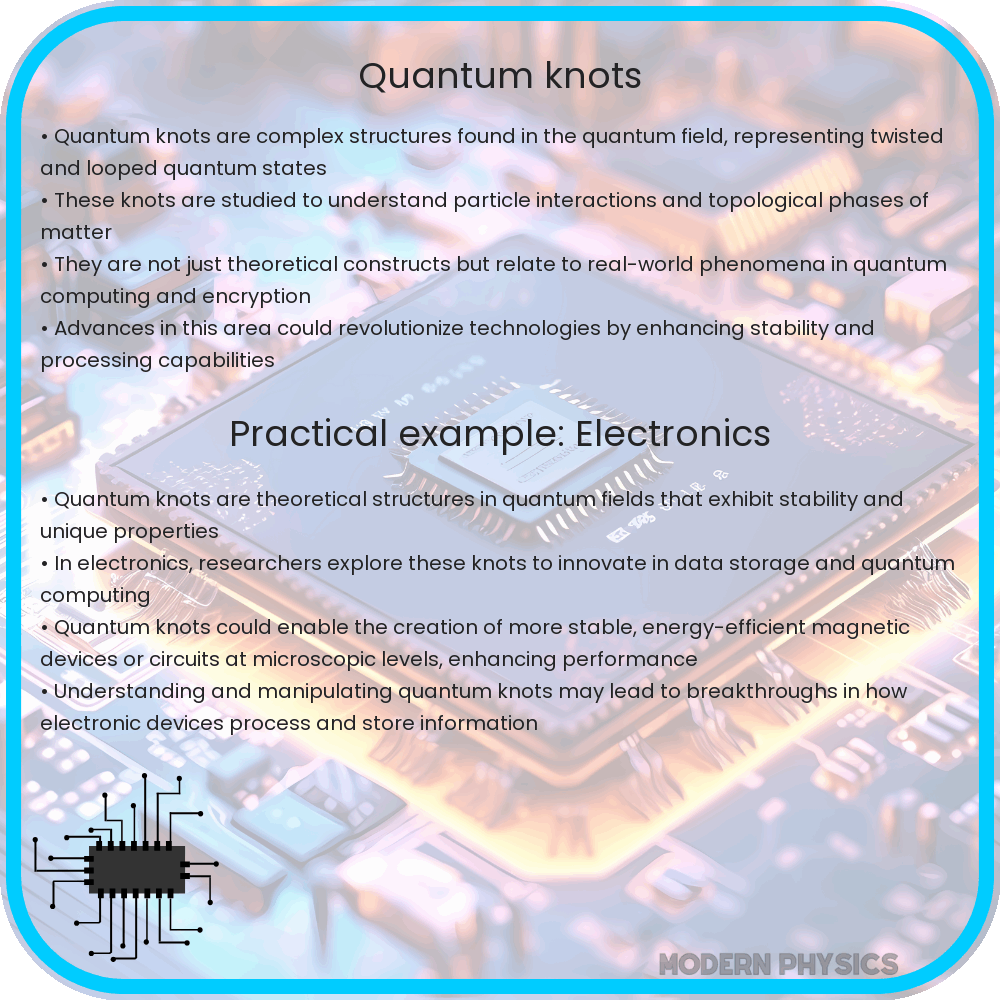
Quantum Knots: Unraveling the Ties of Quantum Mechanics and Topology
In the fascinating world of quantum physics, where the minuscule constituents of matter defy the conventional laws of classical mechanics, a new concept emerges: Quantum Knots. This extraordinary notion represents a confluence of quantum mechanics and topology, a branch of mathematics concerned with the properties of space that are preserved under continuous deformations. Quantum knots are not just theoretical curiosities; they hold potential for groundbreaking applications in various fields, including quantum computing, material science, and understanding the fundamental structure of the universe.
Theoretical Framework and Formation
Quantum knots are essentially knotted structures existing within the quantum field, a space filled with continuously fluctuating energy levels. They are formed when the field lines, akin to the magnetic lines of force, become tangled in a knot-like configuration. This phenomenon can be better understood through the lens of topological quantum field theory, which explores the interactions between quantum particles and the topological aspects of space. The mathematical study of knots, known as knot theory, provides a framework for understanding these complex structures.
Applications in Quantum Computing
One of the most promising applications of quantum knots is in the realm of quantum computing. In this context, quantum knots could be utilized to create more stable and efficient quantum bits, or qubits. Qubits are the fundamental units of information in quantum computing, and their ability to exist in multiple states simultaneously (quantum superposition) is what gives quantum computers their superior processing power. The stability offered by the knotted states of quantum fields could potentially solve some of the current challenges in building reliable quantum computers.
Mysteries and Potential in Material Science
The enigmatic nature of quantum knots also extends to their potential applications in material science. By understanding how these knots form and behave at quantum scales, scientists might be able to develop new materials with unprecedented properties. For instance, materials exhibiting topological insulators properties, which conduct electricity on the surface but act as insulators in the bulk, could benefit from the insights provided by quantum knot research.
Exploring the Universe’s Fundamental Structure
Lastly, quantum knots may offer a window into the very fabric of the universe. Theoretical physicists speculate that the early universe could have been a hotbed for the formation of quantum knots. Studying these structures could unveil new aspects of quantum gravity, a theoretical framework that seeks to reconcile general relativity with the principles of quantum mechanics. As such, quantum knots might hold keys to understanding the most fundamental questions about the nature of reality.
Challenges in Research and Future Directions
Despite their intriguing potential, the study of quantum knots faces significant challenges. One of the primary obstacles is the sheer complexity of these structures. Quantum knots exist in realms that are not directly observable with current technology, making their study largely theoretical. Advanced computational models and simulations play a critical role in exploring these knotted quantum states, but there’s a long road ahead to fully understand and manipulate them. Furthermore, the integration of quantum knots into practical applications, such as quantum computing or material science, requires breakthroughs in both theoretical understanding and experimental techniques.
Interdisciplinary Collaboration and Innovation
The investigation of quantum knots is not confined to the realm of physics alone; it demands an interdisciplinary approach. Collaboration between mathematicians, quantum physicists, material scientists, and computer scientists is essential for making significant progress in this field. Such cross-disciplinary efforts are likely to spur innovation, leading to new theories and technologies that could transform our understanding of quantum mechanics and its practical applications.
Conclusion: A Journey into the Quantum Unknown
Quantum knots represent a fascinating intersection of quantum physics and topology, offering a glimpse into the deeply interconnected nature of the universe. While their full potential and applications are still largely speculative, the pursuit of understanding these complex structures is a testament to the relentless human quest for knowledge. As researchers continue to untangle the mysteries of quantum knots, we stand on the cusp of potentially revolutionary discoveries that could redefine our technological capabilities and deepen our comprehension of the quantum world. The study of quantum knots, therefore, is not just an academic endeavor; it’s a journey into the very heart of reality, challenging our perceptions and pushing the boundaries of the known universe.