
Explore the secure world of Quantum Key Distribution (QKD), its principles, advantages, challenges, and future in our comprehensive guide.
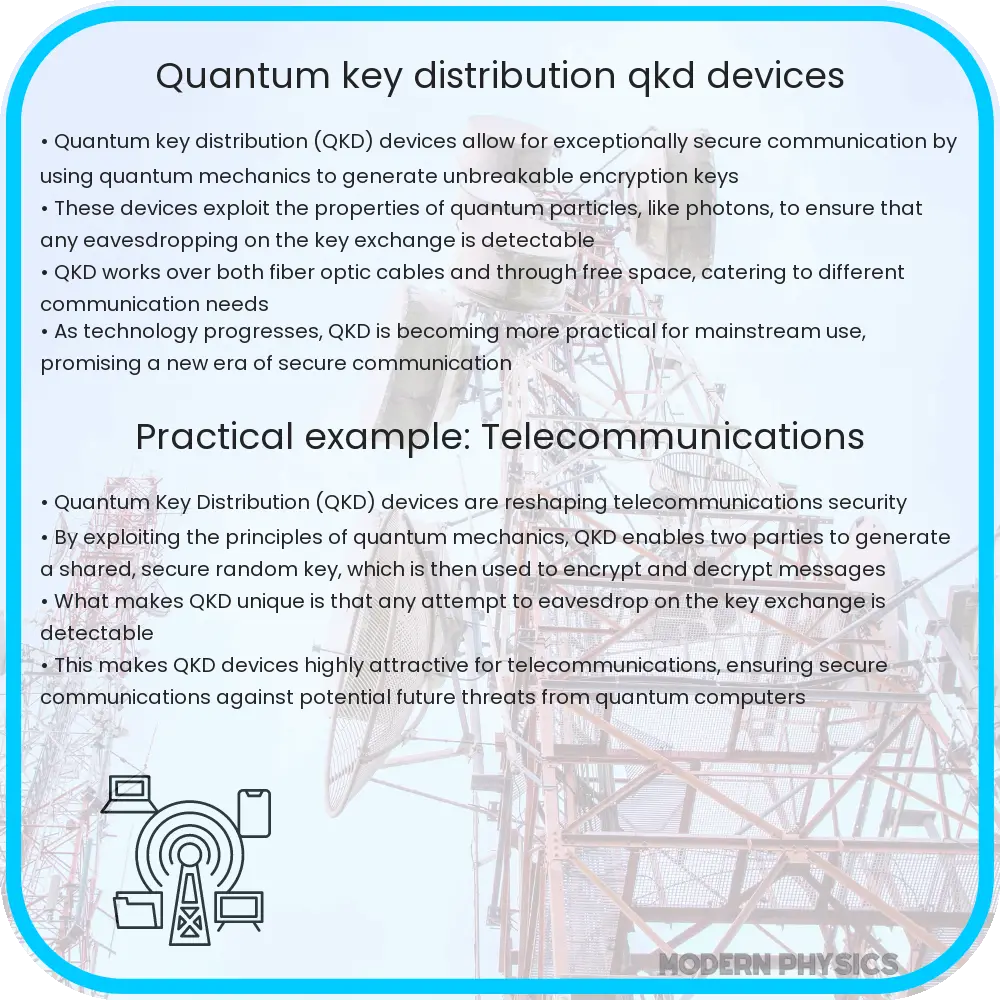
Understanding Quantum Key Distribution
Quantum Key Distribution (QKD) stands at the forefront of modern cryptographic techniques, offering a paradigm shift in secure communication. It leverages the principles of quantum mechanics to facilitate the exchange of encryption keys, ensuring a level of security theoretically immune to the capabilities of even the most advanced classical computers. This article delves into the intricate world of QKD, exploring its principles, advantages, and practical applications.
Principles of Quantum Key Distribution
At the heart of QKD lies the concept of quantum entanglement and Heisenberg’s Uncertainty Principle. Quantum entanglement refers to a phenomenon where pairs or groups of particles interact in such a way that the quantum state of each particle cannot be described independently of the state of the others, even when the particles are separated by a large distance. This entanglement ensures that any attempt to intercept or measure the key alters its state, thereby alerting the parties involved in the communication.
Heisenberg’s Uncertainty Principle further fortifies QKD’s security. According to this principle, certain pairs of physical properties, like position and momentum, cannot both be precisely measured at the same time. In the context of QKD, this implies that an eavesdropper cannot accurately ascertain the quantum state of a particle without disturbing it, thus revealing their presence.
Advantages of Quantum Key Distribution
QKD offers several compelling advantages over traditional cryptographic methods:
- Enhanced Security: By utilizing quantum mechanics, QKD provides a level of security that is fundamentally unachievable by classical cryptographic techniques. Any attempt at interception alters the key, thus making the presence of an intruder immediately known.
- Future-Proof: QKD is considered secure against potential threats posed by quantum computing. While traditional cryptography may become vulnerable to quantum computers, QKD’s security relies on the laws of physics, which are not susceptible to advancements in computational power.
Despite these advantages, the practical implementation of QKD also faces challenges, such as the need for specialized equipment and the limitations in transmission distance. However, ongoing research and technological advancements continue to address these hurdles, making QKD a promising solution for secure communications in an increasingly digital world.
Applications of Quantum Key Distribution
The potential applications of QKD are vast and varied, encompassing areas like:
- Government and Military Communications: Given its high level of security, QKD is ideal for sensitive government and military communications, where confidentiality is paramount.
- Financial Institutions: Banks and financial institutions can benefit from the enhanced security provided by QKD, safeguarding transactions and sensitive data against cyber threats.
In conclusion, Quantum Key Distribution represents a significant leap in the field of secure communications, offering robust protection against both current and future threats. As research progresses, we can expect wider adoption and more innovative applications of this groundbreaking technology.
Challenges and Future Prospects of Quantum Key Distribution
While Quantum Key Distribution (QKD) offers unparalleled security benefits, it is not without its challenges. One of the main obstacles is the technical complexity and cost of implementing QKD systems. The need for specialized quantum equipment, including single-photon detectors and quantum sources, can make the initial setup expensive and technically demanding. Additionally, the effective range of QKD systems is currently limited. Most QKD systems work optimally over a few hundred kilometers, and extending this range requires the use of quantum repeaters, which are still in the developmental stage.
Another challenge is the integration of QKD systems with existing communication infrastructures. Ensuring compatibility with current network architectures and protocols is crucial for the widespread adoption of QKD. Despite these challenges, ongoing research and development are steadily overcoming these hurdles, making QKD more accessible and practical for a variety of applications.
The Evolution of Quantum Key Distribution
As the field of quantum computing continues to evolve, the role of QKD is expected to become increasingly significant. With the looming threat of quantum computers capable of breaking traditional cryptographic schemes, QKD offers a viable solution for maintaining communication security. Research in quantum communication networks is also gaining momentum, with the potential for creating global-scale quantum networks. These networks would enable secure communication across vast distances, a critical requirement for international business and diplomacy.
Furthermore, the integration of QKD with satellite communication is a promising development. Satellites can help overcome the distance limitations of terrestrial QKD systems, enabling secure global communication. Various countries and private entities are actively pursuing this avenue, with several successful demonstrations already showcasing the feasibility of satellite-based QKD.
Conclusion
Quantum Key Distribution represents a revolutionary approach to secure communication, harnessing the peculiarities of quantum mechanics to offer unparalleled security. Despite its current challenges, the rapid pace of technological advancement and growing awareness of quantum threats are driving its evolution and adoption. As we step into an era increasingly dominated by quantum computing, QKD stands as a beacon of security, promising to safeguard our most sensitive data against the most advanced threats. Its potential applications, from government and military communications to financial transactions, highlight its significance in a world where digital security is paramount. The future of QKD, intertwined with the progress of quantum technologies, heralds a new age of secure communication, grounded in the unbreakable laws of physics.