
Explore the cutting-edge realm of Quantum Interference Devices, where quantum physics meets engineering to enhance precision in technology and measurement.
Introduction to Quantum Interference Devices
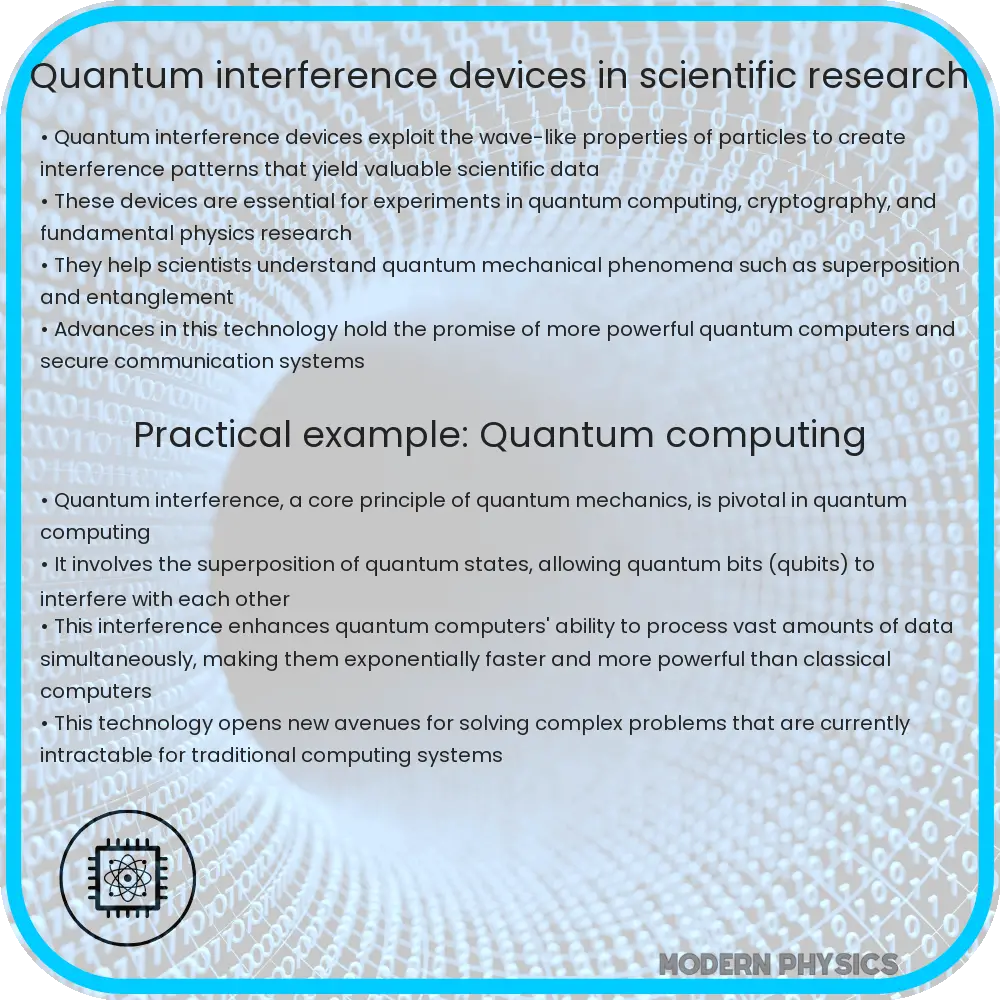
Quantum interference devices represent a cutting-edge fusion of quantum physics and engineering, pushing the boundaries of what’s possible in the realm of precision measurement and technological innovation. These devices leverage the strange and counterintuitive properties of quantum mechanics to provide solutions and functionalities that are impossible with classical physics alone.
Understanding Quantum Interference
At the heart of quantum interference devices is the phenomenon of quantum interference itself. This phenomenon occurs when particles such as electrons or photons exist simultaneously in multiple states or paths, a fundamental aspect of quantum mechanics known as superposition. When these paths reconverge, the waves associated with these particles interact either constructively (strengthening the wave) or destructively (weakening the wave), leading to an interference pattern. The famous double-slit experiment is a prime example of quantum interference, where particles passed through two slits produce an interference pattern on a screen, demonstrating their wave-like behavior.
Applications and Precision of Quantum Interference Devices
Quantum interference devices harness this phenomenon for a variety of advanced applications, particularly in the fields of sensing and imaging. One prominent example is the Quantum Interference Device (QID), which includes technologies such as the Superconducting Quantum Interference Device (SQUID) and the Atomic Interference Device (AID). These devices are renowned for their extreme sensitivity to magnetic fields and gravitational forces, making them invaluable in areas ranging from medical imaging to mineral exploration.
- Superconducting Quantum Interference Devices (SQUIDs): SQUIDs are among the most sensitive magnetometers available, capable of detecting magnetic fields as small as 5 * 10-15 tesla. This remarkable precision allows for the detailed study of the human brain’s magnetic fields in neurology, contributing to advances in diagnosing and understanding neurological disorders.
- Atomic Interference Devices (AIDs): Utilizing atoms cooled to near absolute zero, AIDs exploit the wave nature of atoms to measure acceleration, rotation, and gravitational effects with unprecedented accuracy. These devices are pivotal in enhancing the precision of inertial navigation systems used in both civilian and military aerospace applications.
The Complexity Behind Quantum Interference Devices
The design and operation of quantum interference devices involve intricate challenges, primarily due to the delicate nature of quantum states. These devices must be engineered to maintain the coherence of quantum states, preventing decoherence, which is the loss of quantum mechanical properties due to interaction with the environment. Achieving this often requires operating at extremely low temperatures, utilizing sophisticated materials and maintaining isolation from external disturbances.
Furthermore, the complexity extends to the theoretical understanding and practical implementation of quantum mechanics principles. Engineers and scientists must intricately calculate the expected interference patterns and precisely align and calibrate components to ensure accurate measurements and functionalities. This level of complexity not only demonstrates the advanced state of modern engineering and physics but also highlights the ongoing need for innovation in these fields.
Driving Innovation with Quantum Interference
Quantum interference devices represent a significant leap forward not just in terms of technological prowess but also in opening new pathways for research and development. The principles learned and the technologies developed from quantum interference have implications far beyond their immediate applications. For instance, the precise control and understanding of quantum states essential for these devices are also foundational elements in the burgeoning field of quantum computing.
Innovation in quantum interference devices continues to grow as researchers explore more applications and strive to overcome existing limitations. This includes developing room-temperature quantum devices and enhancing the robustness of these systems against environmental perturbations.
Future Prospects and Challenges
As quantum technology progresses, the potential applications of quantum interference devices continue to expand. These range from ultra-secure quantum communication networks to highly precise timekeeping systems, which could redefine global synchronization standards. However, significant challenges remain, particularly in the areas of scalability and practical deployment. The delicate nature of quantum systems means that scaling up from lab prototypes to industrial-scale applications is non-trivial, requiring breakthroughs in quantum error correction and system stability.
- Enhanced Error Correction: To mitigate the effects of decoherence and other quantum errors, ongoing research is focused on developing more robust error-correcting codes that are essential for the practical use of quantum technologies.
- Materials Innovation: Another critical area is the development of new materials that can operate effectively at higher temperatures while still supporting coherent quantum states, paving the way for more accessible quantum devices.
Conclusion
Quantum interference devices, from SQUIDs to AIDs, exemplify the thrilling intersection of quantum physics and engineering. By harnessing the peculiarities of quantum mechanics, these devices offer capabilities that go far beyond the confines of classical technologies. The impact of these devices extends across various sectors, providing tools that enhance our capabilities in medicine, navigation, and fundamental research.
Despite the challenges, the future of quantum interference devices is bright with promises of revolutionary advancements. As researchers continue to tackle the practical difficulties of quantum system deployment and seek ways to enhance device stability and functionality, we can anticipate new horizons in both technology and fundamental science. Ultimately, the ongoing development of quantum interference technology not only deepens our understanding of the quantum world but also sets the stage for the next generation of technological innovations.