
Explore the quest for quantum gravity, uniting general relativity and quantum mechanics, and delve into the future of physics and the universe.
Exploring the Quest for Quantum Gravity
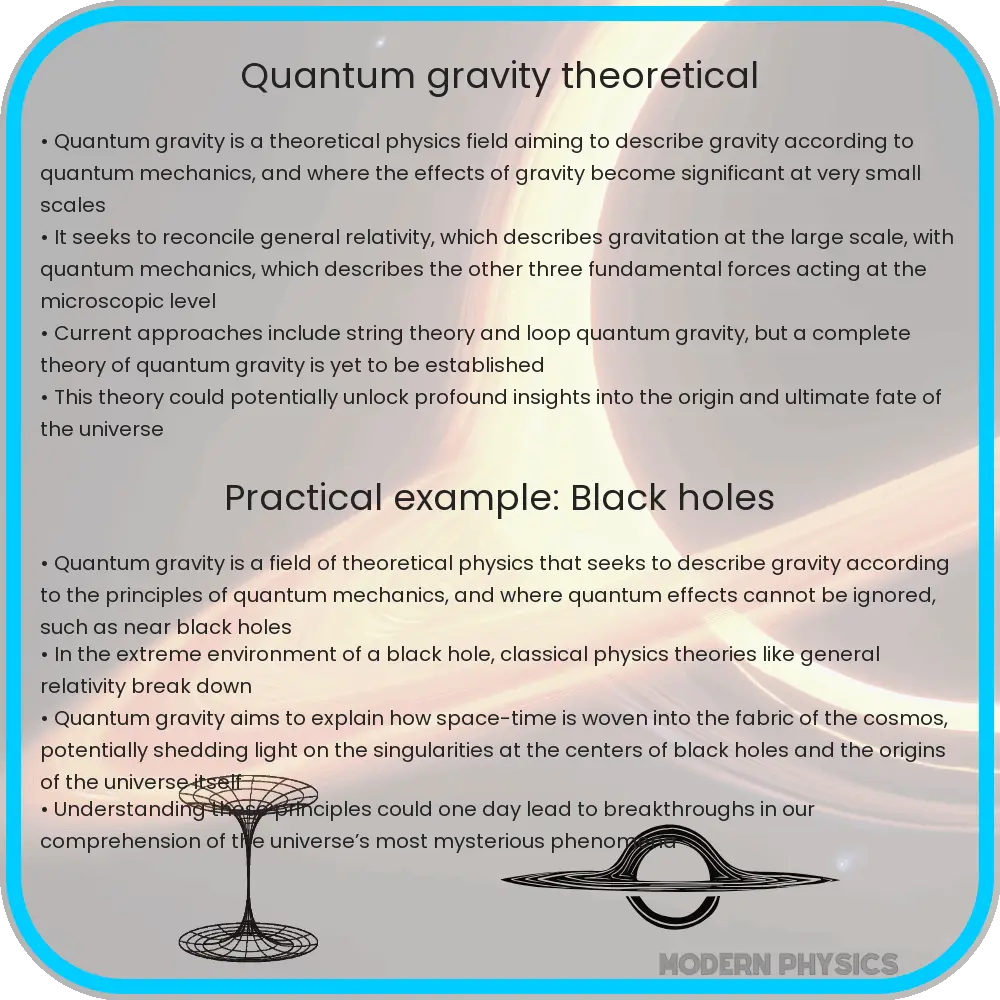
The pursuit of a unified theory of quantum gravity represents one of the most profound endeavors in modern physics. This theoretical framework aims to harmonize the principles of general relativity, which governs the vast cosmos, with quantum mechanics, the rulebook for the subatomic world. The quest for quantum gravity is not merely academic; it seeks to answer fundamental questions about the nature of space, time, and the very fabric of the universe.
General Relativity and Quantum Mechanics: The Pillars of Modern Physics
General relativity, proposed by Albert Einstein in 1915, revolutionized our understanding of gravity. It posited that massive objects cause a distortion in space-time, which is perceived as gravitational attraction. This theory has been validated through numerous experiments and observations, including the bending of light by gravity and the detection of gravitational waves. However, general relativity operates on a macroscopic scale and does not account for the peculiarities of the quantum realm.
On the other hand, quantum mechanics, with its roots in the early 20th century, describes the behavior of particles at the smallest scales. It introduces concepts like wave-particle duality, uncertainty principles, and quantum entanglement. Despite its counterintuitive nature, quantum mechanics has been exceptionally successful in explaining phenomena at atomic and subatomic levels, leading to technologies like semiconductors and MRI machines.
The Challenge of Unification
The difficulty in merging these two theories arises from their fundamentally different assumptions about the universe. General relativity treats space-time as a smooth, continuous fabric, while quantum mechanics operates in a discrete, probabilistic world. This dichotomy leads to mathematical inconsistencies when trying to apply quantum principles to gravitational fields, especially at extremely high energies and tiny scales, like those present at the center of black holes or the moment of the Big Bang.
Several theoretical approaches have emerged in the quest for quantum gravity. String theory, one of the leading candidates, proposes that the fundamental constituents of the universe are not point-like particles, but rather one-dimensional ‘strings’. These strings vibrate at different frequencies, giving rise to the particles and forces we observe. Another approach, loop quantum gravity, suggests that space-time itself is quantized, composed of tiny, discrete loops. Both theories offer intriguing, albeit currently untestable, insights into the nature of reality.
Understanding quantum gravity is more than just a theoretical curiosity. It holds the potential to unlock mysteries surrounding black holes, the nature of time, and the origin and fate of the universe. As we stand on the brink of new discoveries, the quest for quantum gravity continues to inspire and challenge physicists worldwide.
Is this conversation helpful so far?
Advancements and Implications in Quantum Gravity
The pursuit of quantum gravity has led to significant theoretical advancements. For instance, the concept of ‘spacetime foam’ at the Planck scale (approximately \( 1.616 \times 10^{-35} \) meters) suggests a constantly fluctuating, dynamic quantum state of space-time. This idea, while still speculative, could offer insights into the unification of quantum mechanics and general relativity. Additionally, advancements in string theory have introduced extra dimensions beyond our familiar three spatial dimensions and one temporal dimension, proposing a total of 10 or 11 dimensions that could explain the fundamental forces of nature.
Experimental efforts are also underway to test the predictions of quantum gravity theories. Projects like the Large Hadron Collider (LHC) and the Event Horizon Telescope (EHT) are pushing the boundaries of high-energy physics and astrophysical observations, respectively. The LHC seeks to uncover evidence of supersymmetry, a key component of some string theory models, while the EHT’s images of black hole event horizons may provide clues about the nature of gravity in extreme conditions.
Quantum Gravity and the Future of Physics
The journey towards understanding quantum gravity is not only a pursuit of scientific knowledge but also a philosophical quest. It challenges our perception of reality, probing the limits of what we can observe and understand. As researchers continue to grapple with these profound questions, new technologies and methodologies are emerging, such as quantum computing and advanced simulations, which could accelerate our progress in this field.
Quantum gravity also has potential implications for cosmology and our understanding of the universe’s history. By providing a clearer picture of the Big Bang and the initial conditions of the universe, quantum gravity could help explain the formation of galaxies, the nature of dark matter and dark energy, and the ultimate fate of the cosmos.
Conclusion: The Ongoing Quest for Quantum Gravity
In conclusion, the quest for a theory of quantum gravity remains one of the most ambitious and exciting challenges in modern physics. While significant theoretical progress has been made, the unification of quantum mechanics and general relativity continues to elude definitive experimental verification. The pursuit of this elusive theory not only advances our understanding of the fundamental forces and particles but also pushes the boundaries of what we conceive as possible in the physical world. As we venture further into this uncharted territory, the potential discoveries hold the promise of profoundly altering our comprehension of the universe and our place within it.