
Understand quantum gates, the core components of quantum computing, which manipulate qubits using phenomena like superposition and entanglement.
Introduction to Quantum Gates
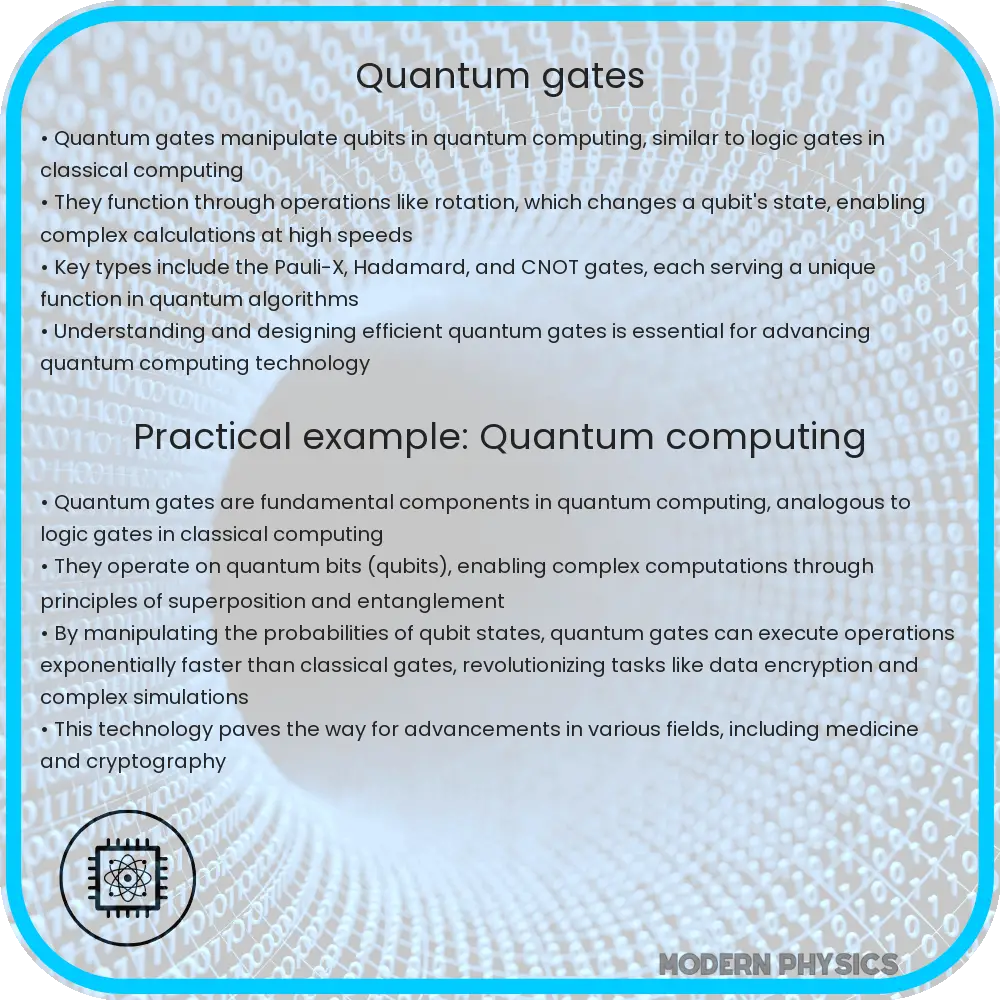
Quantum gates are fundamental elements in the field of quantum computing, analogous to classical logic gates used in conventional computing. These gates operate on quantum bits, or qubits, which represent the basic units of information in quantum computing. Unlike classical bits that are either 0 or 1, qubits can exist in multiple states simultaneously due to the principle of superposition, leading to potentially exponential increases in computing power for certain tasks.
Basics of Quantum Gates
Quantum gates manipulate the state of qubits through quantum mechanical phenomena such as superposition and entanglement. Each gate performs a specific quantum operation, transforming the state of one or more qubits from one quantum state to another. This is typically represented mathematically by unitary matrices; a unitary operation ensures that the total probability of all possible outcomes (when measured) remains 1, preserving quantum information.
Here are some common quantum gates:
- Pauli-X Gate: Often compared to the classical NOT gate, it flips the state of a qubit from |0⟩ to |1⟩ and vice versa. Mathematically, it is represented as:
X = [[0, 1], [1, 0]]
- Hadamard Gate (H Gate): This gate creates superposition. It transforms the base states |0⟩ and |1⟩ into equal superpositions of both, enabling complex algorithms. Represented as:
H = [[1/sqrt(2), 1/sqrt(2)], [1/sqrt(2), -1/sqrt(2)]]
- Phase Shift Gate (S Gate): Changes the phase of the qubit, a critical aspect of quantum algorithms. For example, an S gate applies a phase of π/2. It can be represented as:
S = [[1, 0], [0, i]]
Functions of Quantum Gates
Quantum gates are used to manipulate qubit states systematically to perform computations. By combining different quantum gates in sequences known as quantum circuits, complex operations can be performed, processing multiple probabilities simultaneously. These gates’ unique properties allow them to perform intricate computations more efficiently than their classical counterparts in specific scenarios, such as factoring large numbers, searching databases, and simulating quantum physical processes.
Uses of Quantum Gates
The practical applications of quantum gates are vast and still largely experimental. Today, they are primarily used in:
- Quantum Algorithms: Implementations of algorithms like Shor’s algorithm for factorizing integers and Grover’s algorithm for database searching rely fundamentally on quantum gates.
- Quantum Simulation: Quantum gates help simulate other quantum systems, a potentially transformative application for chemistry and materials science.
- Cryptographic Systems: Certain quantum cryptographic techniques, such as quantum key distribution (QKD), leverage quantum gates for enhanced security measures.
As research and development in quantum computing continues to advance, the role of quantum gates is expected to expand, potentially revolutionizing how we process information and solve complex problems across various fields.
Challenges and Future Directions
Despite their promising capabilities, quantum gates face several challenges. One of the main issues is quantum decoherence, which is the loss of quantum state integrity due to interactions with the external environment. This decoherence can lead to errors in quantum computations, which necessitates the development of robust error-correction methods. Additionally, the physical realization of quantum computers that can operate at scale and at room temperature remains a significant engineering and materials science challenge.
Future research in quantum gates is directed towards overcoming these challenges and enhancing the scalability and reliability of quantum computing technologies. Innovations in quantum error correction, improvements in qubit coherence times, and discoveries in materials science for better qubit stability are key areas of focus. Furthermore, the integration of quantum computing with classical computing infrastructure is also a critical area that requires more development to realize practical applications.
Conclusion
Quantum gates are at the heart of quantum computing, offering revolutionary ways of processing information that could surpass the capabilities of classical computers for specific tasks. Understanding these gates, their functions, and their potential, provides a glimpse into the future of computing and the vast possibilities it holds. As technology progresses, the challenges currently facing quantum computing are expected to be addressed, paving the way for more widespread adoption and implementation of this cutting-edge technology. With continued research and investment, the quantum gates of today are the building blocks for the supercomputers of tomorrow.