
Explore the role of quantum fluctuation observables in advancing physics, enhancing technology, and unlocking the potential of quantum computing.
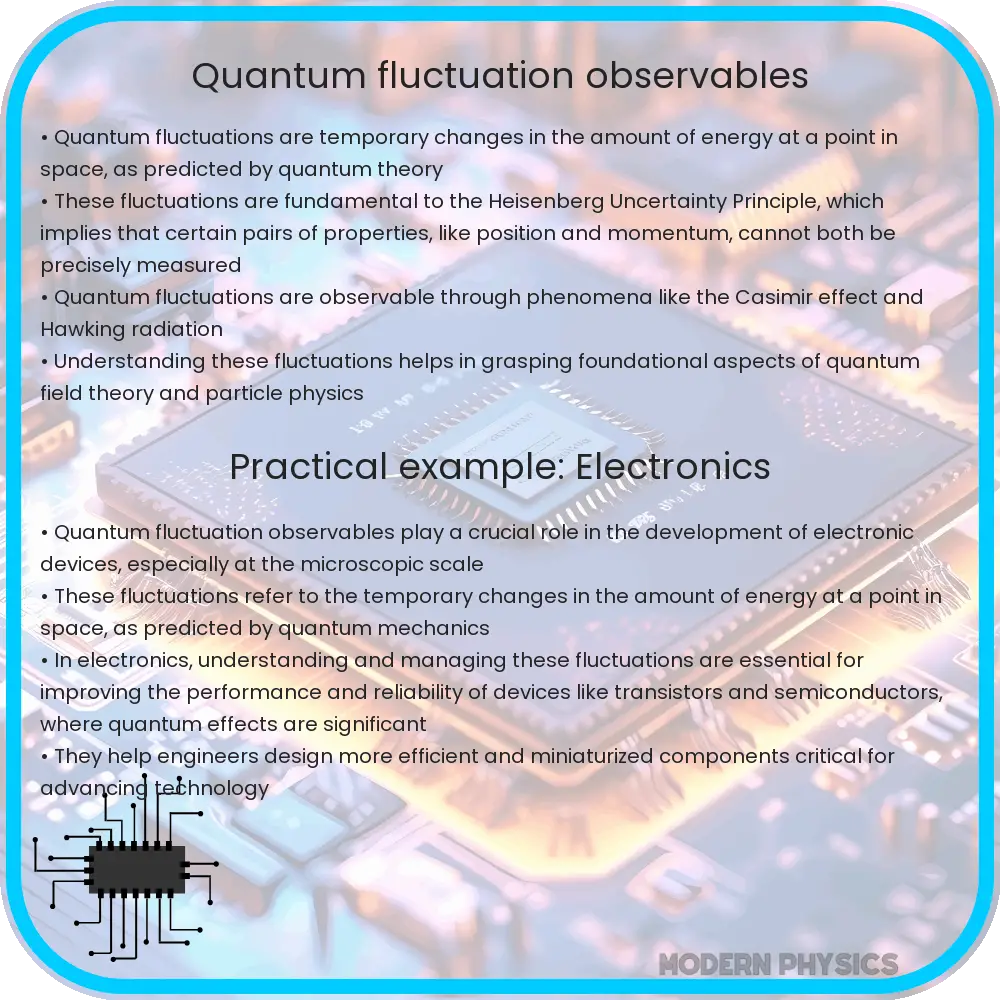
Understanding Quantum Fluctuation Observables
Quantum fluctuations are intrinsic to the fabric of quantum mechanics, manifesting as temporary changes in the energy level of a point in space. Observables related to these fluctuations play a crucial role in understanding the universe at its most fundamental level. This article delves into the precision, coherence, and applications of quantum fluctuation observables, shedding light on their significance in contemporary physics.
Precision in Quantum Fluctuations
The precision of quantum fluctuation measurements is paramount for advancing our understanding of quantum mechanics. Quantum fluctuations are inherently probabilistic, making their precise measurement a challenge for physicists. The development of ultra-sensitive detectors and quantum sensors has allowed for the observation of these fluctuations with unprecedented accuracy. These advancements provide deeper insights into the quantum realm, facilitating a better understanding of phenomena like quantum entanglement and superposition.
Coherence in Quantum Systems
Coherence refers to the phase relationship between different quantum states in a system. In the context of quantum fluctuations, maintaining coherence is essential for observing and utilizing these fluctuations effectively. Quantum coherence enables the superposition of quantum states, allowing particles to be in multiple states simultaneously. This principle is at the heart of quantum computing and quantum communication, where coherence is meticulously preserved to perform complex computations and secure information transfer.
Applications of Quantum Fluctuation Observables
Quantum fluctuation observables find applications in various cutting-edge technologies. In quantum computing, for instance, the manipulation of quantum states, facilitated by an understanding of quantum fluctuations, is fundamental to the operation of qubits, the basic units of quantum information. Similarly, in quantum cryptography, the unpredictability and indeterminacy of quantum fluctuations are used to create secure communication channels that are theoretically impervious to eavesdropping.
Moreover, the study of quantum fluctuation observables contributes to the field of quantum metrology, where these fluctuations are used to improve the precision of measurements beyond the classical limits. This has profound implications for the development of new technologies and the enhancement of existing ones, ranging from GPS systems to medical imaging techniques.
Enhancing Technologies with Quantum Fluctuations
The impact of quantum fluctuation observables extends beyond the realm of theoretical physics, playing a pivotal role in the enhancement of various technological applications. In the field of metrology, quantum fluctuations enable the development of standards for physical quantities with unparalleled precision. This is particularly crucial in the calibration of time and frequency standards, where atomic clocks exploit the quantum properties of atoms for accuracy that is fundamental to global positioning systems (GPS) and internet data transfer.
Quantum Fluctuations in Material Science
Material science also benefits from the study of quantum fluctuations, as they provide insights into the behavior of materials at the quantum level. Understanding these fluctuations enables the design of materials with novel properties, such as superconductors that operate at higher temperatures. These materials have the potential to revolutionize industries by making electrical transmission more efficient and creating new possibilities for magnetic levitation and quantum computing hardware.
The Future of Quantum Fluctuation Observables
The exploration of quantum fluctuation observables is still in its nascent stages, with researchers continually uncovering new phenomena and applications. As experimental techniques become more sophisticated and theoretical models more refined, the potential to harness quantum fluctuations for technological innovation expands. The future may see the development of even more advanced quantum computers, ultra-secure communication systems, and sensors capable of detecting gravitational waves or dark matter.
Conclusion
Quantum fluctuation observables are a cornerstone of quantum mechanics, offering profound insights into the fundamental workings of the universe. The precision and coherence of these observables underpin critical advancements in technology, from quantum computing and cryptography to metrology and material science. As understanding deepens and applications broaden, the study of quantum fluctuations stands as a testament to the power of quantum mechanics to transform our technological landscape. The ongoing exploration of this quantum frontier promises to unveil new mysteries and opportunities, driving forward the boundaries of science and technology.