
Explore quantum field renormalization: its techniques, outcomes, and advances shaping physics and technology. Unraveling the universe’s mysteries.
Introduction to Quantum Field Renormalization
Quantum Field Renormalization is a pivotal concept in modern theoretical physics, particularly in the realms of quantum mechanics and field theory. It addresses the issue of infinite predictions in quantum field theories, refining them into meaningful, finite results. This process has not only deepened our understanding of the fundamental forces and particles in the universe but also paved the way for numerous technological advances.
Techniques of Renormalization
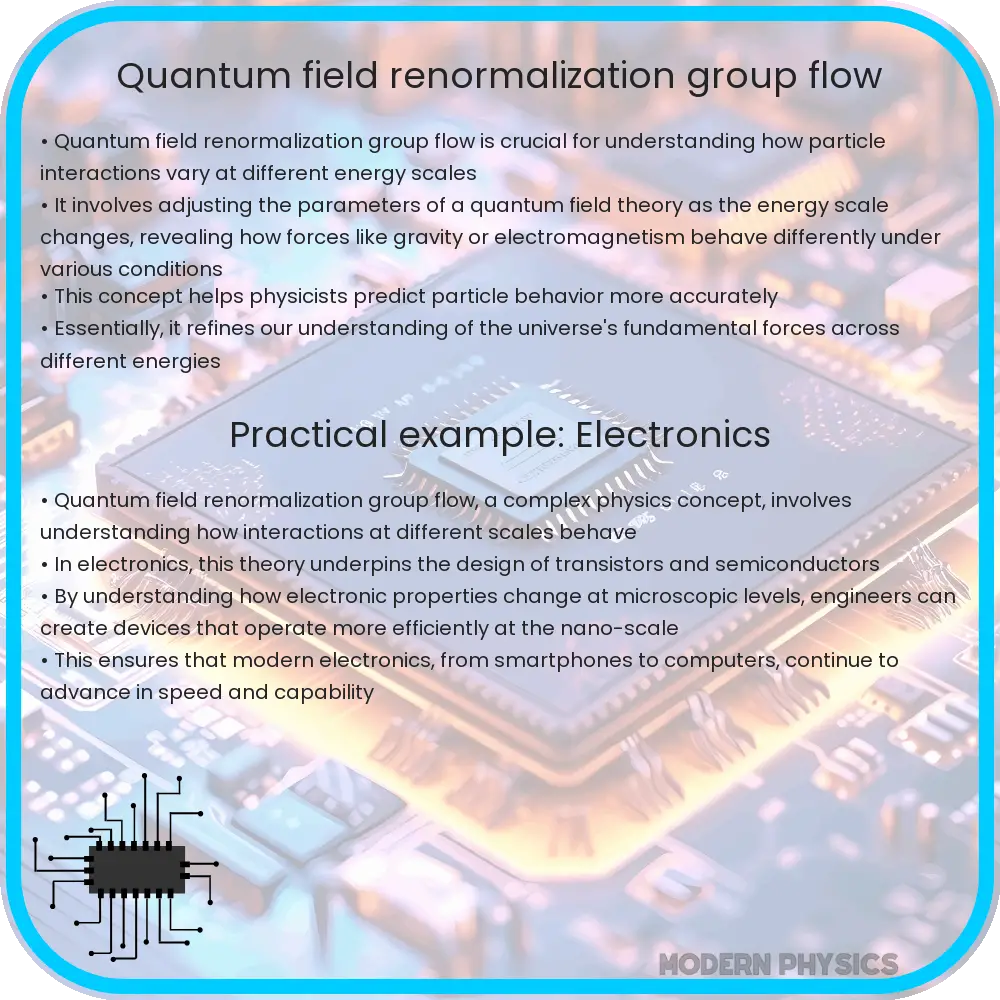
Renormalization involves several sophisticated techniques. One of the key methods is ‘regularization,’ where hypothetical terms are temporarily added to the theory to control the infinities. These terms are then systematically removed through a process called ‘renormalization group flow,’ leading to a consistent and finite theory.
Another technique is ‘dimensional regularization,’ where the space-time dimensions are altered to render divergences more manageable. This approach is particularly useful in gauge theories, like Quantum Chromodynamics (QCD), the theory of the strong interaction.
Outcomes of Renormalization
The outcomes of renormalization are far-reaching. It has provided a deeper understanding of quantum electrodynamics (QED), enabling precise calculations of electron properties and interactions. This is best exemplified in the prediction of the anomalous magnetic moment of the electron, where theory and experiment match with extraordinary precision.
In QCD, renormalization techniques have helped to explain the phenomenon of ‘asymptotic freedom,’ where quarks behave as free particles at high energies. This insight was crucial in validating the Standard Model of particle physics.
Advances in Quantum Field Theory
Renormalization has also fostered advances in quantum field theory. It has led to the development of effective field theories, which provide a framework for understanding phenomena at various energy scales. These theories have been instrumental in predicting new particles and interactions, contributing significantly to particle physics research.
Moreover, the concepts of renormalization have found applications beyond particle physics, influencing areas like condensed matter physics. For example, they have been used to explain critical phenomena in phase transitions, such as the behavior of magnets near their Curie temperature.
Continued research in quantum field renormalization is not only unraveling the mysteries of the universe but also shaping the future of technological innovations, from particle accelerators to quantum computing.
Challenges and Future Directions in Quantum Field Renormalization
Despite its successes, quantum field renormalization still faces challenges. One of the primary issues is the incorporation of gravity into the framework. General relativity, the current best theory of gravity, resists a straightforward renormalization process due to its non-renormalizable infinities. Addressing this challenge is crucial for the development of a unified theory of fundamental interactions, often referred to as ‘quantum gravity’.
Another challenge lies in the exploration of non-perturbative effects. Renormalization techniques are predominantly perturbative, relying on expansions in small parameters. However, many physical phenomena, especially in QCD, require non-perturbative methods for a comprehensive understanding. Lattice field theory is one such non-perturbative approach that has shown promise, particularly in studying the strong force.
Technological Implications and Applications
Technologically, the principles of quantum field renormalization are being applied in cutting-edge fields. In quantum computing, understanding quantum field theories at a deeper level could lead to more efficient algorithms and error correction methods. Additionally, the insights gained from renormalization techniques are influencing the development of materials with novel quantum properties, potentially revolutionizing sectors like energy, telecommunications, and computing.
In the realm of high-energy physics, advancements in renormalization techniques continue to inform the design and interpretation of experiments at facilities like the Large Hadron Collider (LHC). These experiments not only test the predictions of the Standard Model but also search for new physics beyond it.
Conclusion
Quantum field renormalization represents one of the most profound developments in theoretical physics. It has resolved the conundrum of infinities in quantum field theories, leading to an unprecedented understanding of the subatomic world. The impact of renormalization extends beyond physics, influencing technology and providing a foundational framework for future scientific explorations.
The ongoing research in this field, tackling challenges like the integration of gravity and non-perturbative effects, promises not only deeper insights into the fundamental nature of the universe but also the potential for groundbreaking technological advancements. As we continue to push the boundaries of our understanding, quantum field renormalization remains a key area of study, bridging the gap between abstract theoretical constructs and tangible, real-world applications.