
Explore the fascinating world of quantum entanglement, its impact on efficient, scalable, and secure technologies in quantum computing and cryptography.
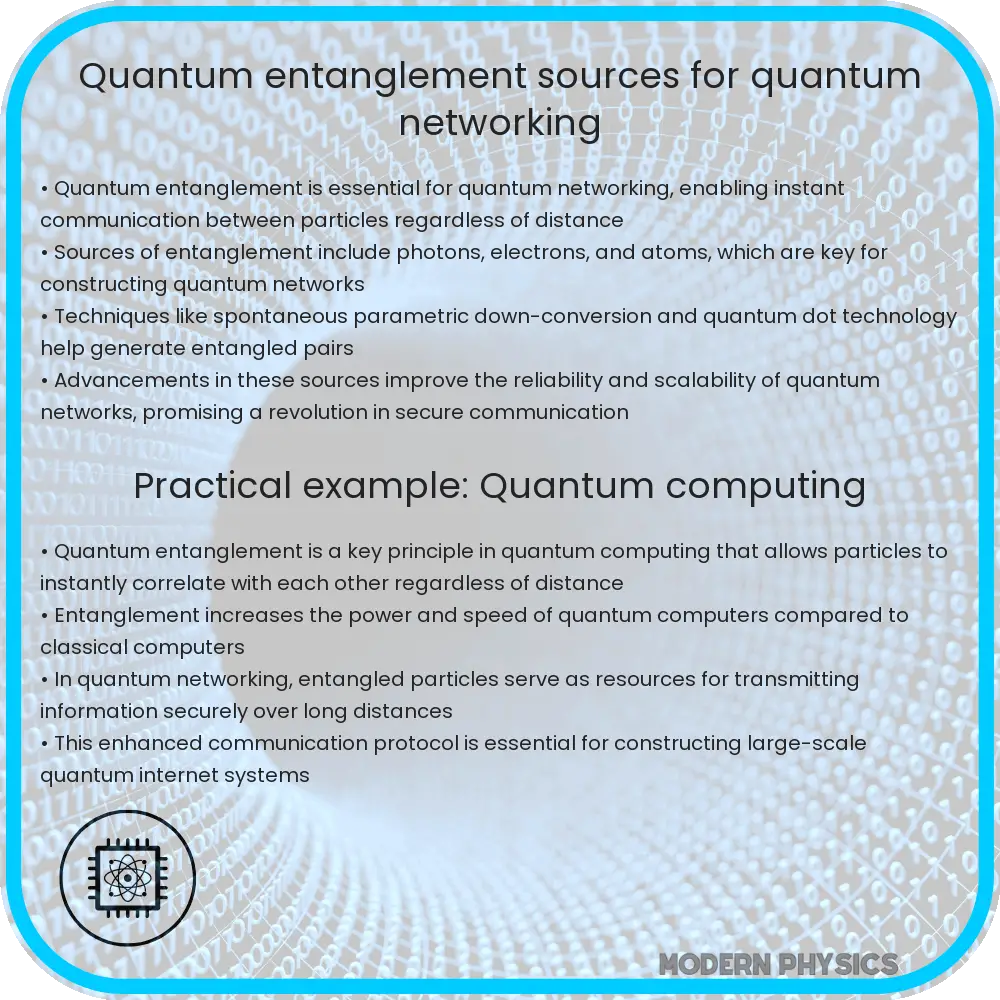
Understanding Quantum Entanglement
Quantum entanglement, a phenomenon at the heart of quantum mechanics, has intrigued scientists and technologists for decades. This bizarre yet fundamental aspect of quantum theory describes a condition where pairs or groups of particles interact in such a way that the quantum state of each particle cannot be described independently of the state of the others, even when the particles are separated by large distances. The implications of quantum entanglement for the fields of information science, cryptography, and computing are profound, leading to the development of new, more efficient, scalable, and secure technologies.
Efficiency and Scalability of Quantum Entanglement Sources
The efficiency of quantum entanglement sources is crucial for practical applications. Recent advancements have led to the development of sources that can produce high rates of entangled pairs with minimal loss. This efficiency is vital for applications like quantum computing and quantum key distribution, where a high yield of entangled pairs directly translates to faster and more reliable performance.
Scalability is another critical factor. The ability to produce and manage entangled states in larger systems is essential for the realization of complex quantum networks. Recent research has shown promising results in scaling up these systems without compromising the quality of entanglement. This is achieved through advanced techniques such as multiplexing and integrating quantum sources with existing telecommunications infrastructure.
Security Implications of Quantum Entanglement
Quantum entanglement offers a significant upgrade in security over traditional methods. In quantum cryptography, such as Quantum Key Distribution (QKD), entangled particles are used to generate cryptographic keys. Any attempt to intercept or measure these particles disturbs their quantum state, thus revealing the presence of an eavesdropper. This inherent security feature of quantum entanglement makes QKD virtually unbreakable, a crucial attribute in an era where data security is paramount.
In conclusion, quantum entanglement sources are rapidly evolving, offering efficient, scalable, and secure solutions for various applications in quantum technology. As research progresses, we can expect these sources to become more sophisticated, paving the way for widespread adoption of quantum-based technologies.
Advanced Applications of Quantum Entanglement
Quantum entanglement is not just limited to theoretical interest; it has practical applications that are revolutionizing various fields. In quantum computing, entangled particles serve as quantum bits or qubits, which can perform complex calculations at speeds unattainable by classical computers. This capability opens up new possibilities in drug discovery, materials science, and solving complex mathematical problems.
Another promising application is in the realm of secure communications. Quantum entanglement forms the backbone of quantum networks, enabling the transmission of information with a level of security impossible to achieve with traditional methods. Such networks are poised to form the basis of future communication systems, ensuring privacy and security in an increasingly digital world.
The Future of Quantum Entanglement Technologies
The future of quantum entanglement technologies is incredibly promising. Researchers are continuously making strides in overcoming challenges such as maintaining entanglement over long distances and developing more efficient entanglement sources. The progress in satellite-based quantum communication, for instance, has demonstrated the potential for establishing a global quantum network.
Moreover, the integration of quantum entanglement technologies with existing infrastructure is a critical step towards their widespread adoption. This integration not only enhances the capabilities of current systems but also ensures a smoother transition to quantum technologies, making them more accessible to various sectors.
Conclusion
In summary, quantum entanglement represents a cornerstone of modern quantum science and technology. Its unique properties offer unprecedented efficiency, scalability, and security, making it instrumental in the development of advanced quantum computing and secure communication systems. As the understanding and application of quantum entanglement continue to evolve, it stands to fundamentally transform technology, offering solutions to some of the most complex challenges of our time. The ongoing research and development in this field are not just exciting for scientists and technologists but hold significant implications for society as a whole, marking the dawn of a new era in technological advancement.