
Explore the mysteries of quantum entanglement in solids, its impact on quantum computing, and the latest breakthroughs paving the way for future technologies.
Exploring Quantum Entanglement in Solids: Unveiling the Mysteries
Quantum entanglement, a phenomenon that Albert Einstein famously described as “spooky action at a distance,” remains one of the most intriguing aspects of quantum mechanics. Within the lattice structures of solids, entanglement presents a canvas rich with both theoretical challenges and practical applications. This article delves into the core of quantum entanglement in solids, exploring its fundamental principles, recent breakthroughs, and the promising horizons it opens for technology and science.
Theoretical Foundations of Quantum Entanglement in Solids
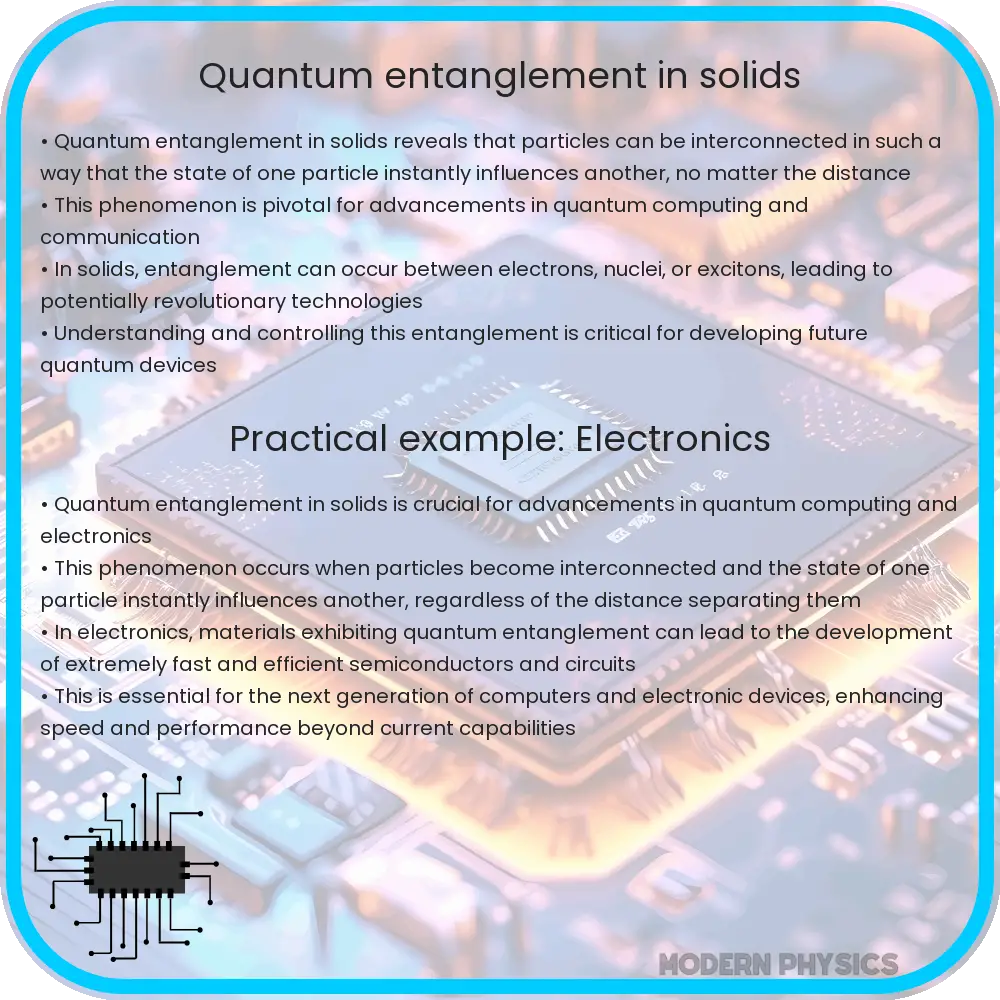
At the heart of quantum entanglement in solids is the principle that particles such as electrons, photons, or atoms can become interconnected, with the state of one instantaneously influencing the state of another, regardless of the distance separating them. This interconnection persists even when the entangled particles are embedded within the complex environments of solid materials, where they interact with a vast array of other particles. The study of these phenomena in solids is grounded in quantum mechanics and condensed matter physics, offering insights into the behavior of matter at its most fundamental level.
Applications of Quantum Entanglement in Solids
The applications of quantum entanglement in solids are as vast as they are impactful. One of the most promising areas is in the field of quantum computing, where entanglement serves as a cornerstone for developing quantum bits or qubits. These qubits are capable of representing and processing information in ways that classical bits cannot, heralding a new era of computing power and efficiency. Additionally, quantum entanglement is pivotal in the advancement of quantum communication technologies, including quantum cryptography and quantum networks, offering unprecedented levels of security and data transmission capabilities.
Breakthroughs in Quantum Entanglement within Solid Materials
Recent breakthroughs in quantum entanglement within solids have been nothing short of revolutionary. Researchers have successfully demonstrated entanglement between particles across macroscopic distances within solids, overcoming the decoherence typically induced by interactions with the surrounding environment. Innovations such as the use of diamond nitrogen-vacancy centers have emerged as powerful platforms for studying entanglement, enabling scientists to manipulate and observe quantum states with remarkable precision. These advancements not only deepen our understanding of quantum mechanics but also pave the way for practical quantum technologies.
Challenges and Future Directions
Despite the significant progress in understanding and harnessing quantum entanglement in solids, challenges remain. Decoherence, the loss of quantum coherence due to interaction with the environment, poses a major hurdle in maintaining entanglement over time and distance. Researchers are actively exploring innovative materials and techniques to shield entangled states from decoherence, including topological insulators and superconducting circuits. Additionally, scaling up quantum systems for practical applications, such as large-scale quantum computing and widespread quantum networks, requires overcoming technical and engineering challenges.
Future directions in the study of quantum entanglement in solids are incredibly promising. The ongoing miniaturization of quantum devices and the integration of quantum systems with existing technologies are areas of intense research. Scientists are also investigating new forms of quantum materials, such as two-dimensional materials and exotic phases of matter like time crystals, to explore their potential for hosting entangled states. These efforts are not only expanding the boundaries of our theoretical understanding but are also opening new avenues for applications in technology and industry.
Conclusion
Quantum entanglement in solids represents a frontier of physics that bridges the deepest theoretical concepts with transformative practical applications. From quantum computing and secure communication to the exploration of new materials, the implications of mastering this quantum phenomenon are profound. Despite the challenges, the relentless pursuit of knowledge and innovation in this field continues to break new ground, promising a future where the once “spooky” entanglement becomes a cornerstone of technological advancement. As we stand on the cusp of a quantum revolution, the journey into the quantum world of solids is not just about understanding the universe at its most fundamental level but also about shaping the future of our technological landscape.