
Explore how quantum-enhanced LiDAR systems revolutionize precision and speed in tech, from autonomous vehicles to environmental monitoring.
Quantum-Enhanced LiDAR Systems: A Leap in Precision, Speed, and Innovation
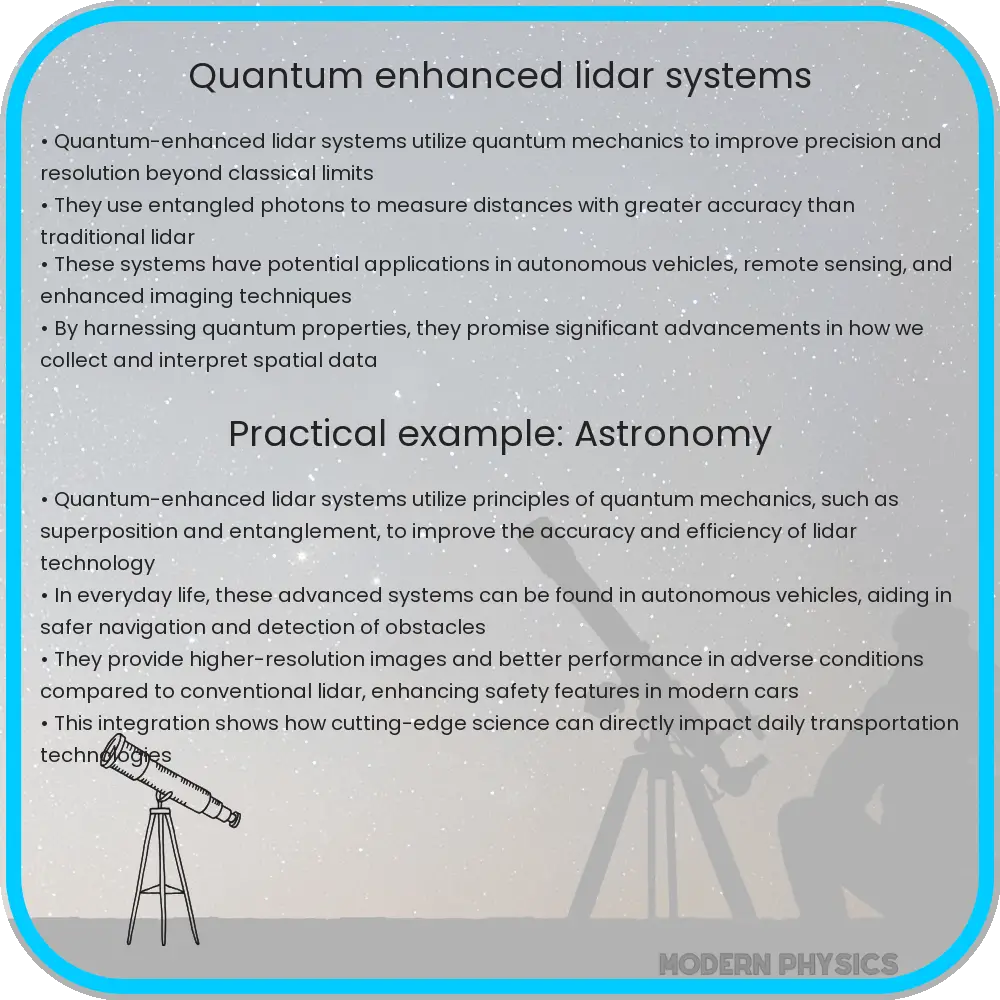
Quantum-enhanced LiDAR (Light Detection and Ranging) systems are at the forefront of technological innovation, offering unparalleled precision and speed in a range of applications from autonomous vehicles to environmental monitoring. By harnessing the principles of quantum mechanics, these advanced systems mark a significant leap beyond traditional LiDAR technology.
Understanding Quantum LiDAR
Traditional LiDAR systems work by emitting laser beams towards an object and measuring the time it takes for the reflection to return. This time-of-flight (TOF) principle allows for the accurate determination of distances. Quantum LiDAR, however, introduces quantum entanglement into the equation, a phenomenon where pairs or groups of particles become interconnected in such a way that the state of one (regardless of distance) can instantly affect the state of another.
The Edge of Quantum Entanglement in LiDAR
Utilizing entangled photons, quantum-enhanced LiDAR systems can achieve measurements with extraordinary precision, far surpassing the capabilities of classical LiDAR. This quantum advantage stems from the ability to detect and measure the phase shifts of entangled photons with a precision that classical physics cannot match. Furthermore, quantum LiDAR can operate effectively in environments where traditional LiDAR systems struggle, such as in high levels of ambient light or through obstacles like foliage.
Applications and Advancements
The implications of quantum-enhanced LiDAR are vast and varied. In autonomous driving, it can provide more accurate and reliable navigation data, improving safety and efficiency. Environmental monitoring benefits from its ability to penetrate dense forest canopies, offering detailed topographical mapping and biomass estimation. Additionally, its precision makes it invaluable in archaeology for uncovering hidden structures without disturbing the ground.
Quantum LiDAR also represents a significant step forward in security and surveillance, capable of detecting objects with much greater accuracy and from farther distances. Its sensitivity to minute changes enables the early detection of environmental changes or potential threats, showcasing its potential in disaster response and homeland security.
Challenges and Future Prospects
Despite its considerable advantages, the implementation of quantum-enhanced LiDAR faces several challenges. The complexity of quantum systems, high costs of development, and the need for advanced materials and technology are significant barriers. Moreover, quantum entanglement is a delicate state that requires precise control and isolation from environmental interferences, making the technology’s deployment in real-world conditions a challenging endeavor.
However, ongoing research and development are rapidly addressing these challenges. Innovations in quantum computing and nanotechnology are paving the way for more compact, efficient, and cost-effective quantum LiDAR systems. Governments and private entities worldwide are investing heavily in quantum technologies, recognizing their potential to revolutionize industries and national security.
Integrating Quantum LiDAR with Emerging Technologies
The integration of quantum-enhanced LiDAR with other emerging technologies, such as artificial intelligence (AI) and the Internet of Things (IoT), opens new avenues for innovation. AI algorithms can analyze the vast amounts of data generated by quantum LiDAR, leading to smarter, more autonomous systems capable of complex decision-making. Meanwhile, IoT devices equipped with quantum LiDAR can provide real-time, high-precision data for smart cities, agriculture, and infrastructure management, fostering a more connected and efficient world.
Conclusion
Quantum-enhanced LiDAR systems stand at the cutting edge of technology, offering unprecedented precision, speed, and versatility across a myriad of applications. While challenges remain in their widespread adoption, the potential benefits they promise in terms of safety, efficiency, and discovery are immense. As we continue to push the boundaries of what’s possible with quantum mechanics, quantum-enhanced LiDAR could well become a cornerstone technology of the future. With its ability to see the world in finer detail than ever before, it holds the key to unlocking new realms of innovation and understanding, reshaping industries and enhancing our interaction with the environment around us.