
Explore the core principles and applications of Quantum Electroweak Dynamics, its challenges, and future directions in modern physics and technology.
Introduction to Quantum Electroweak Dynamics
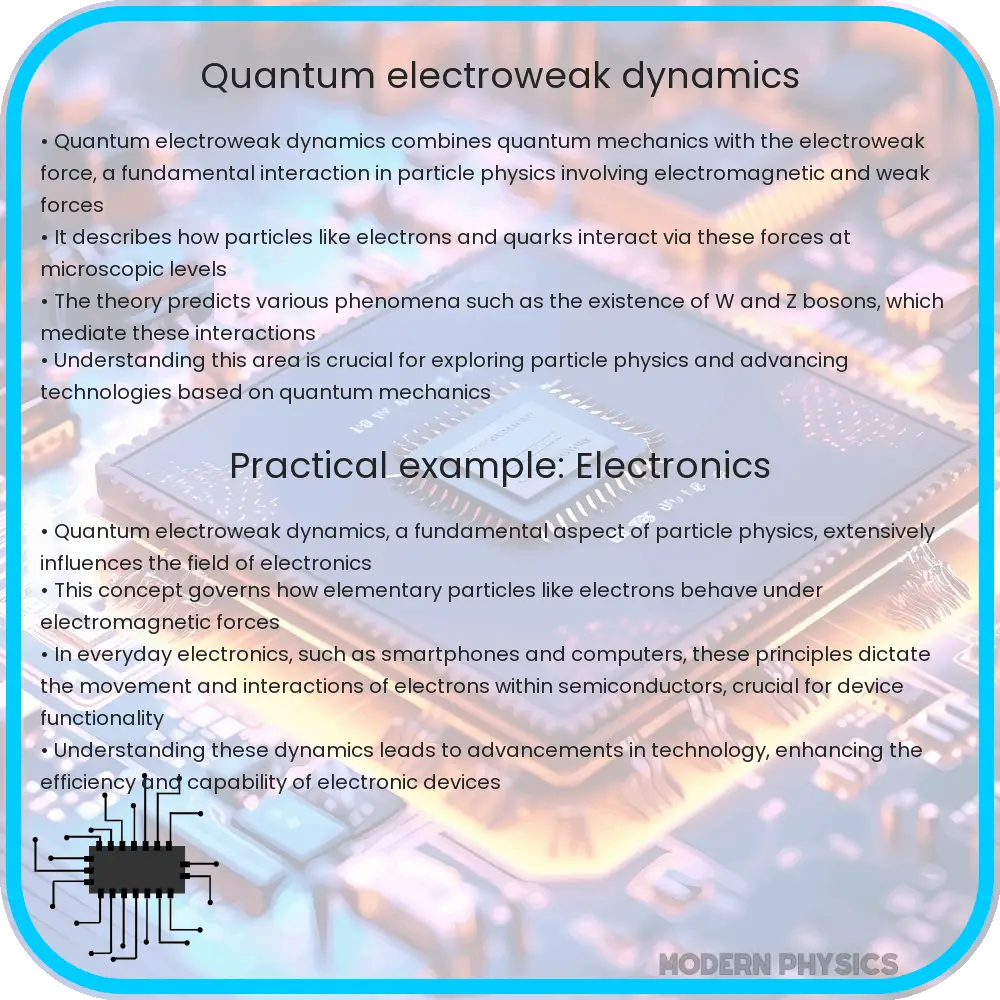
Quantum Electroweak Dynamics (QED) represents a cornerstone in modern physics, integrating quantum mechanics with the electromagnetic and weak forces. This unified framework is part of the Standard Model of particle physics, explaining phenomena at subatomic scales. At its core, QED is about understanding how particles like electrons and quarks interact through electromagnetic and weak forces, shedding light on the fundamental aspects of the universe.
Core Principles of Quantum Electroweak Dynamics
The foundation of Quantum Electroweak Dynamics lies in two primary forces: the electromagnetic force and the weak nuclear force. The electromagnetic force, described by Quantum Electrodynamics, is mediated by photons and is responsible for electric and magnetic interactions. Conversely, the weak force, essential for processes like beta decay, is conveyed by W+, W–, and Z0 bosons.
One of the pivotal principles in QED is gauge invariance, which states that certain physical properties remain unchanged under local transformations. This principle leads to the prediction of the W and Z bosons, integral to the weak force, and the photon, responsible for electromagnetic interactions. Furthermore, the Higgs mechanism, another fundamental concept, explains how particles acquire mass through interactions with the Higgs field, integral for maintaining the consistency of the theory.
Applications of Quantum Electroweak Dynamics
Quantum Electroweak Dynamics has profound implications across various fields. In particle physics, it provides the theoretical underpinnings for understanding the results from large-scale experiments like those conducted at the Large Hadron Collider (LHC). Additionally, QED is essential in cosmology, offering insights into the early universe’s conditions and the fundamental forces that shaped its evolution.
In the realm of nuclear physics, the principles of QED are applied to study beta decay and the structure of atomic nuclei. Furthermore, the framework has significant implications in medical physics, particularly in the mechanisms of radiation therapy, where understanding the interactions at the quantum level can lead to more effective treatments.
Challenges and Recent Developments in Quantum Electroweak Dynamics
Despite its success, Quantum Electroweak Dynamics faces challenges and questions that spur ongoing research and debate. One of the most significant challenges is the integration of gravity into the framework, aiming to achieve a comprehensive theory that also includes general relativity. Additionally, discrepancies like the muon g-2 anomaly suggest there may be physics beyond the Standard Model waiting to be discovered.
Recent developments in QED include advancements in precision measurements and experimental techniques. These have allowed scientists to test the predictions of Quantum Electroweak Dynamics with unprecedented accuracy. Innovations in collider technology and observational astronomy offer new avenues to explore and potentially solve the mysteries surrounding dark matter and dark energy, elements not accounted for in the current framework.
Future Directions and Implications
The future of Quantum Electroweak Dynamics is vibrant and promises significant breakthroughs. Researchers are pushing the boundaries of particle accelerators, such as the LHC, to reach higher energies and luminosities. This could unveil new particles or forces and provide clearer insights into the unification of forces. Moreover, advancements in quantum computing and theoretical physics may offer new methods to solve complex equations governing particle interactions, leading to a deeper understanding of the universe’s fundamental structure.
Furthermore, interdisciplinary collaborations between physicists, chemists, and engineers are expanding the applications of QED in technology, medicine, and materials science. For instance, quantum electroweak principles are being harnessed in developing new semiconductors, better radiation therapies, and innovative energy solutions, demonstrating the practical relevance of these fundamental scientific discoveries.
Conclusion
Quantum Electroweak Dynamics remains a pivotal area of study within physics, offering profound insights into the nature of the universe. While challenges remain, the ongoing research and technological advancements promise to deepen our understanding and lead to new applications that could transform various scientific and technological fields. As we continue to unravel the mysteries of the quantum world, the principles of Quantum Electroweak Dynamics will undoubtedly play a critical role in shaping the future of scientific discovery and innovation.