
Explore the fascinating world of quantum dynamics, focusing on coherence, entanglement, and control, and their impact on future technologies.
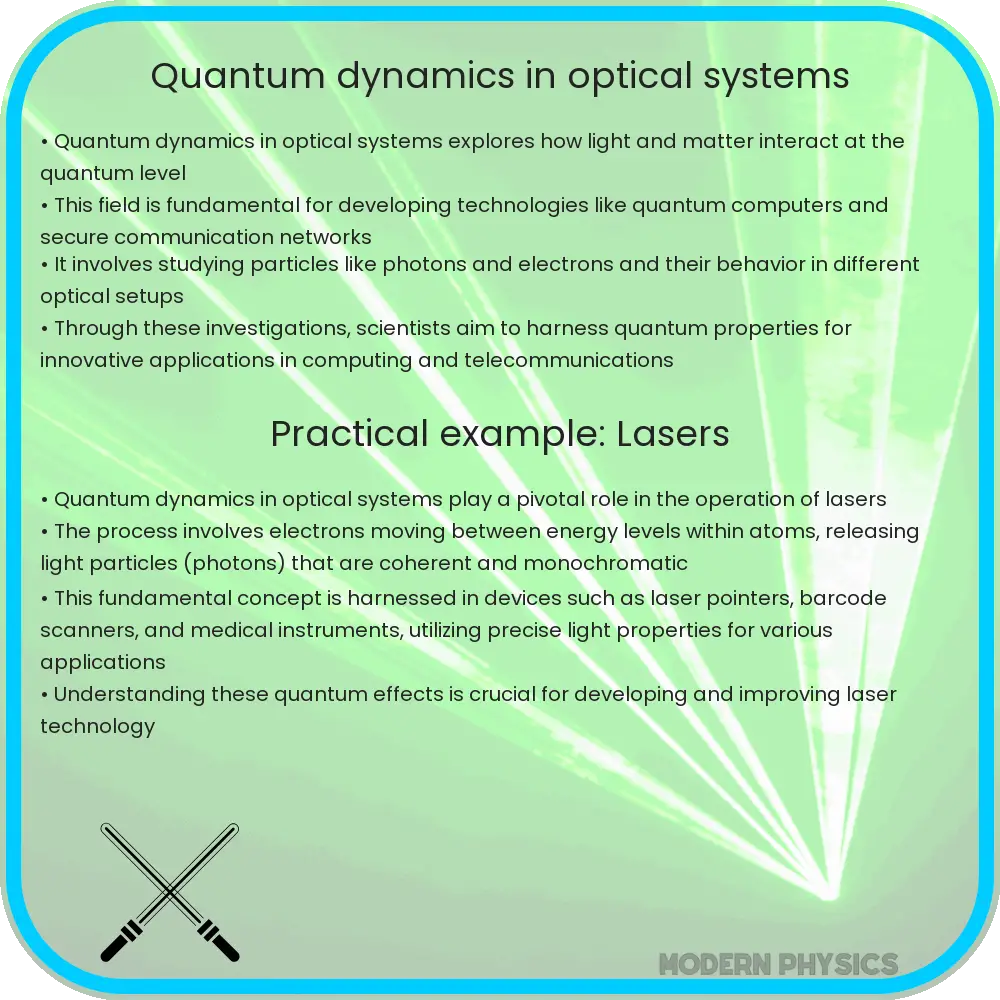
Understanding Quantum Dynamics: Coherence, Entanglement, and Control
Quantum dynamics plays a pivotal role in the realm of quantum physics, offering a fascinating glimpse into the behavior of particles at the quantum level. This field is not just theoretical; it has practical implications for quantum computing, cryptography, and even the development of new materials. At the heart of quantum dynamics are three key concepts: coherence, entanglement, and control. These principles are the cornerstone of understanding how quantum systems interact and behave under various conditions.
Quantum Coherence
Quantum coherence refers to the property of particles being in a superposition of states, allowing them to exist in multiple states simultaneously. This principle is central to the functioning of quantum computers, where bits (qubits) can be both 0 and 1 at the same time, vastly increasing computing power. Coherence is fragile, however, and maintaining it against decoherence—where quantum systems lose their quantum behavior and behave classically—is one of the biggest challenges in quantum physics.
Quantum Entanglement
Quantum entanglement is a phenomenon where particles become interconnected, such that the state of one (no matter the distance separating them) can instantaneously affect the state of the other. Albert Einstein famously referred to it as “spooky action at a distance. Entanglement is a fundamental resource for quantum computing and quantum cryptography, as it allows for the creation of highly secure communication channels and the execution of computations that are impossible for classical computers.
Quantum Control
Quantum control involves the manipulation of quantum systems to achieve desired states or outcomes. This is crucial for the practical application of quantum technologies, including quantum computing and quantum sensing. Techniques for quantum control include the use of laser pulses to steer electrons or the application of magnetic fields to control spin states. The ultimate goal is to maintain coherence and exploit entanglement in a controlled manner to harness the full potential of quantum mechanics.
These three concepts—coherence, entanglement, and control—form the backbone of quantum dynamics, each playing a crucial role in unlocking the mysteries and capabilities of quantum mechanics. As we delve deeper into this field, the possibilities for technological advancement and understanding the fundamental nature of the universe continue to expand.
Applications and Challenges in Quantum Dynamics
The exploration of quantum dynamics has opened up new frontiers in technology and science, promising revolutionary advancements across various domains. Quantum computing, with its potential to solve complex problems much faster than classical computers, is one of the most anticipated applications. Similarly, quantum cryptography offers unprecedented security, leveraging the principles of entanglement to create communication channels that are theoretically immune to eavesdropping. Additionally, quantum sensing and metrology stand to benefit from enhanced precision in measurements, tapping into the inherent sensitivity of quantum states to external influences.
However, harnessing the power of quantum dynamics is not without its challenges. The delicate nature of quantum coherence requires sophisticated methods to isolate quantum systems from their environments, a task that grows increasingly complex with the scale of the system. Similarly, generating and maintaining entangled states over long distances remains a significant hurdle for quantum communication networks. Quantum control, too, demands precise manipulation of quantum states, requiring advances in technology and theory to achieve the desired outcomes reliably.
Future Directions in Quantum Dynamics
The future of quantum dynamics research is bright, with ongoing advancements in theory and experimental techniques paving the way for new applications. Quantum simulation, for instance, holds the promise of unlocking mysteries in physics, chemistry, and materials science by allowing scientists to model systems that are intractable with classical computers. Moreover, the integration of quantum systems with classical technologies presents a fertile ground for innovation, potentially leading to hybrid systems that leverage the best of both worlds.
As the field matures, interdisciplinary collaboration will be key to overcoming the technical and theoretical challenges that remain. The synergy between quantum physics, computer science, engineering, and materials science will be crucial in turning the theoretical promise of quantum dynamics into practical reality.
Conclusion
Quantum dynamics, with its core principles of coherence, entanglement, and control, is at the forefront of a quantum revolution in science and technology. While challenges remain in fully harnessing these phenomena, the potential applications—from quantum computing and cryptography to sensing and metrology—offer a glimpse into a future where quantum mechanics shapes our technological landscape. As researchers continue to unravel the complexities of quantum systems, the principles of quantum dynamics will undoubtedly play a central role in driving innovations that were once the realm of science fiction. The journey into the quantum realm is just beginning, promising profound impacts on our understanding of the universe and our capabilities within it.