
Explore the cutting-edge of quantum correlation experiments, their impact on technology and science, and the challenges and future of quantum mechanics.
Understanding Quantum Correlation Experiments
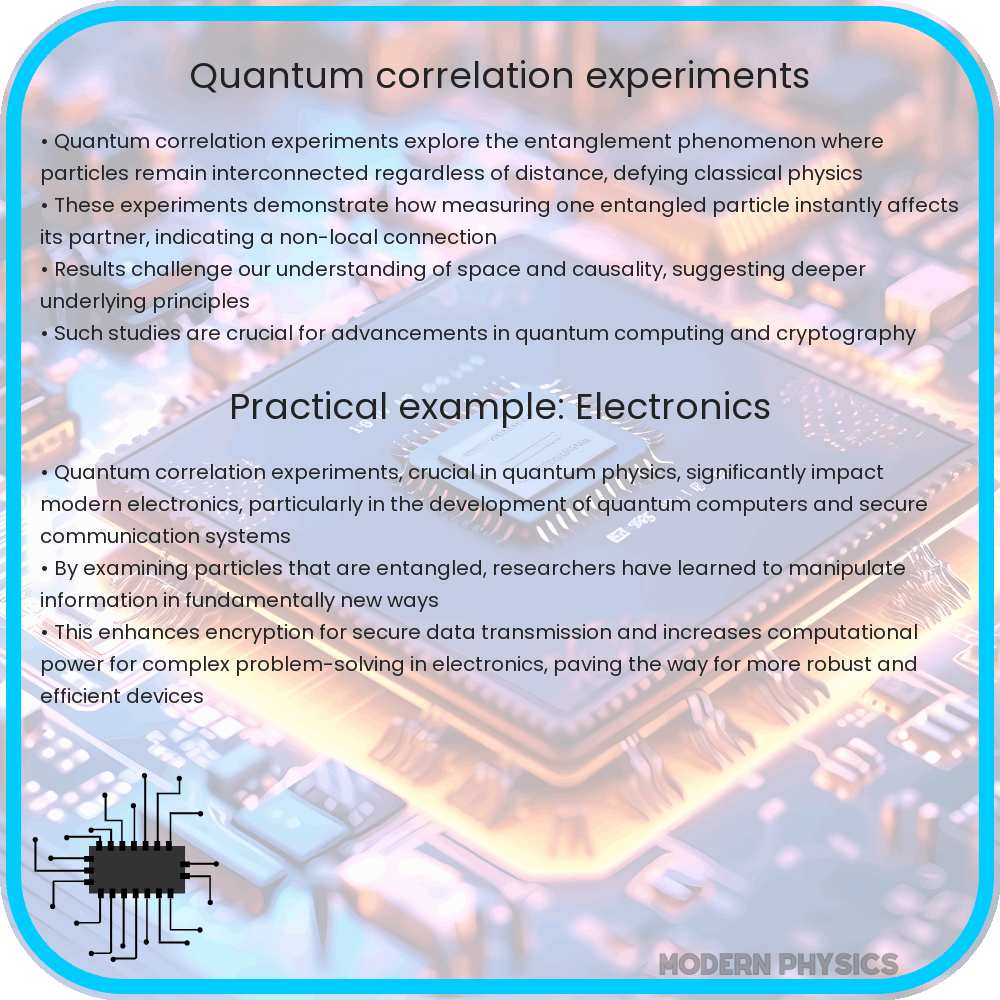
Quantum correlation experiments are at the forefront of advancing our understanding of quantum mechanics, a fundamental theory in physics that explains the nature and behavior of energy and matter on the quantum (atomic and subatomic) level. These experiments delve into phenomena such as quantum entanglement and superposition, challenging our classical views of reality and offering insights into the interconnectedness of particles across distances and states.
Precision in Quantum Experiments
The precision of quantum correlation experiments is paramount. Technological advancements in lasers, detectors, and material science have enabled scientists to measure outcomes with ever-increasing accuracy. This precision is crucial for validating the principles of quantum mechanics and for the practical application of quantum technologies. It involves intricate setups where the properties of particles like photons or electrons are measured under various conditions to test the predictions of quantum mechanics against classical theories.
Entanglement: The Heart of Quantum Correlations
Quantum entanglement is a phenomenon where particles become interconnected so that the state of one (no matter the distance separating them) can instantaneously affect the state of the other. This peculiar aspect of quantum mechanics was famously debated by Albert Einstein and Niels Bohr, with Einstein skeptical of what he called “spooky action at a distance. However, numerous experiments have since confirmed entanglement, demonstrating that particles can share states and information instantaneously over vast distances.
Applications of Quantum Correlations
The implications of quantum correlation experiments extend far beyond theoretical physics, impacting technology and information science. Quantum entanglement is the cornerstone of emerging technologies such as quantum computing, quantum cryptography, and quantum teleportation. These applications promise to revolutionize computing speed, secure communication, and our ability to transmit information.
Quantum computing, for instance, leverages the principles of superposition and entanglement to perform calculations at speeds unattainable by classical computers. Quantum cryptography, on the other hand, uses the principles of quantum mechanics to create secure communication channels that are theoretically impervious to eavesdropping, thanks to the fundamental property that observing a quantum system inevitably alters its state.
The exploration of quantum correlations continues to push the boundaries of our understanding and application of quantum mechanics, heralding a new era of technology and insight into the fabric of our universe.
Challenges and Future Directions
Despite the significant advancements in quantum correlation experiments, several challenges remain. One of the primary hurdles is decoherence, the process by which quantum systems lose their quantum properties, particularly entanglement, due to interaction with their environment. Overcoming decoherence is crucial for the practical implementation of quantum technologies, requiring innovative materials and isolation techniques to preserve quantum states over time and distance.
Another challenge lies in scaling up quantum systems for commercial and scientific applications. Quantum computers, for instance, require a substantial increase in the number of qubits (quantum bits) to solve complex problems that are infeasible for classical computers. However, increasing the number of qubits while maintaining their coherence and entanglement is a daunting technical challenge that researchers worldwide are striving to solve.
Future directions in quantum correlation experiments involve exploring new quantum materials, improving quantum sensors and detectors, and developing novel quantum algorithms. These efforts aim to enhance the precision of quantum measurements, extend the duration and distance over which quantum states can be maintained, and discover new applications of quantum phenomena.
Conclusion
Quantum correlation experiments have profoundly impacted our understanding of the quantum world, challenging classical notions of reality and opening up new technological frontiers. The precision and complexity of these experiments underscore the intricate nature of quantum mechanics and the potential for revolutionary applications in computing, communication, and beyond. Despite the challenges ahead, the continued exploration of quantum correlations holds the promise of unlocking further secrets of the universe and driving the next wave of technological innovation. As researchers and technologists push the boundaries of what’s possible, we stand on the cusp of a new era in science and technology, one that is bound to reshape our world in ways we are only beginning to imagine.