
Explore the efficiency, innovation, and applications of quantum coherence devices, their challenges, and the future of this transformative technology.
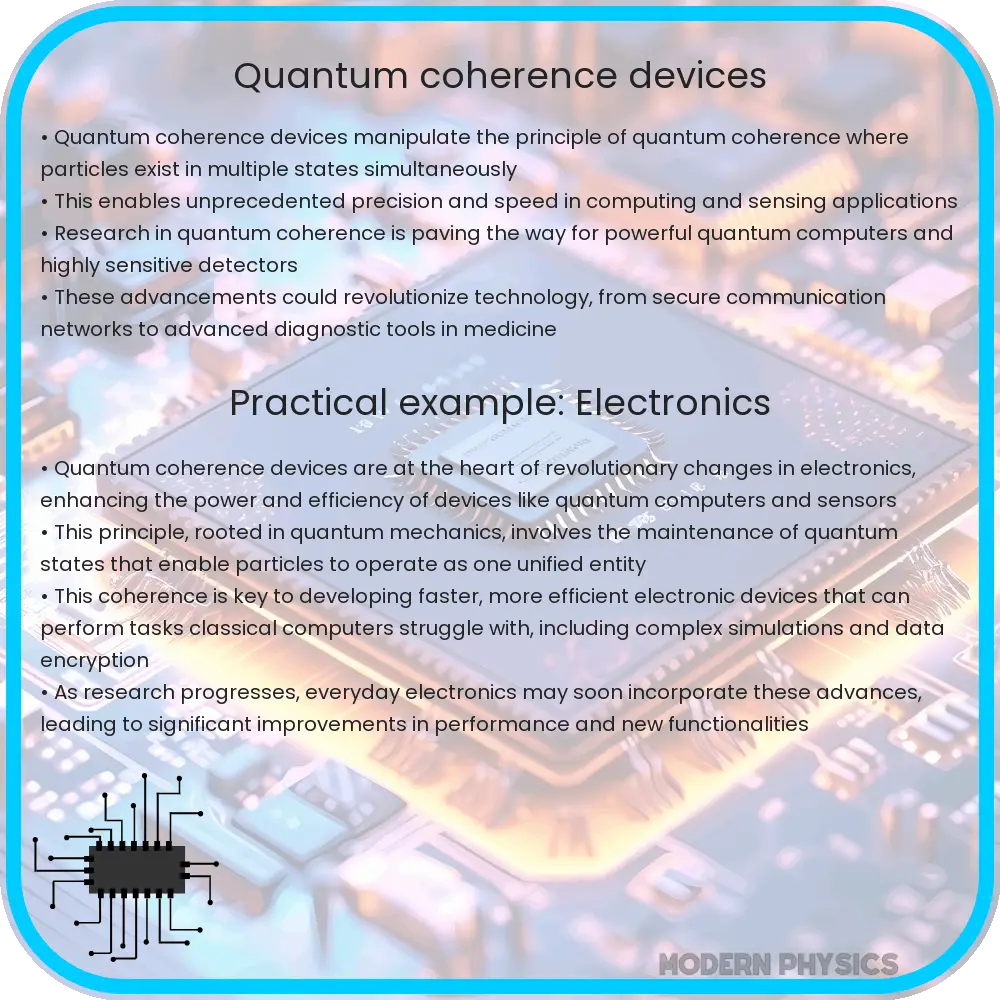
Exploring the Frontier of Quantum Coherence Devices
The realm of quantum coherence devices marks a significant leap forward in our understanding and utilization of quantum mechanics. These devices, operating at the intersection of physics and engineering, harness the principles of quantum coherence to achieve remarkable levels of efficiency and innovation. This article delves into the efficiency, innovation, and applications of quantum coherence devices, showcasing their potential in transforming various technological sectors.
Efficiency: A Quantum Leap
At the core of quantum coherence devices is their exceptional efficiency, primarily attributed to the quantum mechanical phenomenon of superposition. In classical systems, a particle exists in one state at a time. However, in quantum mechanics, particles like electrons or photons can exist in multiple states simultaneously, thanks to superposition. This property is harnessed in quantum coherence devices, leading to systems that are exponentially more efficient than their classical counterparts. For instance, quantum computers use quantum bits or qubits, which can be in a state of 0, 1, or both simultaneously, significantly speeding up computational processes.
Innovation in Quantum Coherence
Quantum coherence has spurred innovation in various fields, from computing to cryptography. Quantum computers, leveraging coherence, are capable of solving complex problems much faster than the best classical computers. This has profound implications in areas like drug discovery, where quantum computers can analyze molecular structures in ways previously impossible. Similarly, in cryptography, quantum key distribution (QKD) uses the principles of quantum mechanics to create virtually unbreakable encryption.
Applications Across Industries
The applications of quantum coherence devices extend across multiple industries. In healthcare, they aid in the development of new medical imaging techniques and precision medicine. In finance, quantum algorithms can optimize portfolio management and risk assessment. Furthermore, in energy, these devices are instrumental in developing new materials for solar cells and understanding complex chemical reactions, potentially leading to more efficient and sustainable energy sources.
One of the most groundbreaking applications is in the field of materials science. Quantum coherence allows for the exploration of new material properties at the atomic level, leading to the development of superconductors and new alloys with unprecedented properties.
Quantum coherence devices also play a pivotal role in the advancement of communication technologies. Quantum satellites, for instance, enable secure global communication networks, leveraging the principles of quantum entanglement and coherence.
It’s clear that quantum coherence devices are not just theoretical constructs but are rapidly becoming integral to a wide array of practical applications, reshaping industries and potentially altering the way we interact with the world on a fundamental level.
Challenges and Future Directions
Despite their promising applications, quantum coherence devices face several challenges. One major hurdle is maintaining quantum coherence over extended periods, as quantum states are highly sensitive to environmental interference. This issue, known as ‘quantum decoherence’, poses a significant challenge in building scalable and reliable quantum systems. Research is ongoing to develop methods to isolate these systems from external disturbances and to invent error correction techniques to maintain coherence.
Another challenge is the requirement of extremely low temperatures for most quantum coherence devices to function. For instance, quantum computers often operate near absolute zero to preserve their quantum states, necessitating complex and costly cooling systems. Advancements in materials science could lead to the discovery of new materials that can maintain quantum coherence at higher temperatures, making these devices more practical and accessible.
Education and Collaboration: Key to Advancement
The advancement of quantum coherence technologies also hinges on education and collaborative efforts. As these technologies are highly interdisciplinary, combining aspects of physics, engineering, computer science, and materials science, there is a growing need for educational programs that cross traditional disciplinary boundaries. Moreover, collaboration between academia, industry, and government is crucial in driving forward the research and development of quantum technologies.
Conclusion
Quantum coherence devices represent a revolutionary step in technological advancement, offering unparalleled efficiency and opening the door to numerous innovative applications. From quantum computing and secure communications to advancements in healthcare and materials science, the potential of these devices is vast and far-reaching. However, challenges such as maintaining coherence and the need for ultra-low operating temperatures pose significant hurdles. Overcoming these will require concerted efforts in research, collaboration, and education. As we continue to unravel and harness the mysteries of quantum mechanics, the future of quantum coherence devices shines bright, promising to unlock new realms of possibility and fundamentally transform our approach to technology and problem-solving.
Ultimately, the journey of quantum coherence devices from theoretical concepts to practical tools is a testament to human ingenuity and curiosity. It underscores the importance of continued exploration and investment in quantum technologies, as they hold the key to unlocking some of the most complex and intriguing mysteries of our universe.