
Explore the pivotal role of quantum coherence in optics, its impact on stability and control in quantum systems, and the future of quantum technologies.
Exploring Quantum Coherence in Quantum Optics
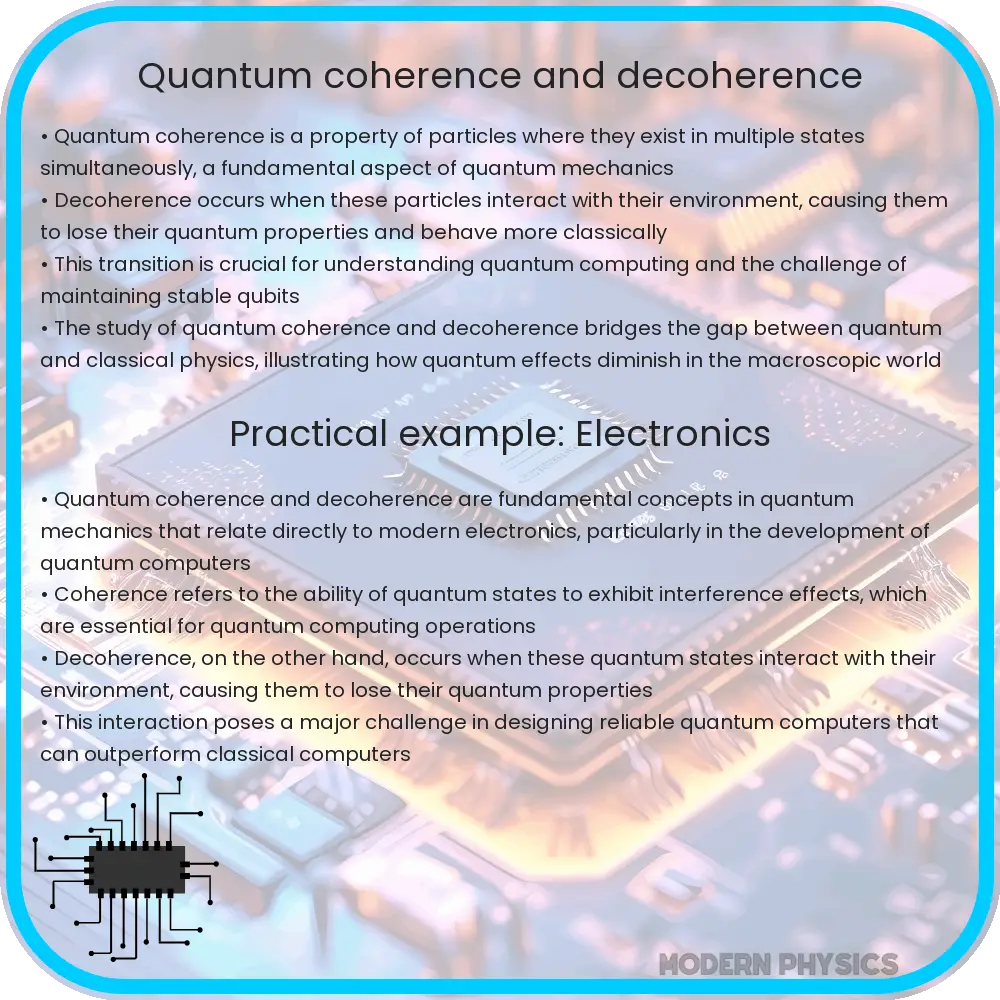
Quantum coherence lies at the heart of quantum optics, a field that explores the quantum mechanical properties of light and its interactions with matter. This phenomenon is a cornerstone for understanding the stability and control mechanisms in quantum systems, enabling advancements in quantum computing, communication, and sensing technologies. In essence, quantum coherence refers to the preservation of the phase relationship between different states in a quantum system, which is fundamental for the superposition principle that allows quantum particles to exist in multiple states simultaneously.
The Role of Quantum Coherence in Stability and Control
Stability and control in quantum systems are crucial for practical applications in quantum technology. Quantum coherence enables the precise manipulation of quantum states, which is essential for the development of stable quantum systems that can withstand environmental disturbances. This is particularly important in quantum computing, where qubits must maintain coherence long enough to perform complex calculations. The challenge lies in isolating these systems from their surroundings to prevent decoherence, a process where the quantum system loses its quantum properties and behaves more classically due to interactions with the environment.
Quantum Optics: A Gateway to Controlling Quantum States
Quantum optics provides a powerful framework for studying and controlling quantum coherence. Through the use of photons – particles of light – researchers can probe, manipulate, and entangle quantum states without directly interacting with them. This indirect method of control is less likely to introduce decoherence, making it an invaluable tool for quantum computing and communication. Techniques such as laser cooling and optical traps have enabled the creation of highly controlled environments for quantum experiments, leading to groundbreaking advancements in quantum technology.
Advancements in Quantum Coherence
Recent advancements in quantum optics have led to significant improvements in the stability and control of quantum systems. For instance, the development of quantum error correction codes and topological quantum computing offers promising solutions to the problem of decoherence, allowing quantum systems to maintain coherence over longer periods. Additionally, the exploration of new materials and nanostructures has opened up novel pathways for enhancing quantum coherence at room temperature, a critical step towards the widespread adoption of quantum technologies.
Enhancing Quantum Coherence Through Engineering and Technology
The engineering of quantum systems and the integration of advanced technologies play pivotal roles in enhancing quantum coherence. Innovations in materials science, such as the use of diamond vacancies or two-dimensional materials, have shown remarkable potential in hosting quantum states with high levels of coherence. Furthermore, the application of quantum control techniques, such as dynamic decoupling and quantum feedback control, has provided powerful methods for mitigating decoherence and extending the coherence times of quantum systems.
Quantum Optics in Quantum Information Science
Quantum optics not only facilitates the understanding and manipulation of quantum coherence but also serves as a foundation for quantum information science. The ability to generate, manipulate, and detect photons with high precision allows for the implementation of quantum communication protocols, such as quantum cryptography and teleportation. These applications leverage the entanglement and superposition principles, enabled by quantum coherence, to perform tasks that are impossible with classical systems, offering unprecedented levels of security and efficiency.
Future Perspectives and Challenges
As the field of quantum optics continues to evolve, it faces both exciting opportunities and significant challenges. The quest for scalable quantum systems that can operate at room temperature and integrate seamlessly with existing technology is ongoing. Researchers are also focused on developing more robust methods for protecting quantum coherence against decoherence mechanisms, which is crucial for the practical implementation of quantum technologies. Moreover, the interdisciplinary nature of quantum optics, intersecting with physics, engineering, and computer science, necessitates a collaborative approach to harness the full potential of quantum technologies.
Conclusion
Quantum coherence, a fundamental aspect of quantum optics, plays a crucial role in the stability and control of quantum systems, driving innovations in quantum computing, communication, and sensing. The field of quantum optics offers powerful tools for manipulating quantum states, paving the way for advancements in quantum technology. Despite the challenges of decoherence and scalability, ongoing research and interdisciplinary collaboration are leading to significant developments in enhancing quantum coherence and realizing the practical applications of quantum technologies. As we continue to unlock the mysteries of quantum mechanics, the prospects for future quantum technologies appear increasingly promising, with the potential to revolutionize information processing and communication.