
Explore the intriguing world of quantum cloning, its principles, applications in cryptography, computing, and how it challenges quantum mechanics.
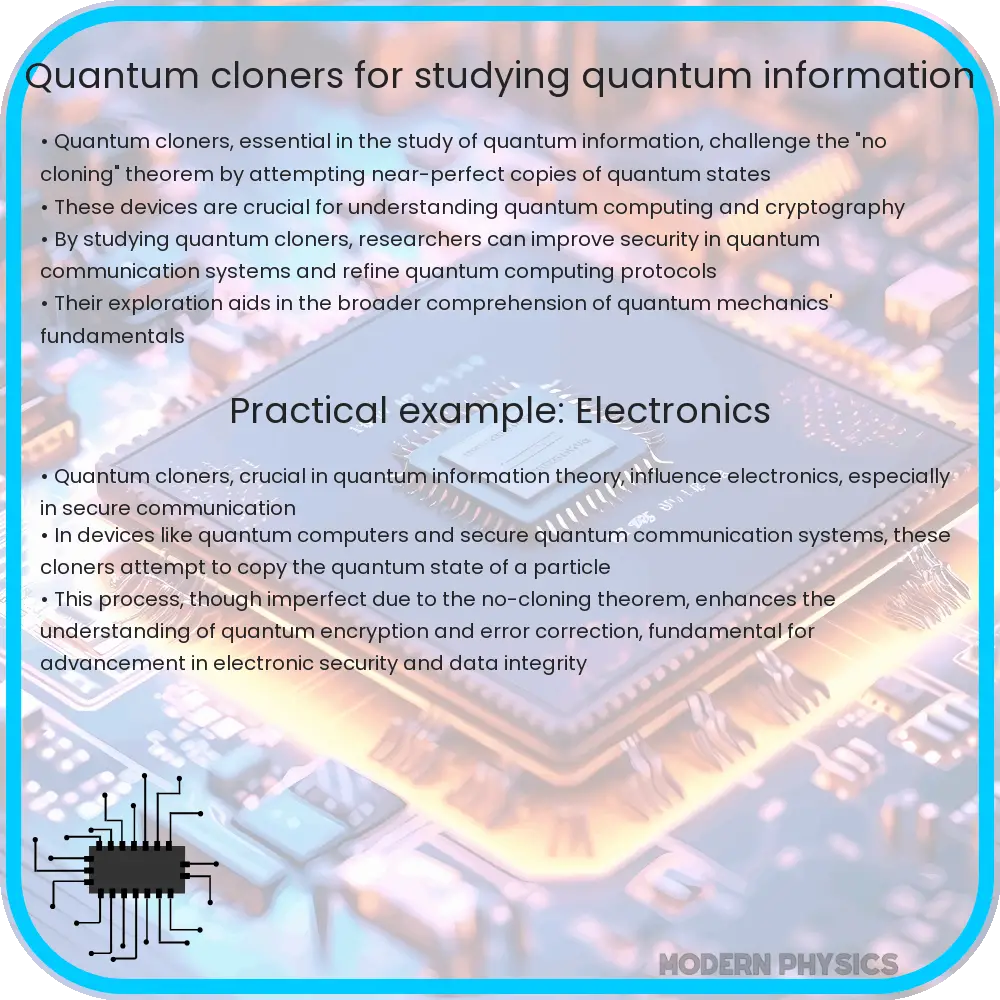
Quantum Cloners: Unveiling the Mysteries of Quantum Technology
At the forefront of modern physics and technology lies the fascinating and complex world of quantum mechanics. Among its most intriguing concepts is the notion of quantum cloning, a process that defies the conventional laws of nature as understood in the classical world. Quantum cloning explores the limits and possibilities of copying quantum states, a task that is both conceptually challenging and technologically significant.
Quantum mechanics, a theory that underpins the smallest scales of energy and particles in the universe, operates under principles vastly different from those of classical physics. One such principle is the no-cloning theorem, which asserts that it is impossible to create an identical copy of an arbitrary unknown quantum state. This theorem is fundamental to understanding the peculiarities and potential of quantum cloning.
The No-Cloning Theorem and Its Implications
Discovered in 1982 by Wootters, Zurek, and Dieks, the no-cloning theorem presents a profound barrier in quantum mechanics. It states that perfect cloning, or creating an exact replica of an unknown quantum state, is not feasible due to the principles of quantum mechanics. This limitation is not just technical but is deeply rooted in the very nature of quantum systems.
The theorem has significant implications for quantum computing and quantum communication. In quantum computing, it ensures the security of quantum information, as it prevents the undetectable copying of quantum bits (qubits). Similarly, in the realm of quantum communication, it underpins the security of quantum cryptography, a method for secure communication based on quantum principles.
Approximate Quantum Cloning
While perfect cloning is impossible, the concept of approximate quantum cloning has emerged. This involves creating a copy that is not perfect but close enough to the original quantum state. Such cloning techniques have practical applications in quantum computing, where they can be used to optimize certain computational processes or enhance the performance of quantum algorithms.
Approximate quantum cloning involves complex quantum operations that delicately balance the fidelity of the copy and the constraints imposed by quantum mechanics. This balance is key to maximizing the usefulness of the cloned quantum states while adhering to the fundamental principles of quantum mechanics.
Advancements in quantum cloning have the potential to revolutionize various fields, from secure communication to advanced computational methods. As research in this area progresses, it is expected to uncover new aspects of quantum mechanics and open doors to innovative technological applications.
Understanding the intricacies of quantum cloning requires a deep dive into the quantum mechanical framework. The next section will explore the technicalities and applications of quantum cloning in greater detail, shedding light on how this concept is pushing the boundaries of what’s possible in the quantum realm.
Technicalities of Quantum Cloning
Quantum cloning operates under the principles of quantum superposition and entanglement. Superposition allows a quantum state to be in a combination of all its possible states simultaneously, whereas entanglement creates a correlation between quantum states. In cloning, these principles enable the generation of a state that is the closest possible copy of the original.
The accuracy of a quantum clone is quantified by its fidelity, a measure of how close the cloned state is to the original. High fidelity is desirable, but the no-cloning theorem ensures that it can never be perfect. Quantum cloning machines, theoretical constructs that execute cloning, are designed to optimize this fidelity within the constraints of quantum mechanics.
Applications of Quantum Cloning
Quantum cloning finds its applications in several key areas of quantum technology. In quantum cryptography, cloning can be used to enhance the security protocols by detecting eavesdropping attempts, as any interference would reduce the fidelity of quantum states. In quantum computing, cloning helps in error correction and the distribution of quantum information across multiple qubits, an essential process for reliable quantum computation.
Furthermore, quantum cloning is crucial in quantum teleportation, where it can assist in transmitting quantum information over large distances with minimal loss of fidelity. This has profound implications for creating quantum networks and achieving quantum communication on a global scale.
Conclusion
Quantum cloning represents a frontier in quantum science and technology, blending the abstract concepts of quantum mechanics with practical applications. While the no-cloning theorem imposes strict limits on the ability to duplicate quantum states, the development of approximate quantum cloning techniques has opened new avenues in quantum computing, cryptography, and teleportation.
The exploration of quantum cloning continues to challenge our understanding of the quantum world. It pushes the boundaries of what we know about information, matter, and the fundamental laws of nature. As we delve deeper into this field, we can expect to see groundbreaking innovations and advancements that could redefine technology, security, and communication in the quantum era. The journey into the quantum realm is just beginning, and quantum cloning is at the heart of this exciting and uncharted territory.