
Explore the intricacies of Quantum Chromodynamics (QCD), its advancements, challenges, and impact across physics and technology.
Understanding Quantum Chromodynamics: Precision and Complexity
Quantum Chromodynamics (QCD) is a cornerstone of modern physics, forming a vital part of the Standard Model of particle physics. It is the theory that describes the strong interaction, one of the four fundamental forces, responsible for holding the nuclei of atoms together. At its heart, QCD deals with quarks and gluons, the basic constituents of protons, neutrons, and other hadrons.
The complexity of QCD arises from the nature of the strong force itself. Unlike the electromagnetic force, which weakens with distance, the strong force becomes stronger as quarks move apart. This phenomenon is known as “color confinement,” implying that quarks are always bound together, making direct observation challenging. The strength of the strong force is measured by a parameter called the strong coupling constant, denoted as αs. This constant is not truly constant but varies with the energy scale of the interaction, a feature known as “asymptotic freedom.
Advances in Quantum Chromodynamics
Significant advances in QCD have been made since its inception in the 1970s. One of the major triumphs was the experimental verification of asymptotic freedom, which earned the Nobel Prize in Physics in 2004. High-energy experiments, such as those conducted at the Large Hadron Collider (LHC), have provided vital insights into the behavior of quarks and gluons at extreme conditions.
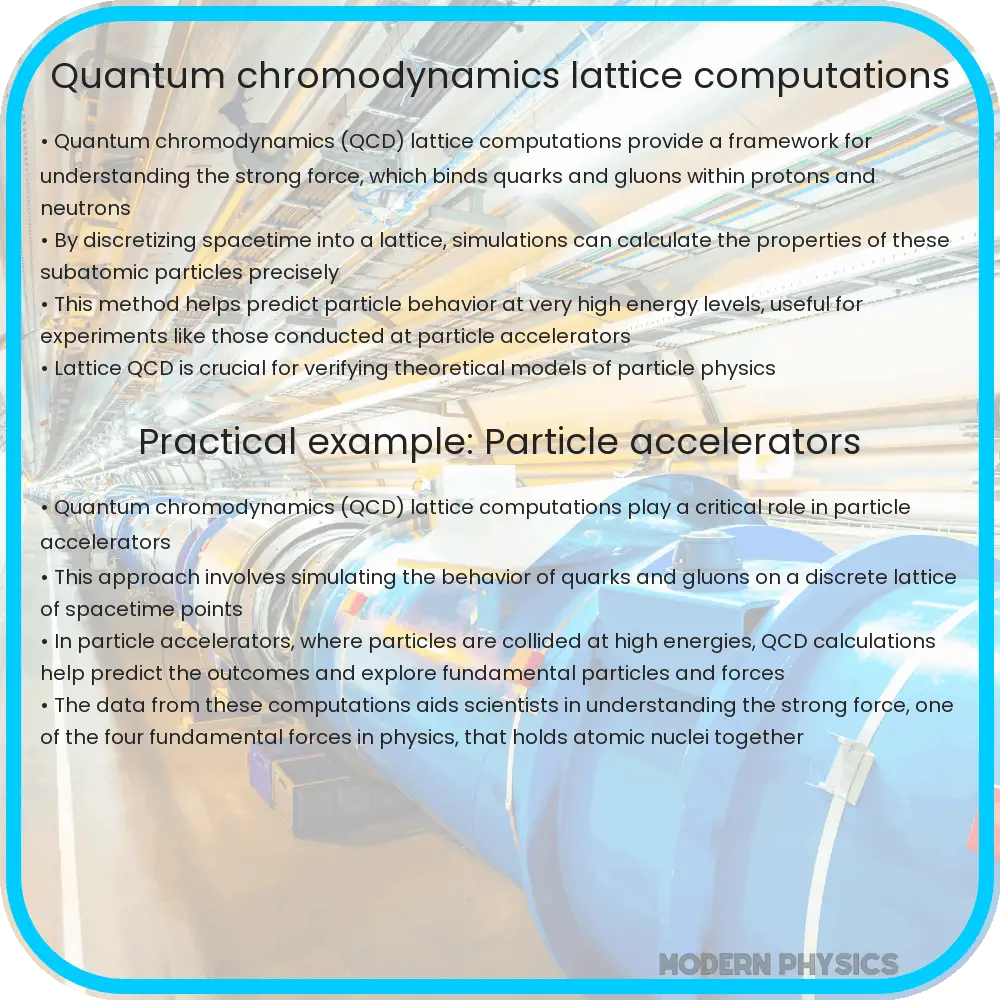
Another crucial development in QCD is the concept of lattice QCD. This computational approach discretizes space and time into a grid or lattice, allowing the calculation of QCD interactions in a controlled manner. Lattice QCD has been instrumental in predicting the masses of various hadrons and understanding the structure of protons and neutrons.
Despite these advances, challenges remain. The complexity of the strong interaction means that many QCD predictions are difficult to compute. Theoretical physicists rely on perturbation theory for high-energy interactions, where the coupling constant is small, and non-perturbative methods like lattice QCD for low-energy phenomena. However, there are still gaps in our understanding, particularly in the transition region between these two regimes.
Challenges and Future Directions in Quantum Chromodynamics
The intricate nature of QCD presents several challenges. One of the most significant is the quark-gluon plasma (QGP), a state of matter believed to have existed just after the Big Bang. In QGP, quarks and gluons are free from their usual confinement within hadrons, a condition replicated in high-energy particle colliders. Understanding QGP not only tests the limits of QCD but also provides insights into the early universe’s conditions.
Another area of active research is the proton spin puzzle. For decades, scientists have been trying to understand how the spin of a proton arises from its constituents – quarks and gluons. Recent experiments and lattice QCD calculations have shed some light, but a complete picture is still elusive. This puzzle highlights the complexity of the strong interaction and the need for more sophisticated theoretical models and computational techniques.
Technological Advances and Interdisciplinary Impacts
Technological advancements have significantly influenced QCD research. Improved particle accelerators and detectors have allowed more precise measurements, while advancements in computing have made complex lattice QCD calculations feasible. These developments have not only benefited physics but also other fields like materials science and computational biology, where similar complex systems are studied.
Interdisciplinary collaboration is increasingly important in tackling QCD’s challenges. Theoretical insights from QCD are finding applications in condensed matter physics, astrophysics, and even information theory. Such cross-pollination of ideas is likely to lead to breakthroughs that transcend the boundaries of traditional disciplines.
Conclusion
Quantum Chromodynamics remains one of the most vibrant areas of research in modern physics. Its blend of theoretical depth and experimental complexity continues to challenge and inspire physicists. The advances in QCD have not only deepened our understanding of the fundamental forces of nature but also paved the way for technological and interdisciplinary innovations. As we delve deeper into the quantum world, the journey of uncovering the mysteries of QCD promises to be as rewarding as the destination itself.