
Explore the fusion of quantum chaos and QCD, unraveling the complex dynamics of quarks, gluons, and their implications in particle and cosmic physics.
Exploring the Intricacies of Quantum Chaos in QCD
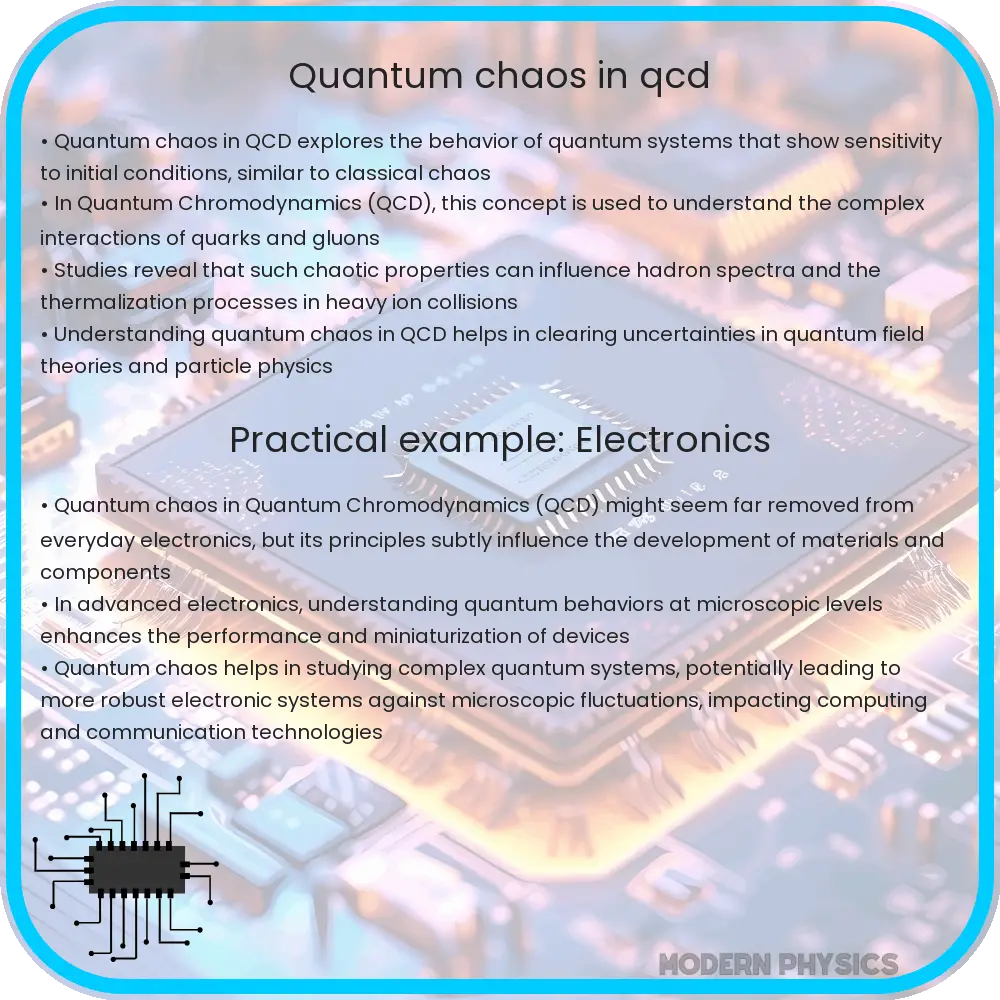
Quantum Chromodynamics (QCD), the fundamental theory describing the interactions of quarks and gluons, reveals a complex landscape when viewed through the lens of quantum chaos. This article delves into the dynamic patterns and spectral properties inherent in quantum chaotic systems, particularly focusing on their manifestations within QCD.
The Essence of Quantum Chaos
Quantum chaos is a field of study that examines the behavior of quantum systems which, in their classical limit, exhibit chaotic dynamics. Unlike classical chaos characterized by sensitivity to initial conditions and unpredictable long-term behavior, quantum chaos involves the study of how these chaotic traits manifest in the realm of quantum mechanics. The key feature of quantum chaos is the intricate patterns in the energy spectra of quantum systems, which can be analyzed using statistical methods akin to those used in random matrix theory.
Quantum Chaos in QCD
In the context of QCD, quantum chaos manifests in the interactions and dynamics of quarks and gluons, the fundamental particles that make up protons and neutrons. The non-linear nature of QCD equations makes it a fertile ground for chaotic behavior. This complexity is further compounded by the fact that quarks are never observed in isolation due to confinement, a unique property of QCD. This confinement leads to complex internal structures within hadrons (protons and neutrons), which are prime examples of quantum chaotic systems.
Patterns and Spectral Analysis
One of the key aspects of studying quantum chaos in QCD is the analysis of patterns in the spectral properties of hadrons. These patterns can provide insights into the underlying dynamics of quarks and gluons. Spectral analysis in quantum chaotic systems often reveals a level spacing distribution that follows the statistics predicted by random matrix theory, differentiating them from regular, non-chaotic systems.
Moreover, the study of quantum chaos in QCD goes beyond theoretical interest. It has practical implications in understanding the strong force, one of the four fundamental forces of nature, and its role in the universe. The insights gained from these studies can influence our understanding of nuclear physics, astrophysics, and even the early universe conditions.
Continuing research in this area is not only about charting the unknown territories of quantum chaos but also about enriching our understanding of the fundamental forces that govern the microcosmic world.
Advancements and Challenges in Quantum Chaos Research in QCD
The exploration of quantum chaos in QCD has witnessed significant advancements, thanks to the development of sophisticated computational techniques and theoretical models. Lattice QCD simulations, for instance, have played a crucial role in providing numerical solutions to QCD equations, enabling researchers to investigate the chaotic properties of quark-gluon interactions in unprecedented detail. Additionally, advancements in experimental particle physics, such as those at the Large Hadron Collider (LHC), have provided empirical data that supports theoretical predictions.
Implications for Other Fields
The insights gleaned from studying quantum chaos in QCD extend beyond the realm of particle physics. For instance, in condensed matter physics, understanding the principles of quantum chaos can shed light on the behavior of electrons in disordered systems, like irregular crystals. In cosmology, the principles of quantum chaos could provide clues about the state of the universe immediately following the Big Bang, where QCD-dominated processes played a critical role.
Future Directions
Future research in quantum chaos within the framework of QCD is poised to explore several intriguing directions. One area is the investigation of the quark-gluon plasma, a state of matter believed to have existed just after the Big Bang. Understanding the chaotic dynamics within this plasma could provide insights into the early universe’s evolution. Another area of interest is the exploration of the connection between quantum chaos and quantum computing. The complex dynamics of quantum chaotic systems might offer novel approaches to solving computational problems in quantum information theory.
Conclusion
In conclusion, the study of quantum chaos in Quantum Chromodynamics offers a fascinating intersection of quantum mechanics and chaotic dynamics. It not only enriches our understanding of the fundamental particles and forces that compose our universe but also bridges the gap between various domains of physics. As research continues to advance, it holds the promise of unveiling deeper insights into the fabric of reality, from the smallest scales of quarks and gluons to the vast cosmos. The journey into the chaotic world of QCD is not just about understanding the quirks of quantum mechanics but also about piecing together the puzzle of the universe itself.