
Explore the fascinating world of quantum beats in optics, their precision, coherence, and applications in spectroscopy, quantum computing, and cryptography.
Understanding Quantum Beats in Optics
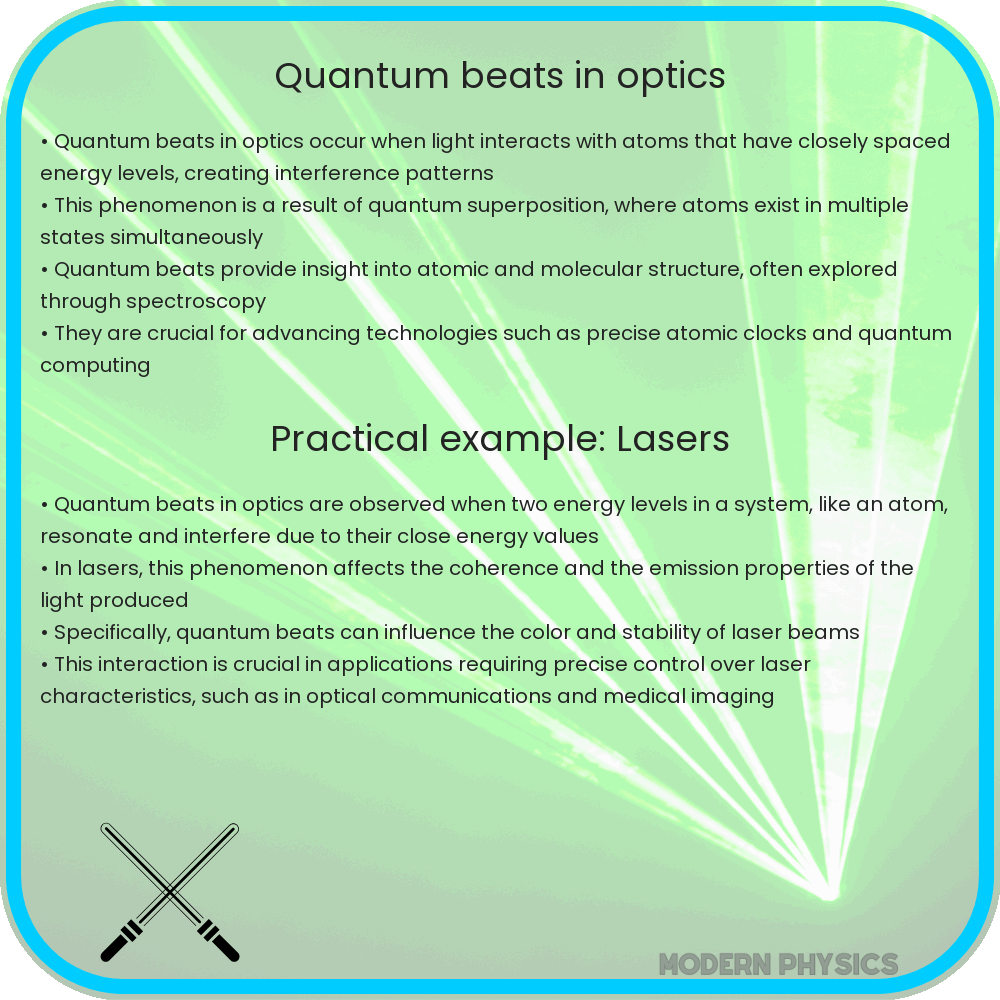
Quantum beats in optics represent a fascinating phenomenon that highlights the coherence and interference effects of quantum states. This intricate dance of light and matter is not just a subject of theoretical interest but has practical applications in various fields such as spectroscopy, quantum computing, and precision measurements. To grasp the essence of quantum beats, it’s essential to understand the principles of quantum mechanics that underpin this phenomenon.
Precision and Coherence in Quantum Beats
At the heart of quantum beats lies the principle of superposition, where quantum systems can exist in multiple states simultaneously until measured. When two or more energy levels of an atom or molecule are excited simultaneously, they can interfere with each other, leading to oscillations in the probability amplitude of finding the system in a particular state. These oscillations, or quantum beats, are a direct consequence of the coherence between the quantum states involved.
The precision of quantum beats is paramount, as it directly influences their coherence time and, subsequently, their applications. Coherence time refers to the duration over which the quantum states can interfere constructively before decoherence sets in— a process where the system loses its quantum mechanical properties due to interactions with the environment. The longer the coherence time, the more precisely quantum beats can be observed and utilized.
Applications of Quantum Beats
- Precision Spectroscopy: Quantum beats are instrumental in spectroscopy, providing a way to measure energy levels and transitions with high precision. This is crucial in understanding the atomic and molecular structure of materials.
- Quantum Computing: The coherence properties of quantum beats play a pivotal role in quantum computing, where qubits (quantum bits) must maintain their state coherently for computation to occur effectively.
- Quantum Cryptography: In quantum cryptography, the security of communication relies on the principles of quantum mechanics, including quantum beats, to detect any eavesdropping attempts.
These applications are just the tip of the iceberg, showcasing the potential of quantum beats in advancing both fundamental science and technology. The ability to control and manipulate quantum beats opens up new avenues for research and innovation, making it a key area of interest in the field of quantum optics.
Is this conversation helpful so far?
Exploring the Depth of Quantum Beats
The exploration of quantum beats extends into the realm of measurement and control of quantum systems. Advanced techniques such as ultrafast laser spectroscopy and coherent control methods have been developed to observe and manipulate these beats. These technologies enable scientists to study the dynamics of quantum beats in real-time, providing insights into the mechanisms of coherence and decoherence at the quantum level.
One of the most promising aspects of quantum beats is their sensitivity to environmental changes, making them ideal for sensing applications. By monitoring the changes in the beat frequency or phase, researchers can detect minute changes in physical, chemical, or biological systems. This sensitivity has implications for the development of highly precise sensors for a range of applications, from environmental monitoring to healthcare diagnostics.
Challenges and Future Prospects
Despite their potential, the practical exploitation of quantum beats faces several challenges. Maintaining coherence over extended periods is difficult due to environmental interactions that lead to decoherence. Furthermore, the complexity of generating and detecting quantum beats requires sophisticated equipment and deep understanding of quantum mechanics.
However, ongoing research in quantum optics and quantum information science is continually pushing the boundaries of what’s possible. With advancements in technology and a deeper theoretical understanding, the hurdles faced today may soon be overcome. The future of quantum beats in optics looks promising, with potential breakthroughs in computational speed, security, and measurement precision on the horizon.
Conclusion
Quantum beats in optics are a cornerstone of quantum mechanics, showcasing the intriguing interplay between coherence, interference, and measurement. Their applications in precision spectroscopy, quantum computing, and cryptography highlight their significance in both scientific research and technological development. Despite the challenges, the ongoing advancements in quantum optics hold the promise of harnessing the full potential of quantum beats. As we continue to explore and understand these quantum phenomena, their impact on technology and science will undoubtedly grow, leading to innovations that are currently beyond our imagination. The study of quantum beats is not just an academic endeavor but a stepping stone towards the future of quantum technologies.