
Explore the revolutionary world of quantum amplifiers: their principles, types, applications, challenges, and future in technology.
Understanding Quantum Amplifiers: An Overview
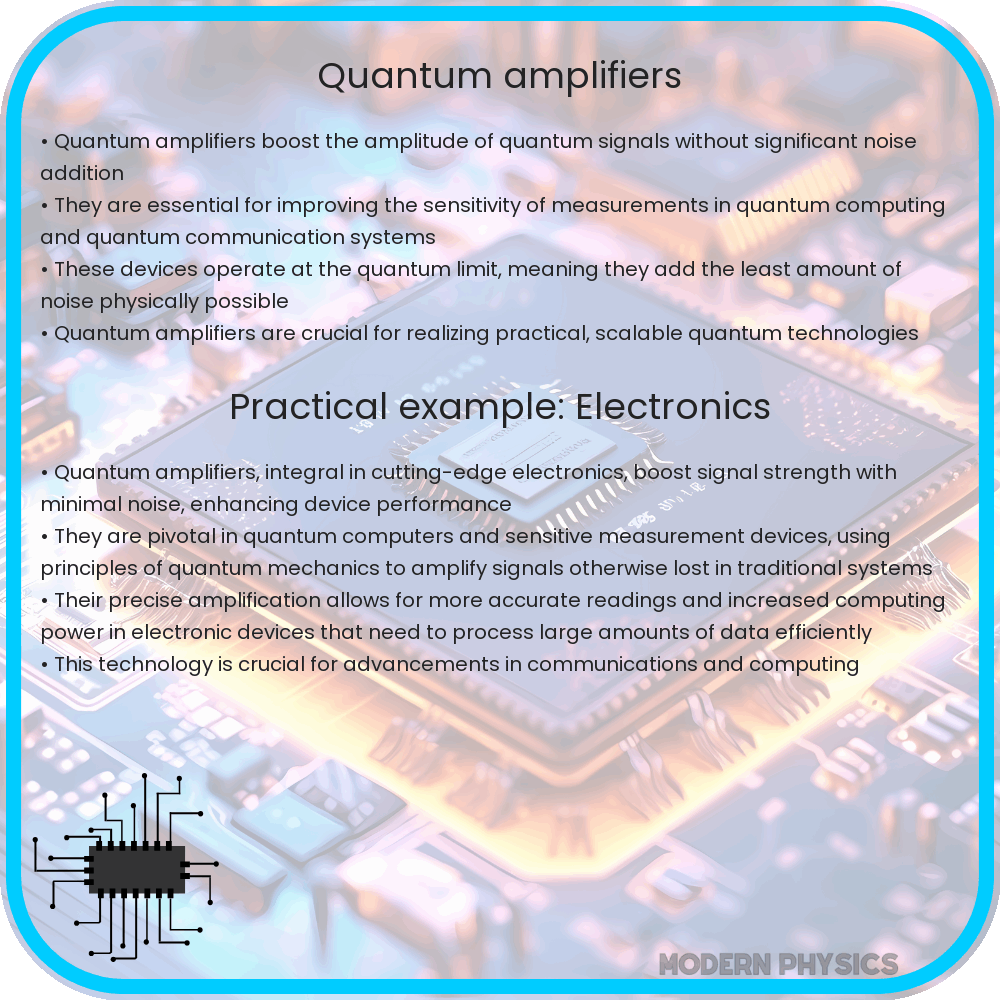
The realm of quantum amplifiers represents a significant leap in the enhancement of signal processing capabilities. These devices are designed to boost the power, precision, and overall performance of signals at the quantum level, which is crucial in a variety of advanced technological applications. In this article, we will explore the fundamental principles of quantum amplifiers, their key features, and their diverse applications.
Principles of Quantum Amplification
Quantum amplifiers operate on the principles of quantum mechanics, a domain where traditional rules of physics are superseded by probabilistic and wave-function based phenomena. At its core, a quantum amplifier aims to increase the amplitude of a quantum signal without significantly adding noise, a challenge due to the inherent uncertainty in quantum states.
One key principle behind quantum amplification is the quantum superposition, which allows particles, like photons or electrons, to exist in multiple states simultaneously. Amplifiers harness this principle to boost the signal while preserving its quantum properties, such as entanglement and coherence.
Types of Quantum Amplifiers
There are various types of quantum amplifiers, each suited for specific applications:
- Parametric Amplifiers: These use a nonlinear medium to amplify a quantum signal. They are highly efficient and can preserve the quantum state of the input signal.
- Optical Amplifiers: These amplify light signals and are pivotal in quantum communication and quantum computing.
- Superconducting Amplifiers: Employing superconducting circuits, these amplifiers are integral in quantum computing for signal processing at extremely low temperatures.
Applications and Advantages
Quantum amplifiers find their application in a myriad of cutting-edge technologies. In quantum computing, they are used to enhance the fidelity of qubits and maintain coherence. Quantum communication systems benefit from amplifiers by achieving longer distances and higher security in data transmission. Additionally, in precision measurement and sensing, these amplifiers significantly improve signal-to-noise ratios, allowing for more accurate detections.
One of the most significant advantages of quantum amplifiers is their ability to operate near the quantum limit, which means they add minimal noise to the signal. This aspect is crucial for maintaining the integrity of quantum information and for the practical implementation of quantum technologies.
Challenges and Future Developments
Despite their numerous advantages, quantum amplifiers face several challenges. The primary challenge is maintaining quantum coherence over time and during the amplification process. Quantum signals are incredibly fragile and can be easily disrupted by environmental factors. This necessitates the development of amplifiers that not only boost signal strength but also preserve quantum states effectively.
Another challenge is the integration of quantum amplifiers into existing technology infrastructures. As quantum technology is still in its nascent stage, significant advancements in engineering and material science are required to make these amplifiers compatible with current systems.
Future developments in quantum amplification technology are focused on overcoming these challenges. Research is ongoing in areas like developing materials that can operate at higher temperatures, thereby reducing the need for complex cooling systems. There is also a strong emphasis on miniaturization and improving the scalability of quantum amplifiers to make them more practical for everyday applications.
Conclusion: The Quantum Leap Forward
Quantum amplifiers represent a significant stride in the evolution of signal processing technology. By leveraging the principles of quantum mechanics, they offer unparalleled precision and power in amplifying signals. Their applications in quantum computing, communication, and precision measurement are poised to revolutionize these fields, offering capabilities far beyond what is possible with classical technologies.
However, the journey ahead is not without its challenges. The fragility of quantum states and the need for seamless integration into existing systems pose significant hurdles. But with the rapid pace of advancements in quantum physics and engineering, the potential of quantum amplifiers is vast and promising. As research continues to address these challenges, we can expect quantum amplifiers to play a pivotal role in ushering in a new era of technological innovation, marked by quantum leaps in capability and performance.