
Explore the complexities of the QCD Vacuum Structure, its role in particle physics, and its implications for the universe and matter formation.
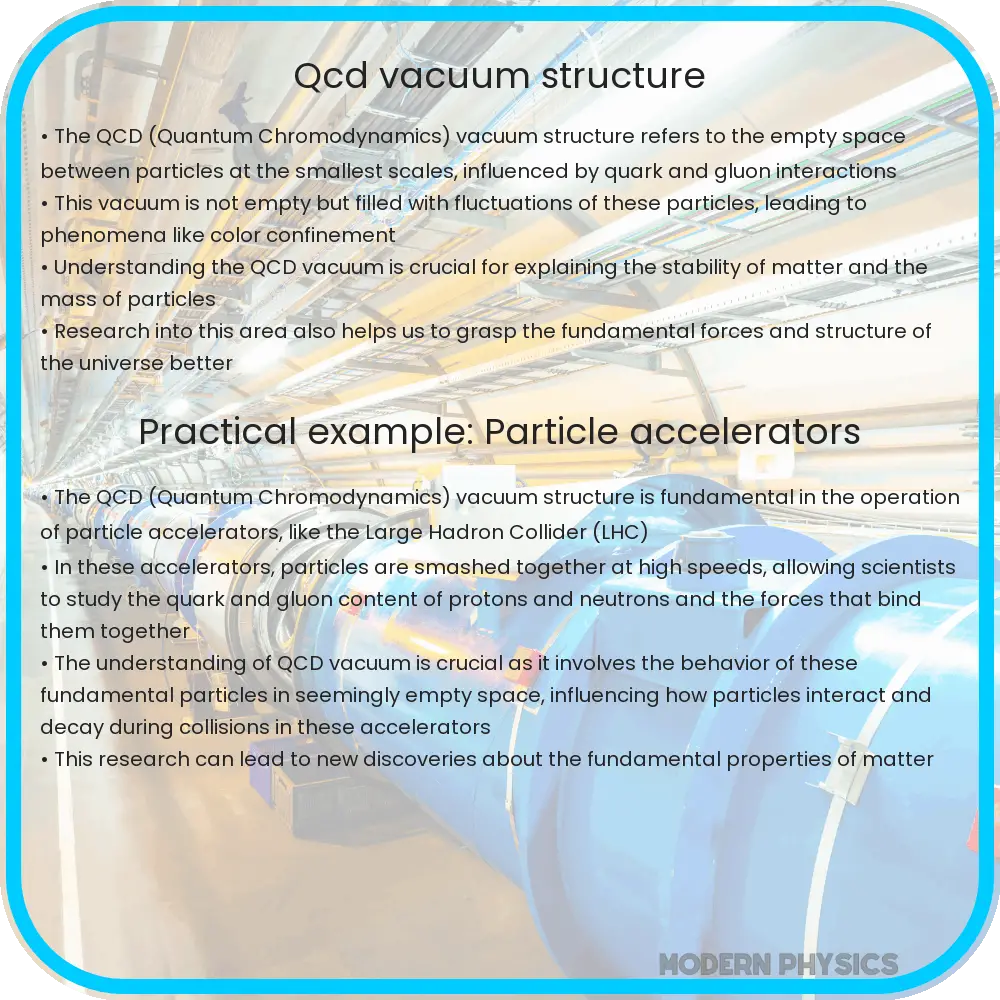
Understanding the QCD Vacuum Structure
The Quantum Chromodynamics (QCD) vacuum structure is an intricate and fundamental aspect of modern physics, particularly in the field of particle physics. QCD, a theory that describes the strong interaction—one of the four fundamental forces of nature—illuminates the behavior of quarks and gluons, the elementary particles that make up protons, neutrons, and other hadrons. This article delves into the complexities of the QCD vacuum, providing insights into its unique characteristics and the pivotal role it plays in the universe.
Fundamentals of QCD Vacuum
The vacuum in QCD is far from being a simple empty space. Contrary to the classical notion of a vacuum as a void, the QCD vacuum is a dynamic and complex state teeming with quark-antiquark pairs and gluons. These particles constantly pop in and out of existence, a phenomenon known as vacuum fluctuations. The unique property of QCD, asymptotic freedom, indicates that quarks behave almost freely at extremely high energies or equivalently, at very short distances. However, at lower energies, they are strongly bound by gluons, the carriers of the strong force, which exhibits the property of confinement.
Analysis of the Vacuum Structure
Analyzing the QCD vacuum involves understanding two key phenomena: confinement and chiral symmetry breaking. Confinement refers to the fact that quarks and gluons are never found in isolation, but are always confined within hadrons. This is a result of the nature of the strong force, which becomes stronger as quarks move apart. Chiral symmetry breaking, on the other hand, is a spontaneous phenomenon wherein the massless quarks acquire mass, contributing significantly to the mass of hadrons.
One of the critical tools in analyzing the QCD vacuum is lattice QCD, a computational approach that discretizes space-time into a lattice, allowing for numerical simulations of QCD. These simulations have been pivotal in understanding the vacuum structure, including the distribution and dynamics of quarks and gluons within it.
Experiments in high-energy physics, such as those conducted at the Large Hadron Collider (LHC), also provide invaluable data for understanding the QCD vacuum. Collisions at high energies momentarily replicate conditions akin to those of the early universe, allowing physicists to observe the behavior of quarks and gluons under extreme conditions.
Moreover, the QCD vacuum has implications beyond particle physics. It plays a crucial role in the stability of matter and the formation of complex structures in the universe. The understanding of the QCD vacuum is not only a pursuit of fundamental knowledge but also a window into the early moments of the universe and the forces that shaped it.
Insights from QCD Vacuum Studies
Advancements in the study of the QCD vacuum have led to profound insights into the fundamental nature of matter. One intriguing aspect is the role of the QCD vacuum in the early universe. During the first moments after the Big Bang, the universe was in a state where quarks and gluons were not confined within hadrons. This primordial state, known as the quark-gluon plasma, is actively studied in high-energy physics experiments. Understanding the transition from this plasma to a universe filled with hadrons involves studying the dynamics of the QCD vacuum.
Another important insight relates to the concept of vacuum energy. In quantum field theory, the energy of the vacuum contributes to the overall energy density of the universe, playing a potential role in cosmological phenomena such as dark energy. However, there exists a significant discrepancy between theoretical predictions of vacuum energy and observations, known as the “cosmological constant problem. This disparity remains one of the biggest unsolved puzzles in modern physics.
Challenges and Future Directions
Despite significant progress, the complete understanding of the QCD vacuum structure poses a considerable challenge. The non-perturbative nature of the QCD vacuum makes it difficult to study using traditional perturbative methods. Lattice QCD provides a powerful tool, but it is computationally intensive and has its limitations, particularly in accurately simulating the dynamics of quarks at high temperatures and densities. Future research in quantum computing may offer new avenues for solving these complex problems.
Furthermore, ongoing and upcoming experiments in particle physics are expected to shed more light on the QCD vacuum. The LHC and future colliders aim to explore higher energy regimes, potentially revealing new aspects of the strong force and the behavior of quarks and gluons. These experiments, coupled with theoretical advancements, promise a deeper understanding of the QCD vacuum and its implications for the universe.
Conclusion
The study of the QCD vacuum structure stands at the frontier of understanding the fundamental forces of nature. It intertwines with various fields of physics, from the behavior of the smallest particles to the vastness of the cosmos. The dynamic and complex nature of the QCD vacuum challenges our conventional notions of a vacuum and offers a window into the early universe and the formation of matter as we know it. As research continues, the QCD vacuum will undoubtedly continue to be a source of fascinating discoveries and insights, deepening our comprehension of the universe’s most profound mysteries.