
Explore the accuracy, uses, and biophysics of pulse oximeters, including their role in healthcare, factors affecting accuracy, and future technological innovations.
Pulse Oximeters: An Overview of Accuracy, Uses, and Biophysical Insights
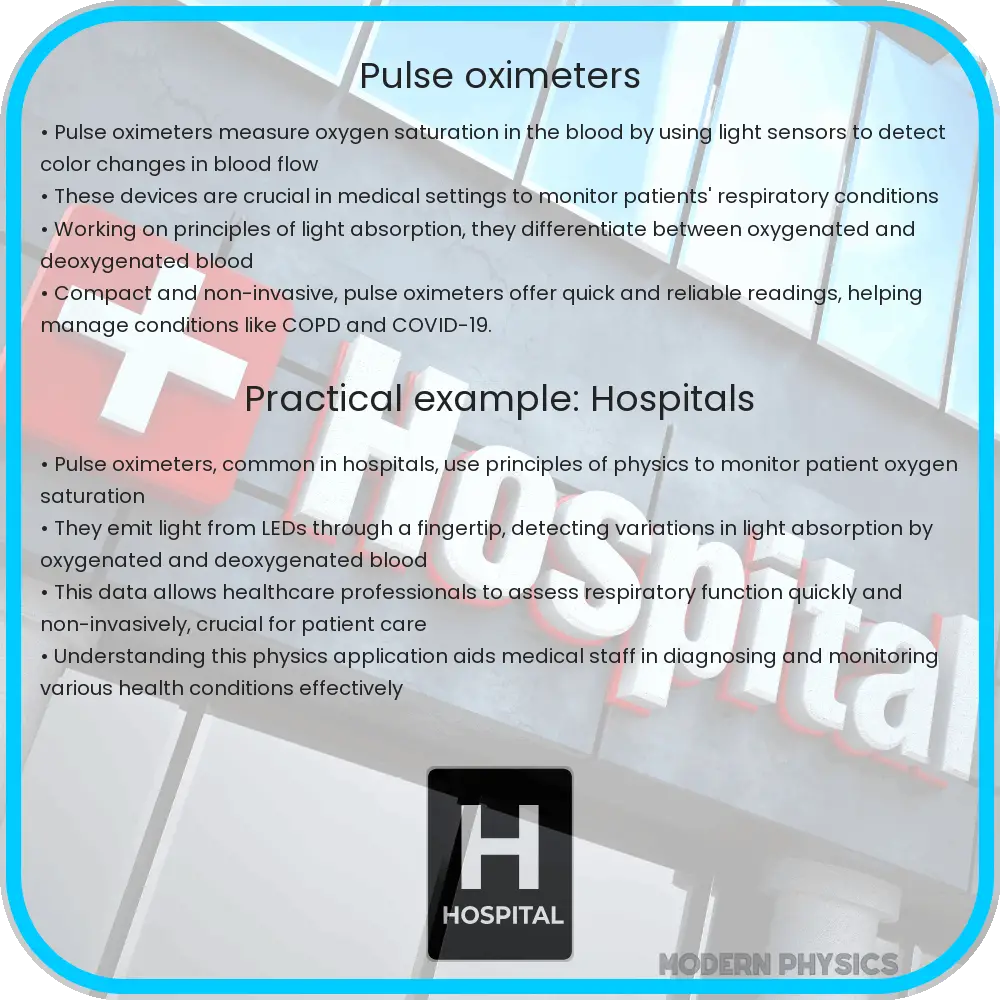
Pulse oximeters are non-invasive medical devices widely used for monitoring the oxygen saturation level (SpO2) in the blood and heart rate. These compact, clip-on devices are pivotal in both clinical and home settings for assessing a patient’s oxygenation status quickly and effectively. Understanding their accuracy, uses, and the underlying biophysics can enhance the application and interpretation of their readings.
Accuracy of Pulse Oximeters
The accuracy of pulse oximeters is crucial for patient care, especially for individuals with conditions affecting blood oxygen levels, such as chronic obstructive pulmonary disease (COPD), asthma, and COVID-19. Most pulse oximeters are designed to have an error margin within ±2% of what an arterial blood gas analysis would indicate. However, factors such as poor circulation, skin pigmentation, and the presence of nail polish can affect accuracy. Recent studies and FDA guidelines emphasize the importance of understanding these limitations and considering individual variations when interpreting results.
Uses of Pulse Oximeters
Pulse oximeters serve a broad spectrum of applications in healthcare, from monitoring oxygen levels during surgical procedures and in intensive care units to guiding treatment decisions for respiratory conditions at home. They are instrumental in:
- Assessing the need for supplemental oxygen therapy.
- Monitoring oxygen saturation levels during and after surgical procedures.
- Evaluating the effectiveness of interventions for respiratory conditions.
- Screening for sleep apnea in a home setting.
Biophysics Behind Pulse Oximetry
The principle of pulse oximetry is based on the differential absorption of red and infrared light by oxygenated and deoxygenated hemoglobin in blood. A pulse oximeter uses light-emitting diodes to project red and infrared light through a pulsatile vascular bed, typically a fingertip or earlobe. The device measures the amount of light absorption and uses this information to calculate the SpO2 level. The biophysical concept underlying this technology involves the Beer-Lambert law, which relates the concentration of a solute in a solution to the intensity of light absorbed by that solution.
Understanding the Limitations and Enhancing Accuracy
To optimize the accuracy of pulse oximetry readings, it is essential to consider several factors that can influence its performance. Movement artifacts, ambient light interference, and alterations in peripheral perfusion can lead to inaccurate readings. Advanced models of pulse oximeters incorporate algorithms to minimize the impact of these factors, but awareness and proper device application remain key. Ensuring a snug fit on the test site, avoiding measurements on extremities with poor circulation, and removing any fingernail polish or artificial nails can help improve accuracy.
Innovations and Future Directions
The ongoing evolution of pulse oximetry technology focuses on enhancing accuracy, reducing limitations, and expanding applications. Innovations such as wearable pulse oximeters integrate seamlessly into daily life, allowing continuous monitoring of oxygen levels for patients with chronic conditions. Research into multi-wavelength oximetry promises to provide more detailed insights into blood oxygenation and hemodynamics. Furthermore, the integration of artificial intelligence (AI) and machine learning algorithms in pulse oximetry is paving the way for more precise and personalized healthcare solutions.
Conclusion
Pulse oximeters are invaluable tools in modern medicine, offering a quick and non-invasive method to monitor blood oxygen saturation and heart rate. While they are generally accurate, it’s important to acknowledge and mitigate factors that can influence their performance. By understanding the biophysical principles of pulse oximetry, healthcare providers and patients can better utilize these devices for effective monitoring and management of various health conditions. Innovations in pulse oximetry technology continue to improve its accuracy, utility, and application, promising to enhance patient care and outcomes in the years to come.