
Explore the fascinating world of proximity-induced superconductivity, its theoretical background, benefits, applications, and the future of quantum technology.
Understanding Proximity-Induced Superconductivity
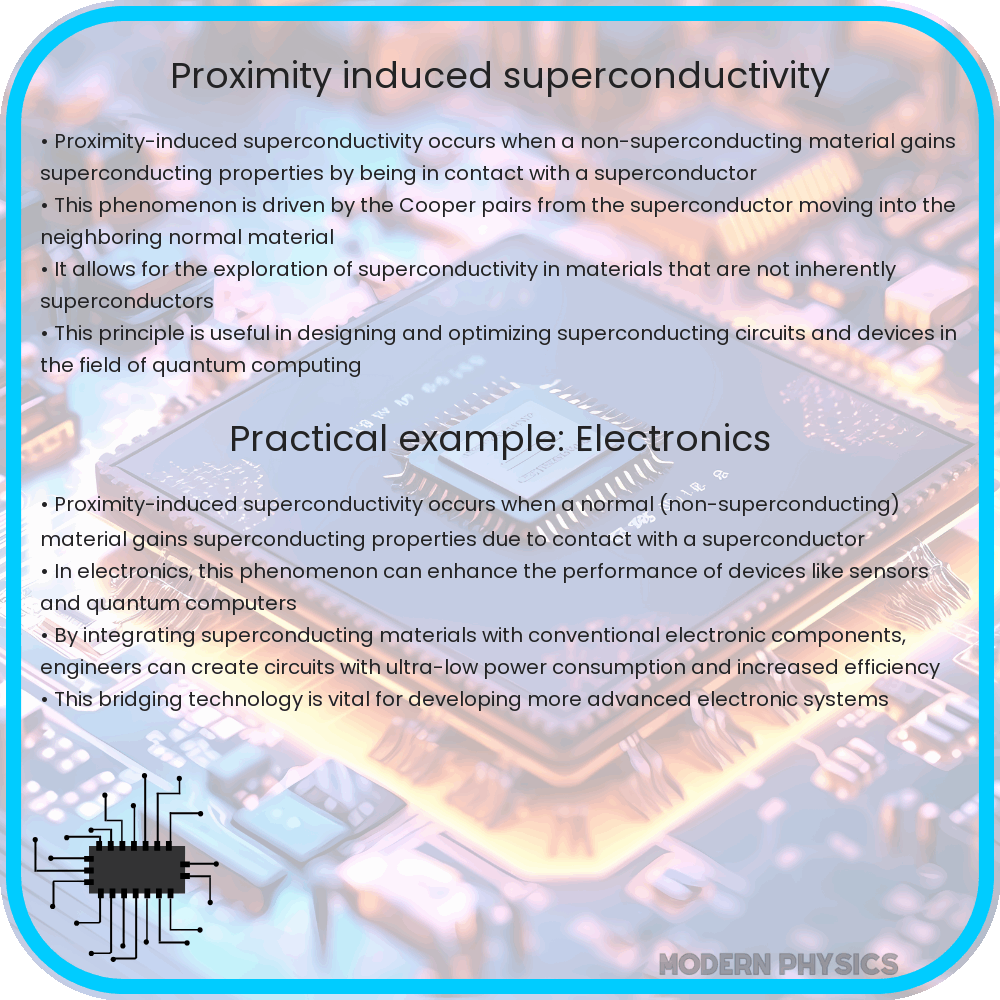
Proximity-induced superconductivity is a fascinating phenomenon where normal, non-superconducting materials gain superconducting properties when placed in close contact with a superconductor. This effect bridges the gap between conventional and quantum physics, illustrating the contagious nature of superconducting states. It opens the door to innovative applications in electronics, medical imaging, and quantum computing.
Theory Behind Proximity-Induced Superconductivity
The theoretical underpinnings of proximity-induced superconductivity lie in the concept of Cooper pair leakage. In superconductors, electrons form pairs known as Cooper pairs, which move without resistance. When a superconductor is placed next to a normal conductor, these Cooper pairs can “leak” into the non-superconducting material, temporarily endowing it with superconductive properties. This occurs over a characteristic length scale, typically within a few nanometers to micrometers, depending on the materials and temperatures involved.
Benefits of Proximity-Induced Superconductivity
One of the primary benefits of proximity-induced superconductivity is its ability to create superconducting conditions without the need for the entire system to be superconducting. This can significantly reduce costs and increase the feasibility of superconducting technologies. Additionally, it allows for the exploration of new physical phenomena and the development of hybrid devices that combine the best properties of superconductors with those of normal materials.
- Enhanced Efficiency: Devices utilizing proximity-induced superconductivity can operate with higher efficiency due to reduced energy losses.
- Innovative Applications: Enables the development of novel superconducting circuits, sensors, and quantum computing elements that were previously impractical.
- Material Flexibility: Allows for the use of diverse materials, paving the way for more adaptable and cost-effective superconducting technologies.
The integration of proximity-induced superconductivity into practical applications hinges on our understanding and manipulation of this quantum mechanical effect. By tailoring the interface between superconducting and non-superconducting materials, researchers aim to harness the full potential of this intriguing phenomenon.
Applications of Proximity-Induced Superconductivity
The applications of proximity-induced superconductivity are vast and varied, extending into multiple high-tech fields. In quantum computing, for example, this phenomenon is used to create qubits, the basic units of quantum information, which can operate at higher temperatures than those made from only conventional superconductors. Additionally, in electronics, it enables the development of superconducting transistors and SQUIDs (Superconducting Quantum Interference Devices), which are crucial for ultra-sensitive magnetic measurements used in medical imaging and geology.
Challenges and Future Directions
Despite its potential, the practical implementation of proximity-induced superconductivity faces several challenges. These include maintaining stable superconducting states at higher temperatures and over larger distances, as well as ensuring the reliability and durability of superconducting interfaces. Future research is directed towards overcoming these hurdles by exploring new superconducting materials, improving interface engineering, and understanding the complex quantum mechanics at play. Success in these areas could revolutionize technology as we know it, leading to more efficient energy systems, advanced computational capabilities, and innovative diagnostic tools.
Conclusion
Proximity-induced superconductivity represents a cornerstone of modern physics, offering a window into the quantum world while promising groundbreaking advancements in technology. Its ability to impart superconducting properties to non-superconducting materials has paved the way for innovative applications, from quantum computing to advanced medical imaging. Despite facing significant challenges, the ongoing research and development in this field are poised to overcome these obstacles, heralding a new era of superconducting technology. As we continue to explore and harness this remarkable phenomenon, we move closer to realizing the full potential of proximity-induced superconductivity, promising a future replete with technological marvels and scientific breakthroughs.