
Explore the formation, evolution, and observation of protostellar objects, the building blocks of stars, and understand the cosmic journey from dust to celestial bodies.
Protostellar Objects: Pillars of Star Formation
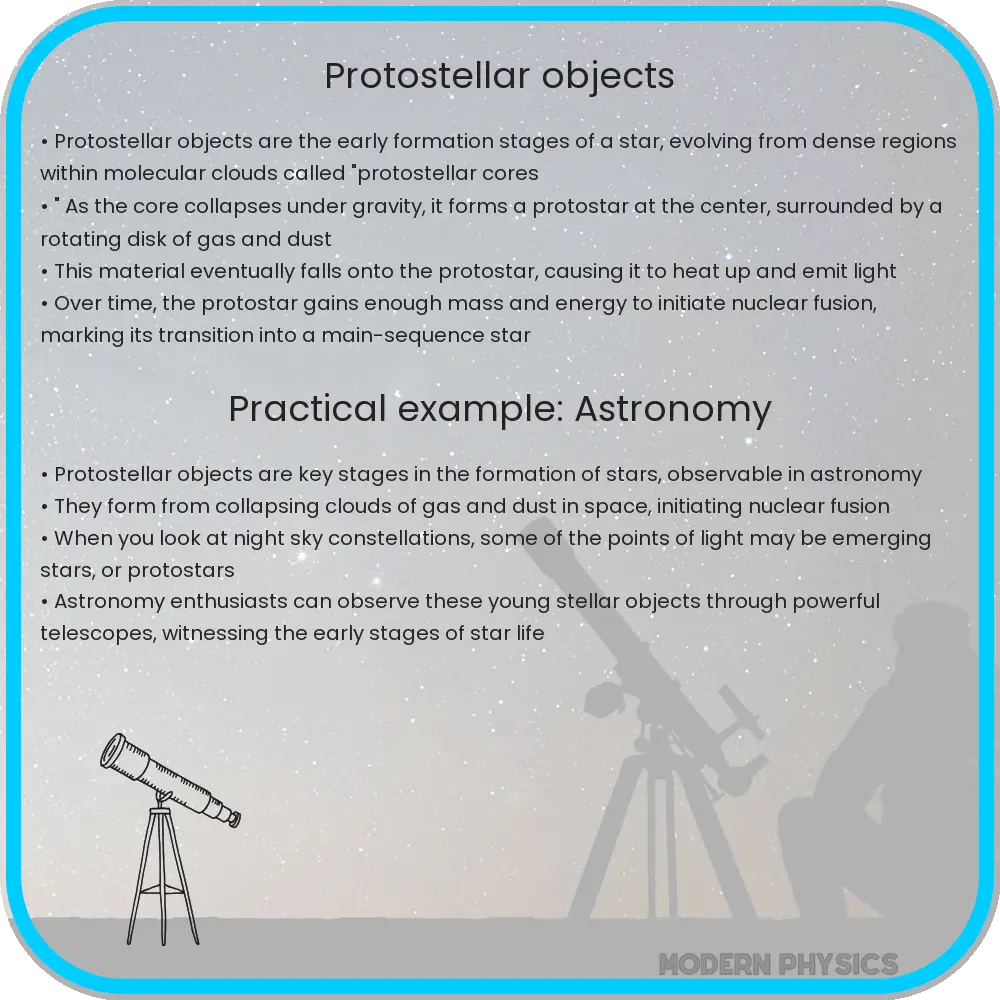
Protostellar objects, often encapsulated within dense cosmic clouds, represent the embryonic phase in the life cycle of a star. These nascent structures are born from the gravitational collapse of gas and dust within molecular clouds, marking the preliminary stage before a star reaches full maturity. This article delves into the fascinating journey of protostellar objects from their formation to their evolution, and how astronomers observe these celestial infants.
Formation of Protostellar Objects
The genesis of a protostellar object commences in the cold, dark regions of a molecular cloud, often triggered by external forces such as shock waves from nearby supernovae or collisions between galaxies. In these dense cloud cores, temperatures plummet below -260°C, setting an ideal stage for star formation. Under the relentless pull of gravity, the cloud begins to collapse, leading to an increase in density and temperature at the core.
During this collapse, angular momentum and magnetic fields play crucial roles in shaping the nascent star. A rotating disk, known as the accretion disk, forms around the central core, funneling material onto the protostar. Meanwhile, jets and outflows eject excess angular momentum, allowing the object to continue contracting.
Evolution into Main Sequence Stars
As the protostellar object accumulates mass from its surroundings, its internal temperature soars, eventually igniting nuclear fusion reactions in its core. Hydrogen atoms combine to form helium, releasing immense energy in the process – a hallmark of a true star. This phase, known as the T Tauri phase for young solar-like stars, is characterized by erratic luminosity and strong stellar winds.
The path from a protostellar object to a main sequence star is a delicate interplay of mass, temperature, and time. Stars like our Sun may take approximately 10 million years to transition from protostellar status to main sequence adulthood, shedding their dusty cocoons to shine brightly in the cosmos.
Observation of Protostellar Objects
Astronomers employ a variety of observational techniques to study protostellar objects. Infrared telescopes pierce through the obscuring dust, capturing the warm glow of these infant stars. Radio and millimeter-wave telescopes map out the density and temperature of the surrounding gas, offering clues about the mass and age of the protostar. Additionally, spectroscopy provides insights into the chemical composition and physical conditions within the protostellar environment.
Chemical Complexity and Protostellar Formation
The environments surrounding protostellar objects are rich in chemical complexity. Molecules such as water (H2O), carbon monoxide (CO), and ammonia (NH3) are commonly found in these regions. Observations and studies of these molecules help scientists understand the physical conditions and processes occurring during star formation. For instance, the presence of certain molecules can indicate the temperature, density, and evolutionary stage of the protostellar object.
Challenges in Observing Protostellar Objects
Despite technological advancements, observing protostellar objects remains a challenging endeavor due to their immense distances, small sizes, and the dense dust that shrouds them. Interstellar dust can absorb and scatter visible light, making protostars invisible to traditional optical telescopes. However, advancements in infrared, submillimeter, and radio astronomy have significantly improved our ability to detect and study these celestial bodies, unveiling the intricate details of star formation.
Future Prospects in Protostellar Research
The future of protostellar research looks promising with the advent of next-generation telescopes and observational technologies. Instruments such as the James Webb Space Telescope (JWST) and the Atacama Large Millimeter/submillimeter Array (ALMA) are expected to provide unprecedented views of protostellar objects, delving deeper into their formation mechanisms and the initial conditions for planetary systems. These advancements will not only enhance our understanding of star formation but also shed light on the origins of our own Solar System.
Conclusion
Protostellar objects serve as fundamental components in the cosmic tapestry, bridging the gap between interstellar clouds and fully formed stars. From their initial formation in the cold expanse of molecular clouds to the fiery ignition of nuclear fusion, these celestial entities trace the intricate path of stellar evolution. Observational challenges notwithstanding, the continuous advancements in astronomical technologies are unlocking new horizons in our quest to understand these stellar infants. As we stand on the brink of new discoveries, the study of protostellar objects remains a cornerstone in unraveling the mysteries of our universe.