
A fundamental concept in physics, pressure describes the force applied per unit area of a surface, critical for analyzing forces, motion, and equilibrium in various physical contexts.
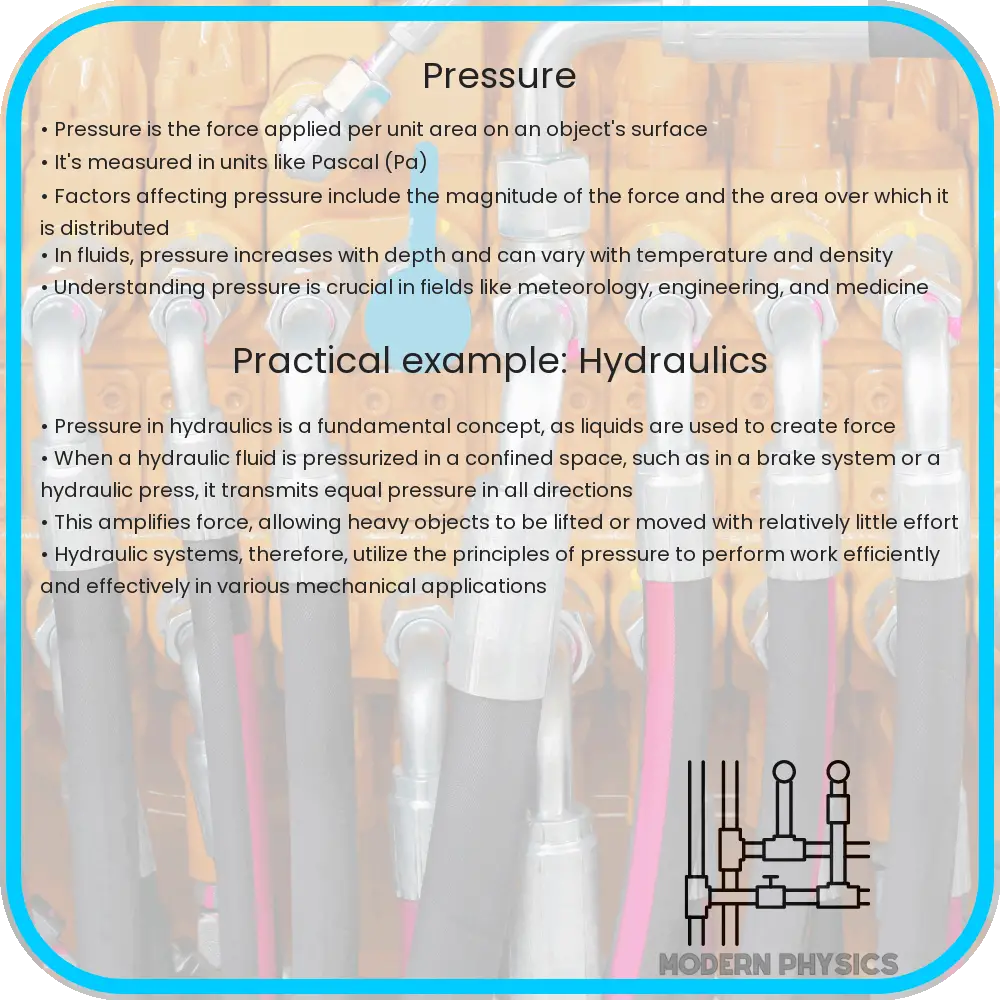
Understanding Pressure in Dynamics: Forces, Motion, and Equilibrium
Pressure is a fundamental concept in physics, intertwined with the dynamics of forces, motion, and equilibrium. It describes the amount of force exerted per unit area of a surface and is a critical factor in studying the behavior of fluids and gases as well as solid objects. In this article, we delve into the basics of pressure in dynamics, exploring its definition, formula, and implications in various physical scenarios.
What is Pressure?
Pressure (P) is defined as the force (F) applied perpendicularly to the surface of an object divided by the area (A) over which the force is distributed. The equation for pressure is thus given by:
P = F / A
Where:
- P is the pressure,
- F is the normal force,
- A is the area over which the force is applied.
Pressure is a scalar quantity, meaning it has magnitude but no direction, and it is typically measured in pascals (Pa), where 1 pascal equals 1 newton per square meter (N/m2).
Pressure in Fluids
In the context of fluids, pressure plays a pivotal role in analyzing fluid dynamics and is influenced by several factors including gravity, velocity, and the fluid’s density. The fundamental principle governing pressure in a fluid at rest is encapsulated by Pascal’s Law, which states that:
“Pressure exerted anywhere in a confined incompressible fluid is transmitted equally in all directions throughout the fluid.
Thus, for a fluid at rest, the pressure at a point is the same in all directions. This is a critical principle used in hydraulic systems, where pressure is used to lift heavy loads, operate brakes, and perform numerous other functions.
Calculating Pressure in Liquids
Consider a column of liquid that is uniformly dense and static. The pressure at any given depth can be calculated using the formula:
P = ρgh
Where:
- ρ (rho) is the density of the liquid,
- g is the acceleration due to gravity,
- h is the depth of the liquid.
This formula demonstrates that pressure in a liquid increases linearly with depth, primarily because of the weight of the liquid above increasing at greater depths.
Pressure in Gases
The behavior of gases under pressure is different from that of liquids, primarily due to their compressibility. Gases follow different laws, such as Boyle’s Law and Charles’ Law, which describe how pressure affects the volume and temperature of a gas. For example:
Boyle’s Law states that for a fixed mass of an ideal gas kept at a constant temperature, the product of the pressure and the volume is constant. Mathematically, it is expressed as:
PV = constant
where:
- P is the pressure of the gas,
- V is the volume of the gas.
This relationship implies that increasing the pressure on a gas decreases its volume, assuming the temperature remains constant.
Applications of Pressure in Engineering
Understanding the dynamics of pressure is crucial in engineering, where it influences the design of a vast array of machines and structures. For instance, engineers must consider the differential pressure across surfaces when designing aircraft wings, submarine hulls, and even architectural structures subjected to wind loads. The ability to manage and manipulate pressure allows engineers to optimize functionality and safety in diverse applications.
In the next section, we will discuss the practical implications of pressure in more complex systems, including how engineers address challenges related to pressure in real-world applications.
Pressure in Complex Engineering Systems
Let’s delve into the role of pressure in more complex engineering systems. An excellent example is the automotive braking system, which operates on the principle of hydraulic pressure. When a driver presses the brake pedal, this force is magnified by a master cylinder, exerting widespread pressure through brake fluid in the brake lines. This pressure then actuates the brake pads, creating the friction needed to slow or stop the vehicle.
Another instance of pressure at work is in the field of aerodynamics within aerospace engineering. Aircraft are designed with a clear understanding of how air pressure varies at different altitudes and speeds. This understanding is crucial for optimizing the aircraft’s lift, drag, and overall stability during flight.
Challenges in Managing Pressure
While understanding and manipulating pressure has significant benefits, it also poses various challenges. One of the main complications arises from the materials used in constructing devices and structures that withstand high pressures. These materials must not only be strong but also resilient to avoid fatigue under constant pressure cycles. Additionally, engineers must deal with the thermal effects on pressure systems, as heat can significantly alter pressure readings and performance.
For example, in the case of steam boilers, maintaining the right pressure is crucial to achieving efficient performance and preventing dangerous explosions. Engineers must design safety valves and pressure release systems to manage these risks effectively.
Environmental and Safety Considerations
When designing with pressure in mind, engineers also need to consider environmental and safety impacts. For instance, the operation of high-pressure systems, such as hydraulic fracturing (fracking) in oil and gas extraction, has raised concerns over groundwater contamination and seismic activity. Therefore, careful management and regulation of such pressures are essential to minimize environmental impact and safeguard public health.
Furthermore, in the medical field, the design of blood pressure monitors and intravenous (IV) infusion pumps requires precise control of pressure to ensure patient safety and the effective administration of medications.
Conclusion
From the deep oceans to the vastness of space, pressure plays a pivotal role across numerous scientific and engineering disciplines. Its foundational principles, from simple hydraulic systems to advanced aerospace design, underscore the broad applicability and importance of understanding pressure dynamics. For engineers, mastering these principles is not just about academic interest but is crucial for creating safe, efficient, and innovative solutions to real-world problems.
As we have explored, whether it’s in fluids or gases, or complex mechanical systems, the concept of pressure is integral in shaping the technologies and infrastructures around us. By continuing to understand and harness the power of pressure, we pave the way for future advancements that could further transform our world.