
Explore the essentials of Pressure-Volume diagrams in thermodynamics: understanding efficiency, work, and real-world applications for sustainable energy.
Understanding Pressure-Volume Diagrams in Thermodynamics
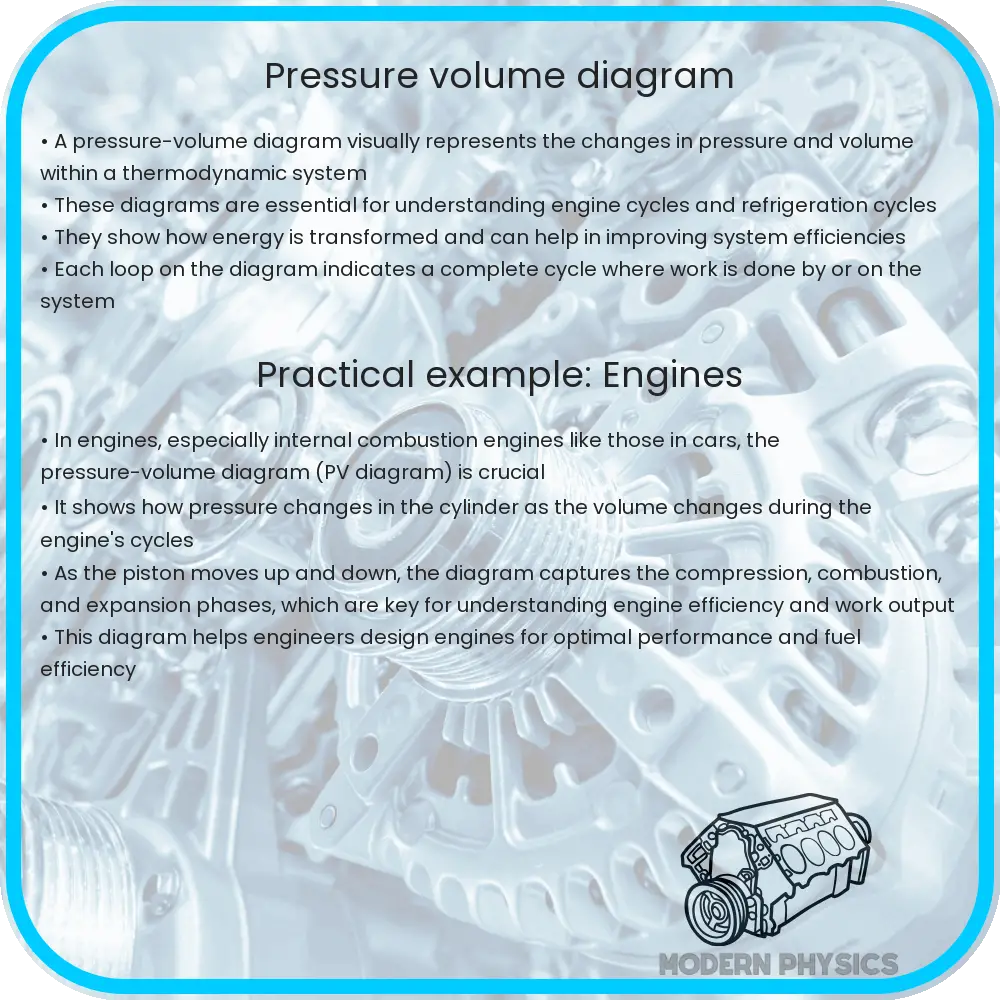
Pressure-Volume (P-V) diagrams are pivotal in the field of thermodynamics, offering a graphical representation of the changes in pressure and volume in a thermodynamic system. These diagrams provide valuable insights into the relationship between pressure, volume, and temperature, and are crucial for analyzing the efficiency and work done by thermodynamic cycles, such as those in engines and refrigerators.
The Basics of Pressure-Volume Diagrams
In a P-V diagram, the x-axis typically represents the volume (V) of the system, while the y-axis represents the pressure (P). Each point on the diagram corresponds to a specific state of the system, defined by its pressure and volume. The curve connecting these points reflects the process the system undergoes, such as compression or expansion.
Thermodynamic Processes and P-V Diagrams
Key thermodynamic processes can be visualized using P-V diagrams:
- Isobaric Process: Characterized by constant pressure, this process is represented by a horizontal line in the P-V diagram.
- Isochoric Process: Involving constant volume, its representation is a vertical line.
- Adiabatic Process: This occurs without heat transfer. The curve in the P-V diagram for an adiabatic process is steeper than for an isothermal process.
- Isothermal Process: Occurring at constant temperature, it is represented by a hyperbolic curve.
Work Done in Thermodynamic Processes
The area under the curve in a P-V diagram represents the work done by or on the system. For instance, in a cycle, the net work done by the system is given by the enclosed area within the cycle path. This is a fundamental concept in understanding how engines and other mechanical systems operate.
Efficiency and the P-V Diagram
Efficiency in thermodynamics is a measure of how well a system converts heat into work. In a P-V diagram, the efficiency of a cycle can be analyzed by comparing the work output to the heat input. For heat engines, this involves examining the area within the cycle and relating it to the heat absorbed and released during the cycle.
Understanding the intricacies of P-V diagrams is essential in fields ranging from mechanical engineering to environmental science, as it helps in the design of more efficient and effective systems.
Advanced Applications of Pressure-Volume Diagrams
Pressure-Volume diagrams are not just theoretical tools but have practical applications in various engineering fields. For example, in the automotive industry, P-V diagrams are used to optimize the efficiency of internal combustion engines. By analyzing the cycle processes in an engine, engineers can make adjustments to improve fuel efficiency and reduce emissions.
In refrigeration and air conditioning systems, P-V diagrams help in understanding the refrigeration cycle, which includes compression, condensation, expansion, and evaporation. This insight is critical for designing systems that maximize cooling while minimizing energy consumption.
Real-World Variations and Challenges
While P-V diagrams provide a simplified model of thermodynamic processes, real-world systems often exhibit more complex behaviors due to factors like friction, heat losses, and material properties. Engineers and scientists use these diagrams as a starting point and then apply corrections or more sophisticated models to better predict and optimize actual system performance.
Environmental and Sustainable Implications
Pressure-Volume diagrams also play a crucial role in environmental science and sustainable engineering. By analyzing the efficiency and work output of systems, such as power plants or HVAC systems, engineers can develop solutions that are not only efficient but also have a reduced environmental impact. This includes the development of renewable energy technologies where P-V diagrams are used to optimize the performance of systems like solar thermal collectors and wind turbines.
Conclusion
In summary, Pressure-Volume (P-V) diagrams are invaluable tools in thermodynamics, providing a clear visual representation of various processes and cycles. They help in understanding the relationship between pressure, volume, and temperature, and are instrumental in calculating work done and efficiency. Their applications extend from theoretical physics to practical engineering, aiding in the design and optimization of engines, refrigeration systems, and renewable energy technologies. As we continue to face environmental challenges, the principles illustrated by P-V diagrams will remain essential in the pursuit of sustainable and efficient energy solutions.
By leveraging the insights provided by P-V diagrams, we can not only improve existing technologies but also innovate new solutions that are environmentally friendly and energy-efficient, marking a step forward in our journey towards a more sustainable future.