
Explore the Poynting Effect in solids: key insights into mechanical coupling, stress analysis, and energy transfer in engineering materials.
Understanding the Poynting Effect in Solids: An Insight into Mechanical Coupling, Stress Analysis, and Energy Transfer
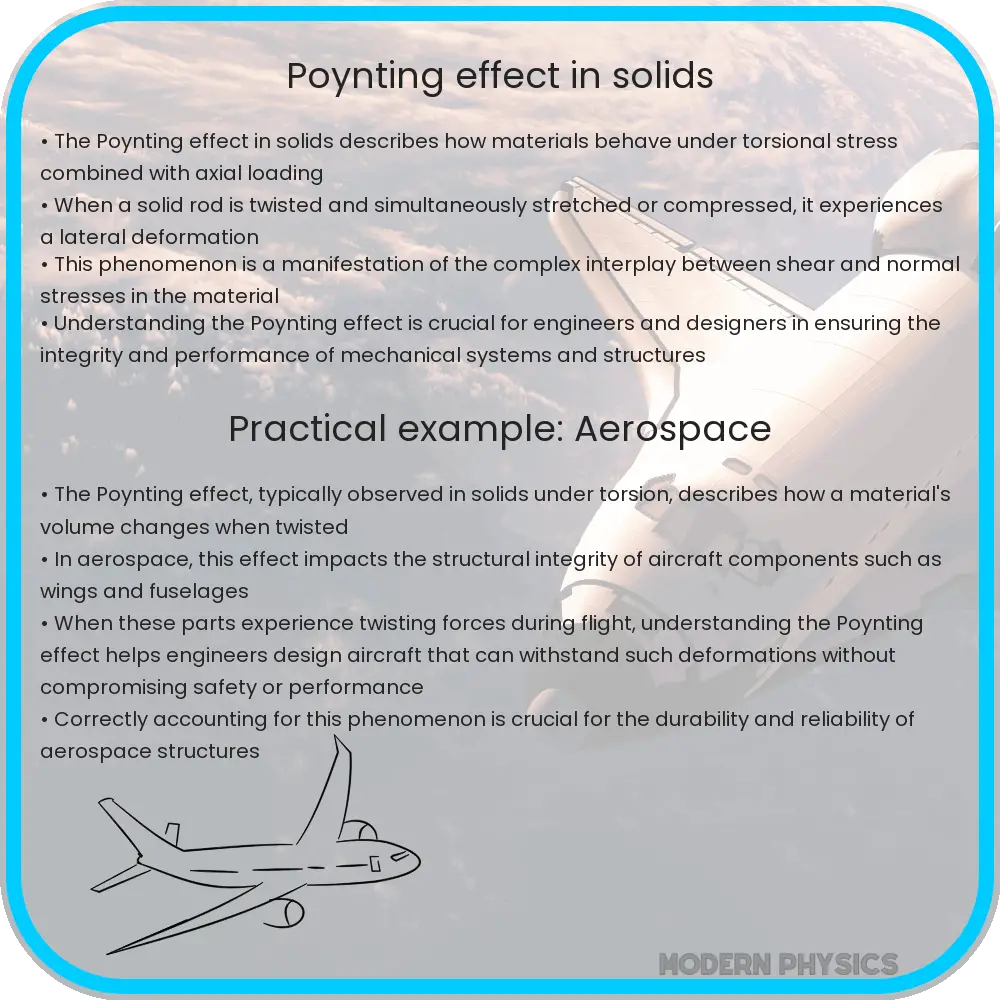
The Poynting effect in solids is a fascinating phenomenon that plays a critical role in the fields of materials science and mechanical engineering. This effect, named after the British physicist John Henry Poynting, refers to the mechanical coupling and energy transfer that occurs when materials are subjected to combined stress and deformation. Understanding this effect is crucial for engineers and scientists in predicting the behavior of materials under various mechanical loads.
Mechanical Coupling in the Poynting Effect
Mechanical coupling in the Poynting effect can be observed in materials that exhibit both elastic and plastic deformation characteristics. When a solid body is twisted, it experiences a change in volume or length, which is a direct result of the mechanical coupling between torsional stress and longitudinal strain. This coupling is essential for understanding how materials respond to complex loading conditions, such as those found in aerospace and automotive applications.
Stress Analysis in the Poynting Effect
Stress analysis in the context of the Poynting effect involves examining how materials deform under torsional stress. This analysis is pivotal in materials engineering, where predicting the stress distribution within a material helps in designing more resilient and efficient structures. The complexity of stress analysis is elevated when considering the nonlinear and anisotropic nature of many materials, making the Poynting effect a significant challenge to model accurately.
Energy Transfer in the Poynting Effect
Energy transfer in the Poynting effect is an area of great interest, particularly in the study of how energy is redistributed within a material under stress. This energy transfer is not always intuitive, as it can involve the conversion of mechanical energy into thermal energy, affecting the material’s overall behavior. Understanding this aspect of the Poynting effect is crucial for developing materials with improved performance under high-stress conditions.
The Poynting effect in solids provides invaluable insights into the complex interactions between stress, strain, and energy transfer in materials. Its study not only enhances our understanding of material behavior but also guides the development of innovative solutions in various engineering applications.
Advanced Applications and Implications of the Poynting Effect in Solids
The practical applications of the Poynting effect in solids are vast and varied. In the realm of aerospace engineering, understanding this phenomenon is crucial for designing aircraft components that must endure extreme torsional stresses without compromising their structural integrity. Similarly, in the automotive industry, the effect aids in the development of safer, more durable vehicles by providing insights into how materials behave under complex loading scenarios.
Furthermore, the Poynting effect has significant implications in the field of nanotechnology and materials science. Researchers are exploring the effect at microscopic levels to develop new materials with unique mechanical properties. These materials could potentially revolutionize various industries by offering unprecedented strength, flexibility, or thermal properties.
Challenges and Future Directions in Research
Despite its importance, the Poynting effect presents several challenges. One major challenge lies in accurately modeling the effect in materials with complex geometries or composite structures. Advanced computational methods and simulation tools are continuously being developed to address this challenge, offering more precise predictions of material behavior under stress.
Looking ahead, the future of research in the Poynting effect is promising. With advancements in computational power and material science, researchers are poised to uncover deeper understandings of this phenomenon. This could lead to breakthroughs in designing materials and structures that are more efficient, durable, and adaptable to various mechanical stresses.
Conclusion
In conclusion, the Poynting effect in solids is a cornerstone concept in mechanical engineering and materials science. Its study offers profound insights into the mechanical coupling, stress analysis, and energy transfer in materials under stress. As we continue to unravel the complexities of this phenomenon, its implications extend far beyond academic curiosity, influencing the design and development of future materials and structures. The ongoing research and challenges in this field promise to bring forth innovative solutions that will shape the technological landscape of the future.