
Explore the Polyakov Loop’s role in quantum field theory, its impact on QCD, phase transitions, and applications in cosmology and particle physics.
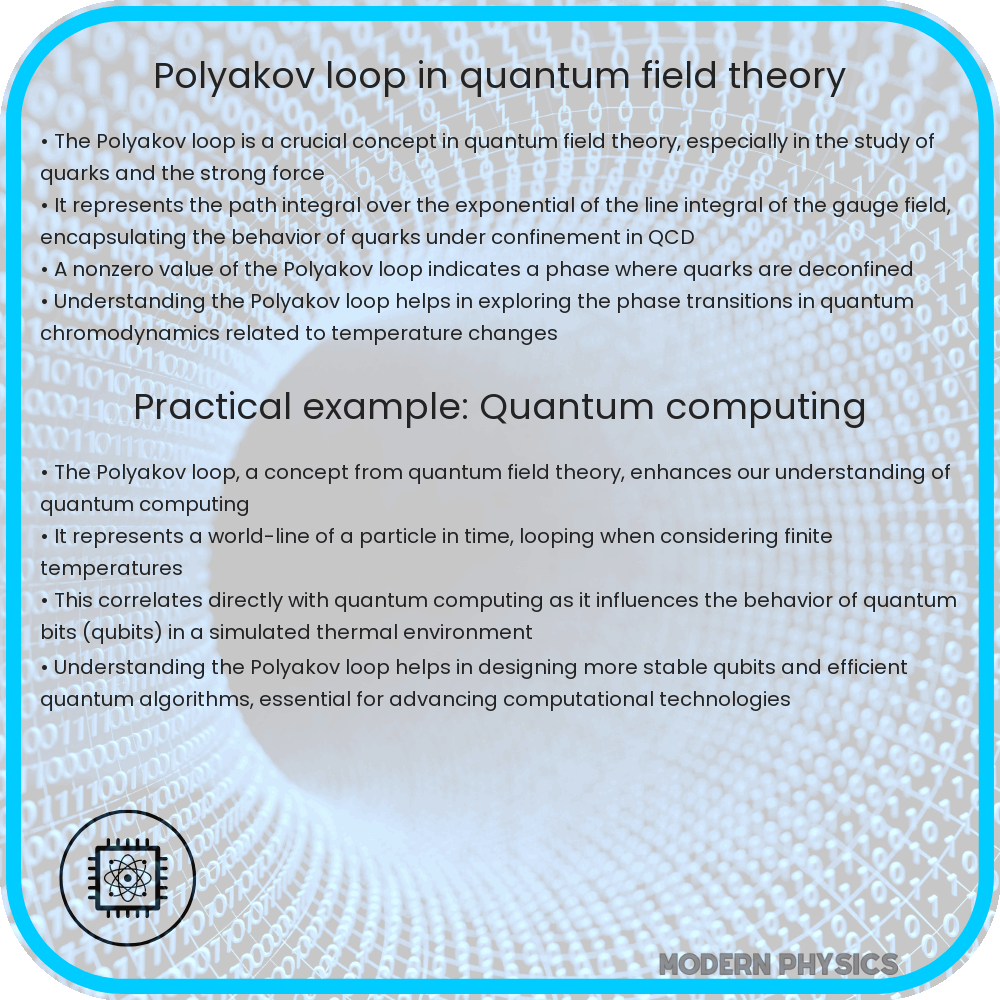
Understanding the Polyakov Loop in Quantum Field Theory
The Polyakov Loop, a fundamental concept in quantum field theory (QFT), plays a crucial role in understanding phase transitions and the behavior of quantum chromodynamics (QCD). This article delves into the intricacies of the Polyakov Loop, its implications in QCD, and its significance in the study of phase transitions within the realm of subatomic particles.
Quantum Chromodynamics and the Polyakov Loop
Quantum chromodynamics is the theory that describes the strong interaction, one of the four fundamental forces of nature, primarily focusing on the interaction between quarks and gluons. The Polyakov Loop emerges as a pivotal tool in QCD for analyzing the confinement phase, where quarks are bound together, and the deconfinement phase, where they exist freely. This transition is akin to the phase change from solid to liquid in everyday materials.
Phase Transitions in QCD
Phase transitions in QCD are of great interest in theoretical physics. They can be studied using the Polyakov Loop, which serves as an order parameter. An order parameter is a quantitative measure that indicates the state of a system – in this case, whether quarks are in a confined or deconfined state. In the confined phase, the expectation value of the Polyakov Loop is zero, signifying that quarks are bound together. In contrast, in the deconfined phase, this value is non-zero, indicating the presence of free quarks.
Mathematical Formulation of the Polyakov Loop
The mathematical representation of the Polyakov Loop is expressed as a path integral in the temporal direction. It is formulated as:
\[ L(\vec{x}) = \mathrm{Tr}\, \mathcal{P} \exp\left( i \int_0^{1/T} d\tau\, A_4(\vec{x},\tau) \right) \]
Here, \( \mathcal{P} \) denotes the path-ordering of the exponential, \( A_4 \) is the temporal component of the gluon field, and \( T \) represents the temperature. The trace, denoted by \( \mathrm{Tr} \), is taken over the color indices of the gauge group in QCD.
Significance in High-Energy Physics
The study of the Polyakov Loop has significant implications in high-energy physics, particularly in understanding the early universe conditions and heavy ion collisions. These extreme environments mimic the deconfined phase of QCD, offering insights into the behavior of matter under such intense conditions.
In summary, the Polyakov Loop is a powerful concept in quantum field theory, providing deep insights into the phase transitions of quarks in QCD. Its applications extend beyond theoretical studies, offering a window into the fundamental nature of our universe.
Applications in Cosmology and Particle Physics
The practical applications of the Polyakov Loop extend to cosmology and particle physics. In cosmology, understanding the behavior of the early universe immediately after the Big Bang is enhanced by studying the Polyakov Loop. It helps physicists comprehend how the universe transitioned from a quark-gluon plasma to a state where matter, as we know it, could form. This transition is crucial for the formation of galaxies, stars, and ultimately life.
Exploring Heavy Ion Collisions
In particle physics, heavy ion collisions, such as those studied at the Large Hadron Collider (LHC), provide an experimental framework to explore the Polyakov Loop. These collisions recreate conditions similar to those a few microseconds after the Big Bang, allowing scientists to observe the deconfinement phase transition in a controlled setting. This research not only validates theoretical predictions but also enhances our understanding of the fundamental forces and particles.
Challenges and Future Directions
Despite its significance, studying the Polyakov Loop presents numerous challenges. One of the primary difficulties lies in the computational complexity of simulating QCD on a lattice, a technique essential for calculating the properties of the Polyakov Loop. Future advancements in computational physics and more sophisticated algorithms are expected to overcome these challenges, leading to more accurate and detailed studies.
Conclusion
The Polyakov Loop is a cornerstone concept in quantum field theory, particularly in the study of QCD and phase transitions. Its significance lies in providing a measurable quantity that helps in understanding the confinement and deconfinement of quarks. This has profound implications in both theoretical physics and practical experiments, such as those conducted in high-energy particle collisions. As research continues, the Polyakov Loop remains a vital tool for physicists in unraveling the mysteries of the universe, from the smallest scales of quarks and gluons to the vast expanse of cosmological phenomena. The ongoing exploration of this concept not only deepens our understanding of the fundamental nature of matter but also propels us towards new horizons in the field of physics.